Gondola days
Francis Hopkinson Smith
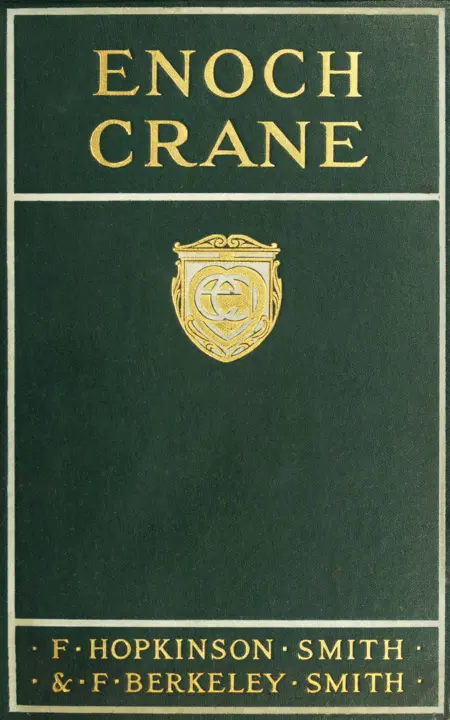
THE CLASSIC COLLECTION · 1916
"Enoch Crane" by Francis Hopkinson Smith and F. Berkeley Smith is a novel written in the early 20th century. The story introduces readers to various characters living in a boarding house in New York City, particularly focusing on the titular character, Enoch Crane, an old gentleman with a crusty exterior but admirable values. The narrative explores themes of societal interactions, love, ambition, and the complexities of human relationships. At the start of the novel, readers meet Joe Grimsby, a vibrant young architect moving into an apartment, who quickly becomes absorbed by the charming new tenant, Sue Ford, and her family. Their arrival sparks interactions among various house residents, including the wise old Enoch Crane and the outgoing Ebner Ford, Sue's stepfather, who is characterized as loud and opportunistic. Through these early interactions, tensions escalate, particularly between Joe's earnest pursuit of a relationship with Sue and the contrasting influences of her stepfather's brashness. The opening part sets an engaging stage for a blend of romance and drama, providing insights into the characters' social dynamics and establishing the groundwork for the unfolding narrative.
Introduction adapted from the source catalogue; source summaries may be automatically generated.
Free to read · English · 85,283 words · No account needed
MAKE TIME FOR A GOOD BOOK
On by default. Untick to stop anonymous reading totals. Each page counts after 10 seconds in view. How this works.
Anonymous counting is on unless you have switched it off.
Joe felt they were friends already.
“Mr. Grimsby,” Sue ventured, turning to Alice Jackson, by way of
presenting him.
“I’m going to call you Joe,” she said frankly, stretching out her gloved hand to him across Sue’s knees.
The moment he had looked into her brown eyes and heard her speak, he knew she was “a dear.” It was evident she was some ten years younger than her husband, a slim, energetic little woman, with a smile that was merry and sincere. He noticed, too, that her dark hair was just turning gray. She was charming--that charm that comes from frankness, intelligence, and refinement.
“I’m going to call you Joe, too,” declared her husband, gripping Joe heartily by both shoulders, “and don’t you forget that my name’s Dick.”
No one would have taken this jolly man of forty-five for the auditor of one of the largest systems of railroads in the country, but he was. He, too, needed a well-earned rest.
Ah, yes--there was another one standing now by the empty buckboard who called him “Joe”--but her small hand lingered in his the longest.
That very night, with big Jim Turner as extra guide, they reached the
Upper Ausable and camp.
It did not take Ed, Joe, or Jim Turner long to find out that the Jacksons were used to the woods. They had a camp of their own in northern Canada, where they had fished and hunted for years, but it was too far away for this trip. As for Sue, she was gloriously happy. She went into ecstasies over everything--the beauty of the ponds, the water, the silence, the snug camp, the table of rough boards, and the crackling fire.
Never had she seemed so dear to Joe, more attractive than ever, in her sensible short skirt of greenish-brown homespun, her trim camping boots, and a very becoming little felt hat, which Joe lost no time in making gay with three scarlet ibis and a silver doctor from his fly-book.
That night at supper came another surprise; under Joe’s tin plate lay a letter, which Sue had slipped there under strict orders from Enoch.
“He will understand, my dear, when he reads it,” he had said to her, and, furthermore, that she should hide it under his plate their first night in camp. Even the Jacksons did not know of its existence.
“Hello!” cried Joe, as he seated himself and discovered it. “Mail, eh! Why, there isn’t any stamp on it. Who of you three dear people brought this?”
The Jacksons’ innocence was evident at a glance.
Joe looked at Sue and smiled.
Your reading position is saved on this browser. Take it to another device with a library code. Reading pages adapt to text, rather than matching a printed edition.
Francis Hopkinson Smith

Francis Davis Millet & W. Hamilton (William Hamilton) Gibson & Will H. (Will Hicok) Low & John Ames Mitchell & Francis Hopkinson Smith
Francis Hopkinson Smith
F. Berkeley (Frank Berkeley) Smith
BEHIND THE BOOK
This eBook is for the use of anyone anywhere in the United States and most other parts of the world at no cost and with almost no restrictions whatsoever. You may copy it, give it away or re-use it under the terms of the Project Gutenberg License included with this eBook or online at www.gutenberg.org. If you are not located in the United States, you will have to check the laws of the country where you are located before using this eBook. Read the source licence.
The original source file, including credits and licence, is retained by this library. Request an original-format copy at no charge. Please include the book title and Project Gutenberg identifier #73453.
KEEP YOUR CURIOSITY GOING
Coulson Kernahan

Maurice Baring
Frances Wright
Cécile Tormay

Frederic Jesup Stimson

W. H. P. (William Henry Pope) Jarvis