THE CLASSIC COLLECTION✦An outlaw’s diary: the CommuneCLASSIC FREE BOOKS
An outlaw’s diary: the Commune
Cécile Tormay
THE CLASSIC COLLECTION · 1917
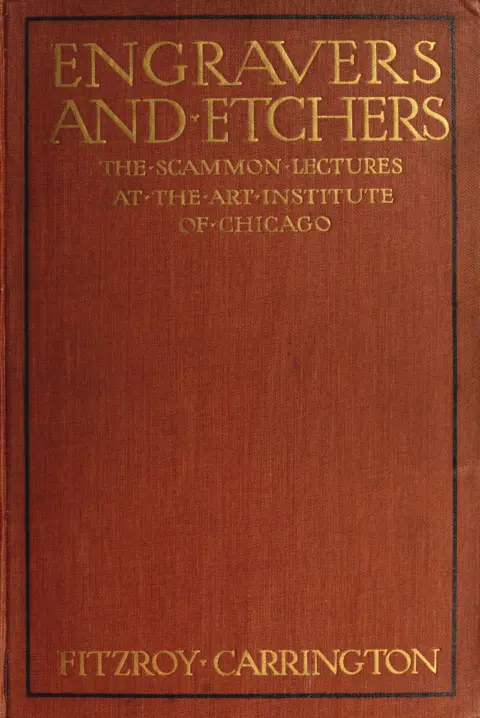
"Engravers and Etchers" by Fitz Roy Carrington is a scholarly collection of lectures written in the early 20th century. The text focuses on the history, theory, and practice of engraving, particularly emphasizing the significance and techniques of notable engravers throughout history. Carrington, an authority in the field, draws from various sources to introduce the art of engraving to students and enthusiasts alike. The opening of the work establishes the context of Carrington's six lectures, highlighting German engraving from its inception through to Martin Schongauer, a key figure in the evolution of this art form. Carrington discusses the origins of engraving, asserting that its roots are found not in a single country but rather in Switzerland, and he presents various engravers who set the stage for future developments. He mentions the Master of the Playing Cards and the Master E.S., among others, exploring their artistic techniques and the unique characteristics that influenced later engravings, notably those by Schongauer and Albrecht Dürer. This initial discussion sets a foundation for understanding the technical and artistic advancements in engraving, which Carrington aims to elaborate upon in the subsequent lectures.
Introduction adapted from the source catalogue; source summaries may be automatically generated.
Free to read · English · 35,524 words · No account needed
MAKE TIME FOR A GOOD BOOK
On by default. Untick to stop anonymous reading totals. Each page counts after 10 seconds in view. How this works.
Anonymous counting is on unless you have switched it off.
ZWEI DATIERTE ZEICHNUNGEN MARTIN SCHONGAUERS. By Sidney Calvin. 2 illustrations. Jahrbuch der königlichen preussischen Kunstsammlungen, Vol. 6, pp. 69-74. Berlin. 1885.
MARTIN SCHONGAUER’S KUPFERSTICHE. By Max G. Friedländer. 5 illustrations. Zeitschrift für bildende Kunst, Vol. 26, pp. 105-112. Leipzig. 1915.
MARTIN SCHONGAUER. By Max Geisberg. 14 illustrations. The Print-Collector’s Quarterly, Vol. 4, No. 2, pp. 102-129. Boston. 1914.
MARTIN SCHONGAUER; NACHBILDUNGEN SEINER KUPFERSTICHE. Edited by Max Lehrs. 115 reproductions on 72 plates. Berlin: Bruno Cassirer. 1914. (Graphische Gesellschaft. Extraordinary Publication 5.)
SCHONGAUERSTUDIEN. By Wilhelm Lübke. 3 illustrations. Zeitschrift für bildende Kunst, Vol. 16, pp. 74-86. Leipzig. 1881.
SCHONGAUER UND DER MEISTER DES BARTHOLOMÄUS. By L. Scheibler. Repertorium für Kunstwissenschaft, Vol. 7, pp. 31-68. Berlin and Stuttgart. 1884.
MARTIN SCHONGAUER ALS KUPFERSTECHER. By Woldemar von Seidlitz. Repertorium für Kunstwissenschaft, Vol. 7, pp. 169-182. Berlin and Stuttgart. 1884.
MARTIN SCHONGAUER ALS KUPFERSTECHER. By Hans Wendland. 32 reproductions. Berlin: Edmund Meyer. 1907.
MARTIN SCHONGAUER. EINE KRITISCHE UNTERSUCHUNG SEINES LEBENS UND SEINER WERKE NEBST EINEM CHRONOLOGISCHEN VERZEICHNISSE SEINER KUPFERSTICHE. By Alfred von Wurzbach. Vienna: Manz’sche K. K. Hofverlags und Universitäts Buchhandlung. 1880.
MASTER OF THE BANDEROLES (flourished c. 1464)
DER MEISTER MIT DEN BANDROLLEN; EIN BEITRAG ZUR GESCHICHTE DES ÄLTESTEN KUPFERSTICHS IN DEUTSCHLAND. By Max Lehrs. 19 reproductions on 7 plates. Dresden: W. Hoffmann. 1886.
MECKENEM, ISRAHEL VAN (c. 1440-1503)
DER MEISTER DER BERLINER PASSION UND ISRAHEL VAN MECKENEM. By Max Geisberg. 6 reproductions. Strassburg: J. H. Ed. Heitz (Heitz & Mündel). 1903. (Studien zur deutschen Kunstgeschichte. Part 42.)
VERZEICHNIS DER KUPFERSTICHE ISRAHELS VAN MECKENEM. By Max Geisberg. 11 reproductions on 9 plates. Strassburg: J. H. Ed. Heitz (Heitz & Mündel). 1905. (Studien zur deutschen Kunstgeschichte. Part 58.)
MASTER =W A= (flourished c. 1470)
DER MEISTER =W A=; EIN KUPFERSTECHER DER ZEIT KARLS DES
KÜHNEN. By Max Lehrs. 77 reproductions on 31 plates. Dresden:
W. Hoffmann. 1895.
STOSS, VEIT (c. 1450-c. 1533)
VEIT STOSS; NACHBILDUNGEN SEINER KUPFERSTICHE. Edited by Engelbert Baumeister. 13 reproductions. Berlin: Bruno Cassirer. 1913. (Graphische Gesellschaft. Publication 17.)
OLMÜTZ, WENZEL VON (flourished 1480-1500)
WENZEL VON OLMÜTZ. By Max Lehrs. 22 reproductions on 11 plates. Dresden: W. Hoffmann. 1889 (In German.)
Engraving in Italy differs, in many essentials, from the art as practised in Germany. Germany may claim priority in point of time, but it is doubtful whether the Florentines--for in Florence, and among the goldsmiths, the art took its rise in Italy--in the beginning were influenced by, or even acquainted with, the work of their northern contemporaries. In Germany the designer and the engraver were one, and some of the greatest masters embodied their finest conceptions in their prints. We may truly say that the world-wide reputation which Dürer and Schongauer have enjoyed for four centuries and more, rests almost entirely upon their engraved, rather than upon their painted, work.
Your reading position is saved on this browser. Take it to another device with a library code. Reading pages adapt to text, rather than matching a printed edition.
BEHIND THE BOOK
This eBook is for the use of anyone anywhere in the United States and most other parts of the world at no cost and with almost no restrictions whatsoever. You may copy it, give it away or re-use it under the terms of the Project Gutenberg License included with this eBook or online at www.gutenberg.org. If you are not located in the United States, you will have to check the laws of the country where you are located before using this eBook. Read the source licence.
The original source file, including credits and licence, is retained by this library. Request an original-format copy at no charge. Please include the book title and Project Gutenberg identifier #66848.
KEEP YOUR CURIOSITY GOING
Cécile Tormay

Moritz Busch
John L. Ransom
Frances Wright
Cécile Tormay

Mabel Potter Daggett