THE CLASSIC COLLECTION✦An outlaw’s diary: the CommuneCLASSIC FREE BOOKS
An outlaw’s diary: the Commune
Cécile Tormay
THE CLASSIC COLLECTION · 1901
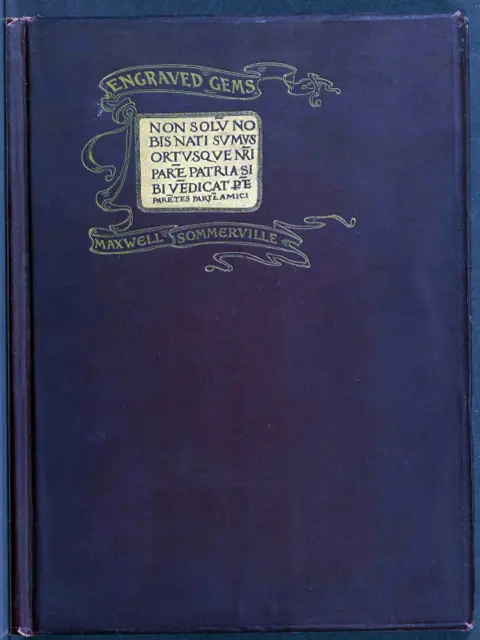
"Engraved Gems" by Maxwell Sommerville is a scholarly work written in the early 20th century. It serves as an abridged and updated exploration of the art and history of gem engraving, focusing on various epochs from antiquity to the 18th century. The text provides insights into the glyptic art, characterized by engraved stones, cylinders, and seals, highlighting the craftsmanship and significance of these artifacts across different cultures. The opening of the book introduces Sommerville's collection at the University of Pennsylvania, detailing the historical journey of engraved gems. He emphasizes the evolution of gem engraving from primitive times through periods of excellence and decline, outlining how the quality of execution varied by era and nationality. The beginning sets a reflective tone, as the author expresses his passion for the subject, inviting readers to appreciate these engraved stones as vital connections to humanity's artistic and cultural past. The narrative promises a historical exploration of gem engraving, revealing its role in both art and science.
Introduction adapted from the source catalogue; source summaries may be automatically generated.
Free to read · English · 15,929 words · No account needed
MAKE TIME FOR A GOOD BOOK
On by default. Untick to stop anonymous reading totals. Each page counts after 10 seconds in view. How this works.
Anonymous counting is on unless you have switched it off.
Large pieces, cameos of two and a half to three inches, have been found which were worn by the Incas as breast ornaments, and are always pierced, which shows that they were suspended from the neck.
In fact, some of the most faithful representations of costume, head-dress, and weapons are in basso-rilievo engraved stones in opaque white Alabaster and pale-green hard Nephrite.
We have much to enjoy as we survey the gems of the various epochs. The multifarious types that have been gathered in forty centuries meet our view, grouped in the tableau of engraved gems.
Our attention is drawn with interest to each sentiment expressed, feature defined, or emotion portrayed. We study the diversified qualities--the fineness or freedom of touch, ingenious effects, delicate lines, choice attitudes, graceful forms, force, spirit, and tenderness--which characterize these monuments of patience.
The engraved gems rescued from the torrent, ebbing and flowing with the fluctuating fortunes of ages, garnered by successive generations, enrich the traditional viaduct traversing the morass of many centuries. Some blocks are less beautiful than others in the structure, but from them we have founded our first footholds, and from them we mount to the work that embellishes the great Etruscan arches even when we revel on the finely pencilled coping-stones of the Greek and Roman epochs, or admire the ornate abutments of the Renaissance, we should revert with pleasure to the earlier, ruder contributions in the foundations, and we can find pleasure in viewing and studying every part.
The builder’s stones are graven--the footway is of pictured pebbles, miniatures, amulets, and seals, reflecting lineaments and traces of the history of entombed generations. Their inscriptions reveal to us the impress of ancient, mediæval, and modern art.
Abraxas or Gnostics, 58-62, 102
Talismans, 58, 102
Agalmatolite, 123
Amethyst, 123
Amulets, 112
Animals and Birds, 112-115
Ant, the, as a talisman, the most minute, 113
Antique Pastes, 116-120
Apollo, 66
Aringa, the, a fish of the Adriatic Sea, 113
Ashurna Sirbal, King of Assyria, palace of, 22
Asshur (Assyrian), Supreme God, 32
Assyrian Records, 39
Astarte, 66
Aztec or Mexican, 127-128
Bacchus and Ariadne, 89-90
Basilidians, 62
Beltis Mylitta (Assyrian), the Great Mother, 32
Bibliothèque Nationale, Paris, 72
Bôdhi-tree at Gaya, 124
British Museum, London, 72, 119
Buddha, 124
Byzantine, 68-75
Period, 11
Cameos, 55, 68, 72, 87, 89, 90, 94, 104, 112, 116, 119, 127
Historical, 55, 104
Religious, 11
Catharine II., Empress of Russia, 87, 94
Charles V., Emperor, 86
Chinese, Burmese, and Siamese, 123-124
Figure-stone, 124
Christ, Century of, 11
Heads of, 75
Cleopatra, beautiful Turquoise Cameo, 108
Commodus, 90
Constantine, Emperor, 68, 71, 94, 104
Baptism of, 72
Conversion of, 72
Coriolanus, interesting Historic Cameo, 104
Crispus, Son of Constantine, 97
Cylinders, Babylonian, 14, 25
Brazil, 32
Chaldean, over 4000 years old, 25
Found in ruins of Um Kir, 35
Nineveh, 32
Oldest form of Seals, 25
Persian, 12
South American Indians, 32
Cypselus, box of, 48
Decebalus, plot of, 111
De Witte, Baron J., 93
Dioscorides, 87
Dolphin, a, the Mariner’s Friend, 113
Duaoumautew, 19
Your reading position is saved on this browser. Take it to another device with a library code. Reading pages adapt to text, rather than matching a printed edition.
BEHIND THE BOOK
This eBook is for the use of anyone anywhere in the United States and most other parts of the world at no cost and with almost no restrictions whatsoever. You may copy it, give it away or re-use it under the terms of the Project Gutenberg License included with this eBook or online at www.gutenberg.org. If you are not located in the United States, you will have to check the laws of the country where you are located before using this eBook. Read the source licence.
The original source file, including credits and licence, is retained by this library. Request an original-format copy at no charge. Please include the book title and Project Gutenberg identifier #57492.
KEEP YOUR CURIOSITY GOING
Cécile Tormay

Moritz Busch
John L. Ransom
Frances Wright
Cécile Tormay

Mabel Potter Daggett