THE CLASSIC COLLECTION✦An outlaw’s diary: the CommuneCLASSIC FREE BOOKS
An outlaw’s diary: the Commune
Cécile Tormay
THE CLASSIC COLLECTION · 1901
"Engraved Gems" by Maxwell Sommerville is a scholarly work written in the early 20th century. It serves as an abridged and updated exploration of the art and history of gem engraving, focusing on various epochs from antiquity to the 18th century. The text provides insights into the glyptic art, characterized by engraved stones, cylinders, and seals, highlighting the craftsmanship and significance of these artifacts across different cultures. The opening of the book introduces Sommerville's collection at the University of Pennsylvania, detailing the historical journey of engraved gems. He emphasizes the evolution of gem engraving from primitive times through periods of excellence and decline, outlining how the quality of execution varied by era and nationality. The beginning sets a reflective tone, as the author expresses his passion for the subject, inviting readers to appreciate these engraved stones as vital connections to humanity's artistic and cultural past. The narrative promises a historical exploration of gem engraving, revealing its role in both art and science.
Introduction adapted from the source catalogue; source summaries may be automatically generated.
Free to read · English · 15,929 words · No account needed
MAKE TIME FOR A GOOD BOOK
On by default. Untick to stop anonymous reading totals. Each page counts after 10 seconds in view. How this works.
Anonymous counting is on unless you have switched it off.
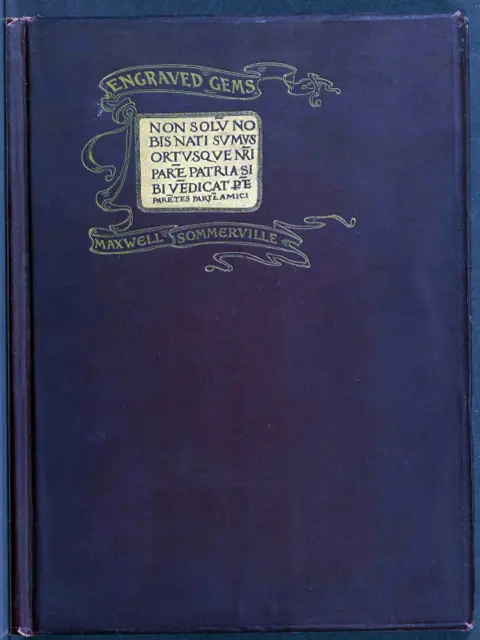
Presuming that the majority of my readers would understand the Latin inscription from an engraved stone, which decorates the cover of this book, I have not given any translation. By request I add the following explanation:
NON SOLVM NO|BIS NATI SVMVS|ORTVSQVE NOSTRI|PARTEM PATRIA SI|BI VENDICAT PARTEM|PARENTES PARTEM AMICI|
“Not alone for ourselves were we born, and of our birth our country claims for itself a part, our parents a part, our friends a part” (vendicat for vindicat).
On the reverse of the stone, which is not shown, is the inscription--
This is one of those peculiar maxims so often found in the Latin language, as it is employed in epitaphs. The simplest manner in which it can be translated is as follows:
{manners}
{customs} {are}
“The {usage } of Death {is } equal for all.”
{law }
Death is here personified, as was Peace, Justice, Concord, etc., by the
Romans.
Vestal Virgins Guarding the Palladium, the Sacred Effigy of Minerva 15
Egyptian 17
Egyptian Scarabeus: The Barque of the Sun, Represented by the Hieroglyph of the City of Heliopolis. The Obelisk below with the God Ra--and the Deess Ma, together Ra-Men-Ma, the Prenomen of King Set First, Second King of the XIX. Dynasty 21
Portrait of Sapor 22
Allegorical Sketch of Persia 23
Impressions of Babylonian Cylinders 27
Impressions of Assyrian, Persian, Hittite, Phœnician, and Cyprian Cylinders 29
Allegorical Sketch of the Source of History 33
Persian Seals 35
Etruscan Sketch 37
Etruscan Scarabeus 40
Phœnician Scarabei and Intaglios 42
Phœnician Intaglios, Mask, etc. 45
Callimachus, the Greek Inventor of the Corinthian Capitol 48
Greek and Roman Intaglio Rings 50
Cameo, the Greek Pallas 52
Roman Gems 54
Cameo in High Relief, Roman Emperor Caracalla 57
Abraxas or Gnostic Gems 59
Abraxas Token 62
Abraxas or Gnostic Gems 63
Early Christian Token 67
Byzantine Gems 69
Byzantine Cabinet and Gems 73
The Annunciation 75
An Orgie of Silenus 78
Renaissance-Medici Period 81
Noah’s Ark 85
A very fine Intaglio by Giovanni Pickler--Ceres 87
Jupiter Ægiochus 91
The Triumph of Constantine 95
John the Baptist Preaching in the Wilderness 103
Historic Cameos: 1347, Trajan offering a Sacrifice to Mars Vincitore; 1348, the Triumphant Entry of Titus Vespasianus into Jerusalem 105
Coriolanus: His Mother and Wife Beseeching Him to Raise the Siege of Rome 107
Historic Cameos: 1339, Trajan Pursuing a Wild Boar; 1350 and 1351, Prisoners; 1349, the Exit from Jerusalem of the Victorious Army of Titus Vespasianus, the Golden Candlesticks, etc. 109
Cock and Serpent: The Cock Intaglio, “Vigilance;” The Serpent in Relief--Cameo; The Serpent’s Tail in its Mouth, “Eternity” 115
Antique Pastes 117
Fragment of Antique Paste, Basso-rilievo 120
A Chimera: Four Faces and the Horn of Jupiter Ammon 122
A Chinese Cameo 124
Aztec or Mexican 126
Aztec or Mexican 128
Odenatus and Zenobia 130
Your reading position is saved on this browser. Take it to another device with a library code. Reading pages adapt to text, rather than matching a printed edition.
BEHIND THE BOOK
This eBook is for the use of anyone anywhere in the United States and most other parts of the world at no cost and with almost no restrictions whatsoever. You may copy it, give it away or re-use it under the terms of the Project Gutenberg License included with this eBook or online at www.gutenberg.org. If you are not located in the United States, you will have to check the laws of the country where you are located before using this eBook. Read the source licence.
The original source file, including credits and licence, is retained by this library. Request an original-format copy at no charge. Please include the book title and Project Gutenberg identifier #57492.
KEEP YOUR CURIOSITY GOING
Cécile Tormay

Moritz Busch
John L. Ransom
Frances Wright
Cécile Tormay

Mabel Potter Daggett