READ · DISCOVER · ENJOYClassic literature · Always free
THE CLASSIC COLLECTION✦English Monastic LifeFrancis Aidan GasquetCLASSIC FREE BOOKS

THE CLASSIC COLLECTION · 1904

English Monastic Life

"English Monastic Life" by Francis Aidan Gasquet is a historical account written in the early 20th century. This work delves into the structure, practices, and daily life within English monasteries prior to the Reformation. With a comprehensive exploration of various monastic orders and their customs, the book aims to provide a detailed portrayal of monastic existence in medieval England. The opening of the book introduces the concept of the monastic life as a means for individuals to aspire to higher spiritual ideals within the Christian faith. It explains how monasticism evolved from early Christian communities into more structured religious orders, driven by the need for a disciplined life separated from worldly distractions. Gasquet references key figures, such as St. Benedict and St. Anthony, as pivotal in shaping monastic practices, establishing the foundation for the communal and ascetic lifestyle that characterized these institutions. Overall, the beginning sets the stage for a deeper exploration of monastic life, aiming to capture the essence of its spiritual and societal significance in English history.

Introduction adapted from the source catalogue; source summaries may be automatically generated.

Start reading ↓

Free to read · English · 80,466 words · No account needed

MAKE TIME FOR A GOOD BOOK

English Monastic Life

On by default. Untick to stop anonymous reading totals. Each page counts after 10 seconds in view. How this works.

Anonymous counting is on unless you have switched it off.

English Monastic Life

“On the 6th of the Kalends of May, in the year of grace 1257, died the blessed mother abbess, Euphemia, most worthy to be remembered, who, by our affection and good fellowship, and with divine sanction, succeeded the late abbess Maud of sweet memory. It is, therefore, most fitting that we should always perpetuate the memory, in our special prayers and suffrages, of one who ever worked for the glory of God, and for the weal of both our souls and bodies. For she increased the number of the Lord’s handmaids in this monastery from forty to eighty, to the exaltation of the worship of God. To her sisters, both in health and sickness, she administered the necessaries of life with piety, prudence, care, and honesty. She also increased the sum allowed for garments by 12d. each. The example of her holy conversation and charity, in conjunction with her pious exhortations and regular discipline, caused each one to know how, in the words of the Apostle, to possess her vessel in sanctification and honour. She also, with maternal piety and careful forethought, built, for the use of both sick and sound, a new and large infirmary away from the main buildings, and in conjunction with it a dormitory with the necessary offices. Beneath the infirmary she constructed a watercourse, through which a stream flowed with sufficient force to carry off all refuse that might corrupt the air.

“Moreover she built there a place set apart for the refreshment of the soul, namely a chapel of the Blessed Virgin, which was erected outside the cloister behind the infirmary. With the chapel she enclosed a large space, which was adorned on the north side with pleasant vines and trees. On the other side, by the river-bank, she built offices for various uses, a space being left in the centre where the nuns are able from time to time to enjoy the pure air. In these and in other numberless ways, the blessed mother Euphemia provided for the worship of God and the welfare of the sisters. But notwithstanding all this, she also so conducted herself with regard to exterior affairs, that she seemed to have the spirit of a man rather than of a woman. The court of the abbey-manor, owing to the useless mass of squalid outbuildings, and the propinquity of the kitchen to the granary and old hall, was in much danger of fire; whilst the confined area and the amount of animal refuse was a cause of offence to both the feet and nostrils of those who had occasion to pass through. The mother Euphemia, realising that the Lord had called her to the rule of the abbey at Wherwell, not that she might live there at ease, but that she might, with due care and despatch, uproot and destroy and dissipate all that was noxious, and establish and erect that which would be useful, demolished the whole of these buildings, levelled the court, and erected a new hall of suitable size and height. She also built a new mill, some distance from the hall, and constructed it with great care in order that more work than formerly might be done therein for the service of the house. She surrounded the court with a wall and the necessary buildings, and round it she made gardens and vineyards and shrubberies in places that were formerly useless and barren, and which now became both serviceable and pleasant. The manor-house of Middleton, which occupied a dry situation and was close to a public thoroughfare, and was further disfigured by old and crumbling buildings, she moved to another site, where she erected permanent buildings, new and strong, on the bank of the river, together with farmhouses. She also set to work in the same way at Tufton, in order that the buildings of both the manor-houses in that neighbourhood might be of greater service, and safer against the danger of fire. These and other innumerable works, our good superior Euphemia performed for the advantage of the house, but she was none the less zealous in works of charity, gladly and freely exercising hospitality, so that she and her daughters might find favour with One Whom Lot and Abraham and others have pleased by the grace of hospitality. Moreover, because she greatly loved to honour duly the House of God and the place where His glory dwells, she adorned the church with crosses, reliquaries, precious stones, vestments, and books. And because the bell-tower above the dormitory fell down through decay one night, about the hour of Matins, when by an obvious miracle from heaven, though the nuns were at that moment in the dormitory, some in bed and some in prayer before their beds, all escaped not only death but even any bodily injury, she caused another bell-tower of worked stone to be erected, conformable to the fair appearance of the church and the rest of the buildings, of commanding height, and of exquisite workmanship. But as she advanced in years, towards the end of her life, there was imminent danger of the complete collapse of the presbytery of the church; by the advice of skilled builders, she caused the presbytery to be taken down to the last stones of the foundations; and because the ground was found to be undermined and unsafe, she caused the damp soil to be dug out to a depth of twelve feet till firm and dry ground was found; when, having invoked the grace of the Holy Spirit, with prayers and tears she laid with her own hands the first stone of the foundations. Moreover she rejoiced to have found favour with God, so that before her last days were ended she saw this work that she had begun brought to its desired end. Thus she, who had devoted herself when amongst us to the service of His house and the habitation of His glory, found the due reward for her merits with our Lord Jesus Christ, through the prayers and merits of the Blessed Virgin Mary and of the blessed apostles SS. Peter and Paul, in whose honour, at the instigation of the abbess Euphemia, this church was dedicated, who with the Father and the Holy Ghost, ever liveth and reigneth God through all the ages of eternity. Amen.”

Your reading position is saved on this browser. Take it to another device with a library code. Reading pages adapt to text, rather than matching a printed edition.

More from this author

BEHIND THE WORDS

About Francis Aidan Gasquet

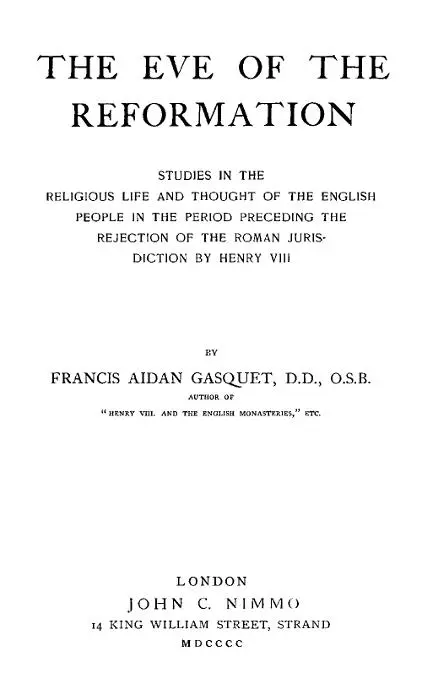
Francis Aidan Gasquet (1846–1929). Explore Parish life in mediæval England, The Eve of the Reformation Studies in the Religious Life and Thought of the English people in the Period Preceding the Rejection of the Roman jurisdiction by Henry VIII, English Monastic Life and other works in this collection. These books span history, religion & spirituality.

Explore this author’s books →

THE READERS’ VERDICT

How did this story stay with you?

Not rated yet
Your rating for English Monastic Life

Be the first to share your verdict.

One rating per browser, which you can change or remove. A necessary browser identifier remembers your vote. How ratings work

A GOOD STORY DESERVES COMPANY

Pass this book along.

A great read is even better when it’s shared.

SEND A LITTLE INSPIRATION

Share this book

BEHIND THE BOOK

Edition & source details.

Title
English Monastic Life
Author
Francis Aidan Gasquet
First publication (Open Library catalogue match)
1904
Digital edition publisher
Project Gutenberg
Gutenberg release date
2013-04-29
Language
English
Source edition imprint
Not stated in source catalogue
Source identifier
Project Gutenberg #42614
Contributors
No additional named contributors in source metadata

Public-domain source & licence

This eBook is for the use of anyone anywhere in the United States and most other parts of the world at no cost and with almost no restrictions whatsoever. You may copy it, give it away or re-use it under the terms of the Project Gutenberg License included with this eBook or online at www.gutenberg.org. If you are not located in the United States, you will have to check the laws of the country where you are located before using this eBook. Read the source licence.

Full source licence and obtaining an original copy

The original source file, including credits and licence, is retained by this library. Request an original-format copy at no charge. Please include the book title and Project Gutenberg identifier #42614.

the full Project Gutenberg License must appear
prominently whenever any copy of a Project Gutenberg work (any work
on which the phrase “Project Gutenberg” appears, or with which the
phrase “Project Gutenberg” is associated) is accessed, displayed,
performed, viewed, copied or distributed:

This eBook is for the use of anyone anywhere in the United States and most
other parts of the world at no cost and with almost no restrictions
whatsoever. You may copy it, give it away or re-use it under the terms
of the Project Gutenberg™ License included with this eBook or online
at www.gutenberg.org. If you
are not located in the United States, you will have to check the laws
of the country where you are located before using this eBook.

1.E.2. If an individual Project Gutenberg electronic work is
derived from texts not protected by U.S. copyright law (does not
contain a notice indicating that it is posted with permission of the
copyright holder), the work can be copied and distributed to anyone in
the United States without paying any fees or charges. If you are
redistributing or providing access to a work with the phrase “Project
Gutenberg” associated with or appearing on the work, you must comply
either with the requirements of paragraphs 1.E.1 through 1.E.7 or
obtain permission for the use of the work and the Project Gutenberg
trademark as set forth in paragraphs 1.E.8 or 1.E.9.

1.E.3. If an individual Project Gutenberg electronic work is posted
with the permission of the copyright holder, your use and distribution
must comply with both paragraphs 1.E.1 through 1.E.7 and any
additional terms imposed by the copyright holder. Additional terms
will be linked to the Project Gutenberg License for all works
posted with the permission of the copyright holder found at the
beginning of this work.

1.E.4. Do not unlink or detach or remove the full Project Gutenberg
License terms from this work, or any files containing a part of this
work or any other work associated with Project Gutenberg.

1.E.5. Do not copy, display, perform, distribute or redistribute this
electronic work, or any part of this electronic work, without
prominently displaying the sentence set forth in paragraph 1.E.1 with
active links or immediate access to the full terms of the Project
Gutenberg License.

1.E.6. You may convert to and distribute this work in any binary,
compressed, marked up, nonproprietary or proprietary form, including
any word processing or hypertext form. However, if you provide access
to or distribute copies of a Project Gutenberg work in a format
other than “Plain Vanilla ASCII” or other format used in the official
version posted on the official Project Gutenberg website
(www.gutenberg.org), you must, at no additional cost, fee or expense
to the user, provide a copy, a means of exporting a copy, or a means
of obtaining a copy upon request, of the work in its original “Plain
Vanilla ASCII” or other form. Any alternate format must include the
full Project Gutenberg License as specified in paragraph 1.E.1.

1.E.7. Do not charge a fee for access to, viewing, displaying,
performing, copying or distributing any Project Gutenberg works
unless you comply with paragraph 1.E.8 or 1.E.9.

1.E.8. You may charge a reasonable fee for copies of or providing
access to or distributing Project Gutenberg electronic works
provided that:

• You pay a royalty fee of 20% of the gross profits you derive from
the use of Project Gutenberg works calculated using the method
you already use to calculate your applicable taxes. The fee is owed
to the owner of the Project Gutenberg trademark, but he has
agreed to donate royalties under this paragraph to the Project
Gutenberg Literary Archive Foundation. Royalty payments must be paid
within 60 days following each date on which you prepare (or are
legally required to prepare) your periodic tax returns. Royalty
payments should be clearly marked as such and sent to the Project
Gutenberg Literary Archive Foundation at the address specified in
Section 4, “Information about donations to the Project Gutenberg
Literary Archive Foundation.”

• You provide a full refund of any money paid by a user who notifies
you in writing (or by e-mail) within 30 days of receipt that s/he
does not agree to the terms of the full Project Gutenberg™
License. You must require such a user to return or destroy all
copies of the works possessed in a physical medium and discontinue
all use of and all access to other copies of Project Gutenberg™
works.

• You provide, in accordance with paragraph 1.F.3, a full refund of
any money paid for a work or a replacement copy, if a defect in the
electronic work is discovered and reported to you within 90 days of
receipt of the work.

• You comply with all other terms of this agreement for free
distribution of Project Gutenberg™ works.


1.E.9. If you wish to charge a fee or distribute a Project
Gutenberg™ electronic work or group of works on different terms than
are set forth in this agreement, you must obtain permission in writing
from the Project Gutenberg Literary Archive Foundation, the manager of
the Project Gutenberg™ trademark. Contact the Foundation as set
forth in Section 3 below.

1.F.

1.F.1. Project Gutenberg volunteers and employees expend considerable
effort to identify, do copyright research on, transcribe and proofread
works not protected by U.S. copyright law in creating the Project
Gutenberg™ collection. Despite these efforts, Project Gutenberg™
electronic works, and the medium on which they may be stored, may
contain “Defects,” such as, but not limited to, incomplete, inaccurate
or corrupt data, transcription errors, a copyright or other
intellectual property infringement, a defective or damaged disk or
other medium, a computer virus, or computer codes that damage or
cannot be read by your equipment.

1.F.2. LIMITED WARRANTY, DISCLAIMER OF DAMAGES - Except for the “Right
of Replacement or Refund” described in paragraph 1.F.3, the Project
Gutenberg Literary Archive Foundation, the owner of the Project
Gutenberg™ trademark, and any other party distributing a Project
Gutenberg™ electronic work under this agreement, disclaim all
liability to you for damages, costs and expenses, including legal
fees. YOU AGREE THAT YOU HAVE NO REMEDIES FOR NEGLIGENCE, STRICT
LIABILITY, BREACH OF WARRANTY OR BREACH OF CONTRACT EXCEPT THOSE
PROVIDED IN PARAGRAPH 1.F.3. YOU AGREE THAT THE FOUNDATION, THE
TRADEMARK OWNER, AND ANY DISTRIBUTOR UNDER THIS AGREEMENT WILL NOT BE
LIABLE TO YOU FOR ACTUAL, DIRECT, INDIRECT, CONSEQUENTIAL, PUNITIVE OR
INCIDENTAL DAMAGES EVEN IF YOU GIVE NOTICE OF THE POSSIBILITY OF SUCH
DAMAGE.

1.F.3. LIMITED RIGHT OF REPLACEMENT OR REFUND - If you discover a
defect in this electronic work within 90 days of receiving it, you can
receive a refund of the money (if any) you paid for it by sending a
written explanation to the person you received the work from. If you
received the work on a physical medium, you must return the medium
with your written explanation. The person or entity that provided you
with the defective work may elect to provide a replacement copy in
lieu of a refund. If you received the work electronically, the person
or entity providing it to you may choose to give you a second
opportunity to receive the work electronically in lieu of a refund. If
the second copy is also defective, you may demand a refund in writing
without further opportunities to fix the problem.

1.F.4. Except for the limited right of replacement or refund set forth
in paragraph 1.F.3, this work is provided to you ‘AS-IS’, WITH NO
OTHER WARRANTIES OF ANY KIND, EXPRESS OR IMPLIED, INCLUDING BUT NOT
LIMITED TO WARRANTIES OF MERCHANTABILITY OR FITNESS FOR ANY PURPOSE.

1.F.5. Some states do not allow disclaimers of certain implied
warranties or the exclusion or limitation of certain types of
damages. If any disclaimer or limitation set forth in this agreement
violates the law of the state applicable to this agreement, the
agreement shall be interpreted to make the maximum disclaimer or
limitation permitted by the applicable state law. The invalidity or
unenforceability of any provision of this agreement shall not void the
remaining provisions.

1.F.6. INDEMNITY - You agree to indemnify and hold the Foundation, the
trademark owner, any agent or employee of the Foundation, anyone
providing copies of Project Gutenberg™ electronic works in
accordance with this agreement, and any volunteers associated with the
production, promotion and distribution of Project Gutenberg™
electronic works, harmless from all liability, costs and expenses,
including legal fees, that arise directly or indirectly from any of
the following which you do or cause to occur: (a) distribution of this
or any Project Gutenberg work, (b) alteration, modification, or
additions or deletions to any Project Gutenberg work, and (c) any
Defect you cause.

Section 2. Information about the Mission of Project Gutenberg

Project Gutenberg is synonymous with the free distribution of
electronic works in formats readable by the widest variety of
computers including obsolete, old, middle-aged and new computers. It
exists because of the efforts of hundreds of volunteers and donations
from people in all walks of life.

Volunteers and financial support to provide volunteers with the
assistance they need are critical to reaching Project Gutenberg’s
goals and ensuring that the Project Gutenberg collection will
remain freely available for generations to come. In 2001, the Project
Gutenberg Literary Archive Foundation was created to provide a secure
and permanent future for Project Gutenberg and future
generations. To learn more about the Project Gutenberg Literary
Archive Foundation and how your efforts and donations can help, see
Sections 3 and 4 and the Foundation information page at www.gutenberg.org.

Section 3. Information about the Project Gutenberg Literary Archive Foundation

The Project Gutenberg Literary Archive Foundation is a non-profit
501(c)(3) educational corporation organized under the laws of the
state of Mississippi and granted tax exempt status by the Internal
Revenue Service. The Foundation’s EIN or federal tax identification
number is 64-6221541. Contributions to the Project Gutenberg Literary
Archive Foundation are tax deductible to the full extent permitted by
U.S. federal laws and your state’s laws.

The Foundation’s business office is located at 41 Watchung Plaza #516,
Montclair NJ 07042, USA, +1 (862) 621-9288. Email contact links and up
to date contact information can be found at the Foundation’s website
and official page at www.gutenberg.org/contact

Section 4. Information about Donations to the Project Gutenberg
Literary Archive Foundation

Project Gutenberg™ depends upon and cannot survive without widespread
public support and donations to carry out its mission of
increasing the number of public domain and licensed works that can be
freely distributed in machine-readable form accessible by the widest
array of equipment including outdated equipment. Many small donations
($1 to $5,000) are particularly important to maintaining tax exempt
status with the IRS.

The Foundation is committed to complying with the laws regulating
charities and charitable donations in all 50 states of the United
States. Compliance requirements are not uniform and it takes a
considerable effort, much paperwork and many fees to meet and keep up
with these requirements. We do not solicit donations in locations
where we have not received written confirmation of compliance. To SEND
DONATIONS or determine the status of compliance for any particular state
visit www.gutenberg.org/donate.

While we cannot and do not solicit contributions from states where we
have not met the solicitation requirements, we know of no prohibition
against accepting unsolicited donations from donors in such states who
approach us with offers to donate.

International donations are gratefully accepted, but we cannot make
any statements concerning tax treatment of donations received from
outside the United States. U.S. laws alone swamp our small staff.

Please check the Project Gutenberg web pages for current donation
methods and addresses. Donations are accepted in a number of other
ways including checks, online payments and credit card donations. To
donate, please visit: www.gutenberg.org/donate.

Section 5. General Information About Project Gutenberg electronic works

Professor Michael S. Hart was the originator of the Project
Gutenberg concept of a library of electronic works that could be
freely shared with anyone. For forty years, he produced and
distributed Project Gutenberg eBooks with only a loose network of
volunteer support.

Project Gutenberg eBooks are often created from several printed
editions, all of which are confirmed as not protected by copyright in
the U.S. unless a copyright notice is included. Thus, we do not
necessarily keep eBooks in compliance with any particular paper
edition.

Most people start at our website which has the main PG search
facility: www.gutenberg.org.

This website includes information about Project Gutenberg,
including how to make donations to the Project Gutenberg Literary
Archive Foundation, how to help produce our new eBooks, and how to
subscribe to our email newsletter to hear about new eBooks.


KEEP YOUR CURIOSITY GOING

Your next chapter awaits.