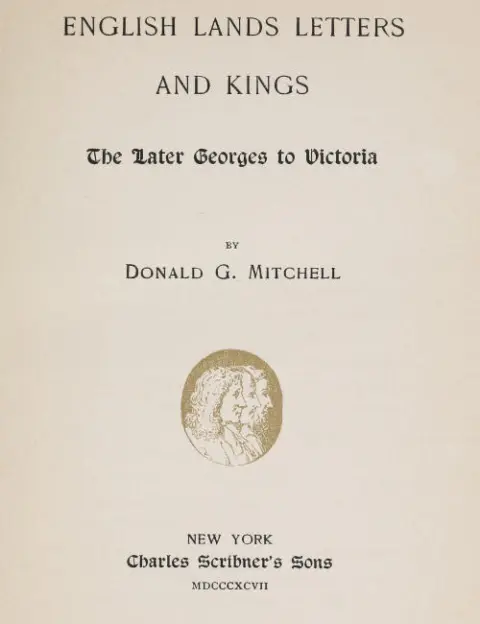
English Lands, Letters and Kings, vol. 4: The Later Georges to Victoria
Donald Grant Mitchell
THE CLASSIC COLLECTION · 1889
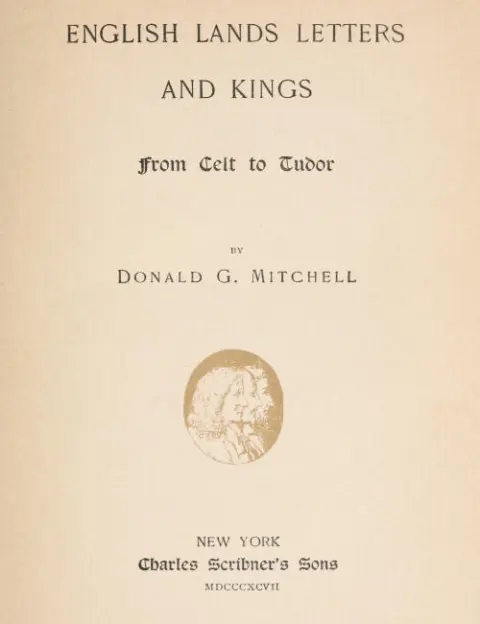
"English Lands, Letters and Kings, vol. 1: From Celt to Tudor" by Donald G. Mitchell is a historical account written in the late 19th century. This work serves as an informal exploration of English literature and history, stretching from early Celtic influences through to the Tudor period. The author aims to make engaging connections between literary figures, historical events, and geographical contexts in England, providing an accessible overview for readers interested in the emergence of English literature and culture. The opening portion establishes the author's intent to guide readers through an assortment of talks that reflect on early English history, literature, and the landscapes that shaped them. The narrative introduces significant themes such as the impact of Celtic heritage on English literature, the role of early Christian monks in preserving knowledge, and the emergence of figures like Cædmon and Beda, who contributed to the beginnings of English poetry and scholarship. Mitchell suggests that these discussions will weave together notable literary figures and their historical backgrounds, encouraging readers to appreciate the symbiotic relationship between the lands of England and the letters produced therein. Overall, the beginning sets a tone that is both informative and richly contextual, inviting readers to join in a journey through England's cultural evolution.
Introduction adapted from the source catalogue; source summaries may be automatically generated.
Free to read · English · 64,872 words · No account needed
MAKE TIME FOR A GOOD BOOK
On by default. Untick to stop anonymous reading totals. Each page counts after 10 seconds in view. How this works.
Anonymous counting is on unless you have switched it off.
[123] George Gascoigne (b. 1530; d. 1577) published a tract, in those days, entitled The Princely Pleasures of Kenelworth Castle, which appears in Nichol’s Progresses of Queen Elizabeth; as does also Laneham’s Account of the Queen’s Entertainment at Killingworth [sic] Castle.
Abbeys and Priories of England, 66 et seq.
Aldhelm, the Saxon scholar and poet, 10, 64.
Alfred, King, 17 et seq.
Aneurin, a Welsh bard, the reputed author of Gododin, 7.
“Arcadia” of Philip Sidney, 237.
Archery in England, 199.
Arnold, Matthew, on Celtic literature, 8.
Arthur, King, the legends of, 39 et seq.;
Geoffrey’s version of, 42;
Map’s version, 42;
Layamon’s version, 43.
Ascham, Roger, 197;
his “Toxophilus,” 199;
his “Schoolmaster,” 199;
teacher of Queen Elizabeth, 201.
Bacon, Francis, 242;
his character, 250 et seq.;
his essays, 257;
his Novum Organum and De Augmentis, 258;
his death, 259.
Bacon, Roger, 77 et seq.
Balladry, English, 158.
Barnes, Dame Juliana, 153.
Battle Abbey, 35.
Beda, 15, 64.
Beowulf, 41.
“Betrothed,” Scott’s novel, 48.
Berners, Lord, his translation of Froissart, 129.
Bible, Wyclif’s translation of, 90;
Tyndale’s translation, 185;
reading of, by the common people forbidden in reign of Henry
VIII., 191.
Black Prince, 93, 104, 106.
Boccaccio, 83.
Bœthius’ “Consolation of Philosophy,” translated by King Alfred, 19.
“Boke of the Duchesse,” Chaucer’s poem, 107.
Books at the end of the thirteenth century, 62;
decoration of, 65.
“Brut” of Layamon, 43.
Burleigh, Lord, 212, 242.
Cædmon, 13 et seq.;
possible influence of his paraphrase on Milton, 15.
Camden, William, 176, 303.
Camelot, 39, 40.
Canute’s verse about the singing of the monks of Ely, 22.
Canterbury School, 10.
“Canterbury Tales,” Chaucer’s, 114.
Caxton, 45, 149;
books from his press, 151.
Celtic literature, early, 7 et seq.
Chapman, George, and his Homer, 266.
Chaucer, 89, 97 et seq.;
his early life in London, 98;
a scholar, 100;
his connection with the royal household, 103;
his translation of the Roman de la Rose, 104;
his “Boke of the Duchesse,” 107;
his “Parliament of Foules,” 107;
his “Troilus and Cresseide,” 108;
his journeys on the Continent, 108;
his portrait, 112;
his “Canterbury Tales,” 114;
characters of the Canterbury pilgrims, 114 et seq.;
localities of the pilgrimage, 117;
his literary thefts, 119;
example of his art, 120 et seq.
Chevy Chase, ballad of, 159.
“Comus,” Milton’s, its relation to Peele’s “An Old Wives Tale,” 285.
Confessio Amantis of Gower, 128.
Coryat, Thomas, 304.
Cranmer, 182, 185.
“Crayon, Geoffrey,” 38.
Damoiselle, life of a, in the thirteenth century, 72.
Danish invasions of England, 17.
Dante, 83.
Dekker, Thomas, 287.
Drake, Sir Francis, 242.
Drayton, Michael, 291;
his “Poly-olbion,” 292;
his “Nymphidia,” 293.
Edward I., II., and III., 82 et seq.
Edward VI., 182, 197.
Elizabeth, Queen, Roger Ascham’s encomium of her studiousness, 201;
comes to the throne, 204;
her religion, 206;
Froude’s unfavorable portrait of, 207;
Soranzo’s description of, 208;
her greatness, 209;
her literary attempts, 311;
her love of pageants, 312;
her progresses, 313;
at Kenilworth, 314;
her death, 321.
Elizabethan authors, 214.
Emerson, his enjoyment of Taliesin, 8.
Erasmus, 177.
“Euphues,” by Lyly, 245.
Falstaff, Jack, 133.
Foxe, John, 187.
Froissart, Lord Berners’ translation of, 129.
Froude, Mr., his history characterized, 207.
Geoffrey of Monmouth, 37 et seq.
Your reading position is saved on this browser. Take it to another device with a library code. Reading pages adapt to text, rather than matching a printed edition.
Donald Grant Mitchell
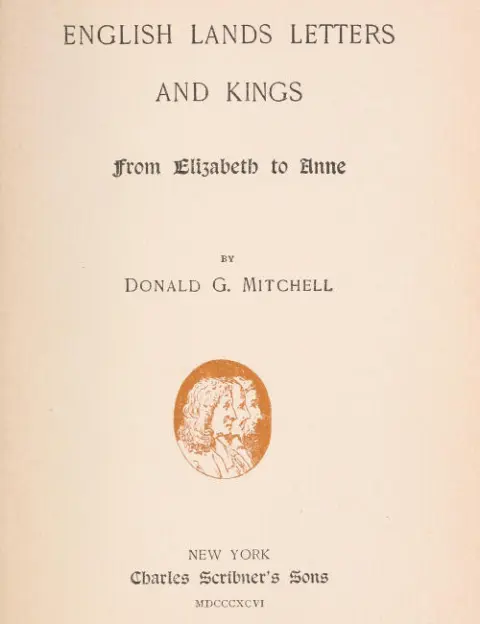
Donald Grant Mitchell
Donald Grant Mitchell
Donald Grant Mitchell
BEHIND THE BOOK
This eBook is for the use of anyone anywhere in the United States and most other parts of the world at no cost and with almost no restrictions whatsoever. You may copy it, give it away or re-use it under the terms of the Project Gutenberg License included with this eBook or online at www.gutenberg.org. If you are not located in the United States, you will have to check the laws of the country where you are located before using this eBook. Read the source licence.
The original source file, including credits and licence, is retained by this library. Request an original-format copy at no charge. Please include the book title and Project Gutenberg identifier #54168.
KEEP YOUR CURIOSITY GOING
Cécile Tormay

Moritz Busch
John L. Ransom
Frances Wright
Cécile Tormay

Mabel Potter Daggett