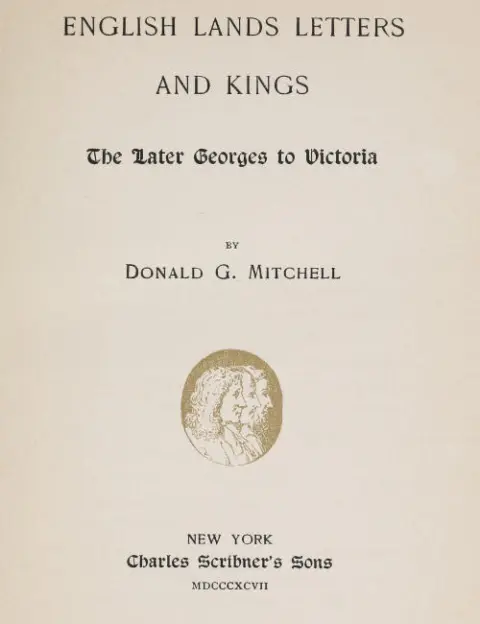
English Lands, Letters and Kings, vol. 4: The Later Georges to Victoria
Donald Grant Mitchell
THE CLASSIC COLLECTION · 1889
"English Lands, Letters and Kings, vol. 1: From Celt to Tudor" by Donald G. Mitchell is a historical account written in the late 19th century. This work serves as an informal exploration of English literature and history, stretching from early Celtic influences through to the Tudor period. The author aims to make engaging connections between literary figures, historical events, and geographical contexts in England, providing an accessible overview for readers interested in the emergence of English literature and culture. The opening portion establishes the author's intent to guide readers through an assortment of talks that reflect on early English history, literature, and the landscapes that shaped them. The narrative introduces significant themes such as the impact of Celtic heritage on English literature, the role of early Christian monks in preserving knowledge, and the emergence of figures like Cædmon and Beda, who contributed to the beginnings of English poetry and scholarship. Mitchell suggests that these discussions will weave together notable literary figures and their historical backgrounds, encouraging readers to appreciate the symbiotic relationship between the lands of England and the letters produced therein. Overall, the beginning sets a tone that is both informative and richly contextual, inviting readers to join in a journey through England's cultural evolution.
Introduction adapted from the source catalogue; source summaries may be automatically generated.
Free to read · English · 64,872 words · No account needed
MAKE TIME FOR A GOOD BOOK
On by default. Untick to stop anonymous reading totals. Each page counts after 10 seconds in view. How this works.
Anonymous counting is on unless you have switched it off.
[81] A coarse comedy written (probably) by John Still, one time Bishop of Bath. Its title on the imprint of 1575 runs thus:--“A ryght pithy, pleasant and merie Comedy, intytuled Gammer Gurton’s Nedle; played on the Stage not longe ago in Christes Colledge, in Cambridge, made by Mr. S., Master of Art.”
[82] Sir Thomas Wyatt (or Wyat), b. 1503; d. 1542. The Earl of Surrey (Henry Howard, and cousin to Catharine Howard, one of the wives of Henry VIII.), b. about 1517, and beheaded 1547.
[83] Understood to be based on the relations of a certain Unfortunate Traveller (Jack Wilton) by Nash, 1595. The story was credited by Drayton, Winstanley, the Athenæ Oxonienses of Wood (edition of 1721), by Walpole (Noble Authors), and by Warton: The relations spoken of, however, show anachronisms which forbid their acceptance.
[84] B. 1515; d. 1568. His works (in English) were collected and edited by Bennett in 1761. Fuller (of the Worthies) writes of Ascham: “He was an honest man and a good shooter. His Toxophilus is a good book for young men; his Scholemaster for old; his Epistles for all men.”
[85] Report of Giacomo Soranzo (Venetian Ambassador) under date of 1554: Rawdon Brown’s Calendar State Papers, 1534-54.
[86] Rawdon Brown’s Calendar State Papers, 1554. From Venetian Archives.
[87] A Thomas Sackville, b. 1527; d. 1608, was author of a portion of Mirror for Magistrates; also associated with Thomas Norton, in production of the Tragedy of Gorboduc.
[88] Thomas Tusser, b. about 1527; d. 1580.
[89] Raphael Holinshed, d. about 1580. First edition of his Chronicle was
published in 1577.
[90] William Cecil, b. 1520; d. 1598. Biography by Nares, 1828-31.
[91] Richard Hooker (1553-1600). Edition of his works (by Keble) first appeared 1836. First book of Laws of Ecclesiastical Polity has been edited for Clarendon Press Series by R. W. Church, 1868.
[92] Grosart, in his Life of Spenser (pp. 236-37), gives good reasons for doubting this story which is based mainly on the Jonson-Drummond interviews. Grosart also questions--as Prof. John Wilson had done before him--all the allegations of Spenser’s extreme indigence.
[93] Philip Sidney, b. 1554; d. 1586.
[94] The first edition of Rinaldo was printed at Venice in 1562: this great epic was completed at Padua in 1575.
[95] John Lyly, b. 1554; d. 1606.
[96] The style of Lyly has been traced by Dr. Landmann, an ingenious German critic, to the influence of Don Antonio de Guevara, a Spanish author, who wrote El Libro Aureo de Marco Aurelio, 1529. It was translated into English by Lord Berners in 1531 (published in 1534).
Your reading position is saved on this browser. Take it to another device with a library code. Reading pages adapt to text, rather than matching a printed edition.
Donald Grant Mitchell
Donald Grant Mitchell
Donald Grant Mitchell
Donald Grant Mitchell
BEHIND THE BOOK
This eBook is for the use of anyone anywhere in the United States and most other parts of the world at no cost and with almost no restrictions whatsoever. You may copy it, give it away or re-use it under the terms of the Project Gutenberg License included with this eBook or online at www.gutenberg.org. If you are not located in the United States, you will have to check the laws of the country where you are located before using this eBook. Read the source licence.
The original source file, including credits and licence, is retained by this library. Request an original-format copy at no charge. Please include the book title and Project Gutenberg identifier #54168.
KEEP YOUR CURIOSITY GOING
Cécile Tormay

Moritz Busch
John L. Ransom
Frances Wright
Cécile Tormay

Mabel Potter Daggett