THE CLASSIC COLLECTION✦Hawthorne (English Men of Letters Series)CLASSIC FREE BOOKS
Hawthorne (English Men of Letters Series)
Henry James
THE CLASSIC COLLECTION · 1875
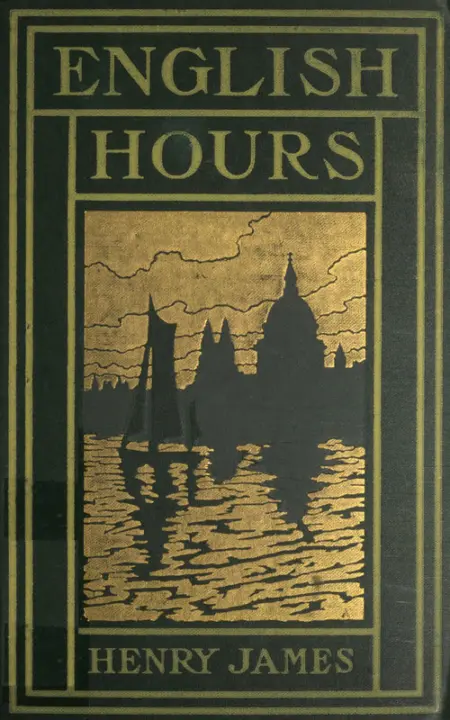
"English Hours" by Henry James is a collection of travel essays published in 1905. Drawing from more than thirty years of writing about England, James chronicles his experiences in his adopted country, from London's "greasy" streets to the pastoral countryside of Devon, Warwickshire, and Suffolk. With knowing affection, he captures both the "dreadful, delightful" British capital and the quiet charms of rural towns like Rye, offering readers an intimate portrait of Victorian and Edwardian England through American eyes.
Introduction adapted from the source catalogue; source summaries may be automatically generated.
Free to read · English · 76,282 words · No account needed
MAKE TIME FOR A GOOD BOOK
On by default. Untick to stop anonymous reading totals. Each page counts after 10 seconds in view. How this works.
Anonymous counting is on unless you have switched it off.
I mounted upon a four-horse coach, a charming coach with a yellow body and handsome, clean-flanked leaders; placing myself beside the coachman, as I had been told this was the point of vantage. The coach was one of the vehicles of the new fashion—the fashion of public conveyances driven, for the entertainment of themselves and of the public, by gentlemen of leisure. On the Derby Day all the coaches that start from the classic headquarters—the “White Horse” in Piccadilly—and stretch away from London toward a dozen different and well-selected goals, had been dedicated to the Epsom road. The body of the vehicle is empty, as no one thinks of occupying any but one of the thirteen places on the top. On the Derby Day, however, a properly laden coach carries a company of hampers and champagne-baskets in its inside places. I must add that on this occasion my companion was by exception a professional whip, who proved a friendly and amusing cicerone. Other companions there were, perched in the twelve places behind me, whose social quality I made less of a point of testing—though in the course of the expedition their various characteristics, under the influence of champagne, expanded so freely as greatly to facilitate the process. We were a society of exotics—Spaniards, Frenchmen, Germans. There were only two Britons, and these, according to my theory, were Australians—an antipodal bride and groom on a centripetal wedding-tour.
The drive to Epsom, when you get well out of London, is sufficiently pretty; but the part of it which most took my fancy was a district preëminently suburban, the classic community of Clapham. The vision of Clapham had been a part of the furniture of one’s milder historic consciousness—the vision of its respectable common, its evangelical society, its rich drab humanity, its goodly brick mansions of the Georgian era. I now seemed really to focus these elements for the first time, and I thought them very charming. This epithet indeed scarcely applies to the evangelical society, which naturally, on the morning of the Derby Day and during the desecrating progress of the Epsom revellers, was not much in the foreground. But all around the verdant if cockneyfied common are ranged commodious houses of a sober red complexion, from under whose neo-classic pediments you expect to see a mild-faced lady emerge—a lady in a cottage-bonnet and mittens, distributing tracts from a green silk satchel. It would take, however, the very ardour of the missionary among cannibals to stem the current of heterogeneous vehicles which at about this point takes up its metropolitan affluents and bears them in its rumbling, rattling tide. The concourse of wheeled conveyances of every possible order here becomes dense, and the spectacle from the top of the coach proportionately absorbing. You begin to perceive that the brilliancy of the road has in truth departed and that a sustained high tone of appearance is not the note of the conditions. But when once you have grasped this fact your entertainment is continuous. You perceive that you are “in” for the vulgar on an unsurpassable scale, something blatantly, unimaginably, heroically shocking to timid “taste;” all that is necessary is to accept this situation and look out for illustrations. Beside you, before you, behind you, is the mighty London populace taking its ébats. You get for the first time a notion of the London population at large. It has piled itself into carts, into omnibuses, into every possible and impossible species of “trap.” A large proportion of it is of course on foot, trudging along the perilous margin of the middle way in such comfort as may be gathered from fifteen miles’ dodging of broken shins. The smaller the vehicle, the more rat-like the animal that drags it, the more numerous and ponderous its human freight; and as every one is nursing in his lap a parcel of provender as big as himself, wrapped in ragged newspaper, it is not surprising that roadside halts are frequent and that the taverns all the way to Epsom (it is wonderful how many there are) are encompassed by dense groups of dusty pilgrims, indulging liberally in refreshment for man and beast. And when I say man I must by no means be understood to exclude woman. The female contingent on the Derby Day is not the least remarkable part of the London outpouring. Every one is prepared for “larks,” but the women are even more brilliantly and resolutely prepared than the men; there is no better chance to follow the range of type—not that it is to be called large—of the British female of the lower orders. The lady in question is usually not ornamental. She is useful, robust, prolific, excellently fitted to play the somewhat arduous part allotted to her in the great scheme of English civilisation, but she has not those graces which enable her to lend herself easily to the decoration of life. On smaller holidays, or on simple working-days, in London crowds, I have often thought she had points to contribute to the primary fine drawing, as to head and shoulders, of the Briton of the two sexes as the race at large sketches them. But at Epsom she is too stout, too hot, too red, too thirsty, too boisterous, too strangely accoutred. And yet I wish to do her justice; so I must add that if there is something to which an American cannot refuse a tribute of admiration in the gross plebeian jollity of the Derby Day, it is not evident why these dowdy Bacchantes should not get part of the credit of it. The striking thing, the interesting thing, both on the outward drive and on the return, was that the holiday was so frankly, heartily, good-humouredly taken. The people that of all peoples is habitually the most governed by decencies, proprieties, rigidities of conduct, was for one happy day unbuttoning its respectable straight-jacket and affirming its large and simple sense of the joy of life. In such a spectacle there was inevitably much that was unlucky and unprofitable; these things came uppermost chiefly on the return, when demoralisation was supreme, when the temperament of the people had begun really to take the air. For the rest, to be dressed with a kind of brutal gaudiness, to be very thirsty and violently flushed, to laugh perpetually at everything and at nothing, thoroughly to enjoy, in short, a momentous occasion—all this is not, in simple persons of the more susceptible sex, an unpardonable crime.
Your reading position is saved on this browser. Take it to another device with a library code. Reading pages adapt to text, rather than matching a printed edition.
Henry James
Henry James
Henry James

Henry James
BEHIND THE BOOK
This eBook is for the use of anyone anywhere in the United States and most other parts of the world at no cost and with almost no restrictions whatsoever. You may copy it, give it away or re-use it under the terms of the Project Gutenberg License included with this eBook or online at www.gutenberg.org. If you are not located in the United States, you will have to check the laws of the country where you are located before using this eBook. Read the source licence.
The original source file, including credits and licence, is retained by this library. Request an original-format copy at no charge. Please include the book title and Project Gutenberg identifier #58938.
KEEP YOUR CURIOSITY GOING
Wilfrid Scawen Blunt
Wilfrid Scawen Blunt

E. W. (Edgar Watson) Howe

David Patterson (Spirit) Hatch

David Patterson (Spirit) Hatch

David Patterson (Spirit) Hatch