THE CLASSIC COLLECTION✦Hawthorne (English Men of Letters Series)CLASSIC FREE BOOKS
Hawthorne (English Men of Letters Series)
Henry James
THE CLASSIC COLLECTION · 1875
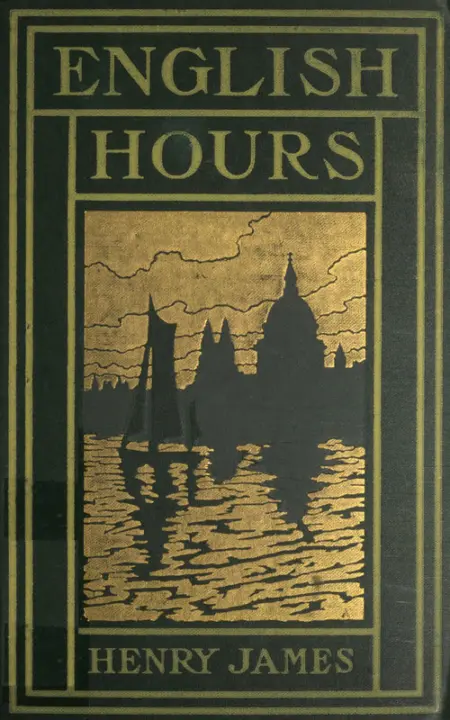
"English Hours" by Henry James is a collection of travel essays published in 1905. Drawing from more than thirty years of writing about England, James chronicles his experiences in his adopted country, from London's "greasy" streets to the pastoral countryside of Devon, Warwickshire, and Suffolk. With knowing affection, he captures both the "dreadful, delightful" British capital and the quiet charms of rural towns like Rye, offering readers an intimate portrait of Victorian and Edwardian England through American eyes.
Introduction adapted from the source catalogue; source summaries may be automatically generated.
Free to read · English · 76,282 words · No account needed
MAKE TIME FOR A GOOD BOOK
On by default. Untick to stop anonymous reading totals. Each page counts after 10 seconds in view. How this works.
Anonymous counting is on unless you have switched it off.
I walked down to Westminster Abbey on Good Friday afternoon—walked from Piccadilly across the Green Park and through that of St. James. The parks were densely filled with the populace—the elder people shuffling about the walks and the poor little smutty-faced children sprawling over the dark damp turf. When I reached the Abbey, I found a dense group of people about the entrance, but I squeezed my way through them and succeeded in reaching the threshold. Beyond this it was impossible to advance, and I may add that it was not desirable. I put my nose into the church and promptly withdrew it. The crowd was terribly compact, and beneath the gothic arches the odour was not that of incense. I gradually gave it up, with that very modified sense of disappointment that one feels in London at being crowded out of a place. This is a frequent form of philosophy, for you soon learn that there are, selfishly speaking, too many people. Human life is cheap; your fellow mortals are too numerous. Wherever you go you make the observation. At the theatre, at a concert, an exhibition, a reception, you always find that, before you arrive, there are people enough in the field. You are a tight fit in your place, wherever you find it; you have too many companions and competitors. You feel yourself at times in danger of thinking meanly of the human personality; numerosity, as it were, swallows up quality, and the perpetual sense of other elbows and knees begets a yearning for the desert. This is the reason why the perfection of luxury in England is to own a “park”—an artificial solitude. To get one’s self into the middle of a few hundred acres of oak-studded turf and to keep off the crowd by the breadth, at least, of the grassy shade, is to enjoy a comfort which circumstances make peculiarly precious. But I walked back through the profane pleasure-grounds of London, in the midst of “superfluous herds,” and I found the profit of vision that I never fail to derive from a great English assemblage. The English are, on the whole, to my eyes so appreciably the handsomest people in Europe—remembering always, of course, that when we talk of the frequency of beauty anywhere we talk of a minor quantity, more small or less small—that it takes some effort of the imagination to believe that the appearance requires demonstration. I never see a large number of them without feeling this impression confirmed; though I hasten to add that I have sometimes felt it to be much shaken in the presence of a limited group. I suspect that a great English crowd would yield a larger percentage of regular faces and tall figures than any other. With regard to the upper class, I suppose this is generally granted; but, with all abatements, I should extend it to the people at large. Certainly, if the English populace strike the observer as regular, nature, in them, must have clung hard to the higher ideal. They are as ill-dressed as their betters are well-dressed, and their garments have that sooty surface which has nothing in common with the continental costume of labour and privation. It is the hard prose of misery—an ugly and hopeless imitation of respectable attire. This is especially noticeable in the battered and bedraggled bonnets of the women, which look as if their husbands had stamped on them, in hobnailed boots, as a hint of what may be in store for their wearers. Then it is not too much to say that two thirds of the London faces, as the streets present them, bear in some degree or other the traces of alcoholic action. The proportion of flushed, empurpled, eruptive masks is considerable; a source of depression, for the spectator, not diminished by the fact that many of the faces thus disfigured have evidently been planned on lines of high superficial decency. A very large allowance is to be made, too, for the people who bear the distinctive stamp of that physical and mental degradation which comes from the slums and purlieus of this duskiest of modern Babylons—the pallid, stunted, misbegotten and in every way miserable figures. These people swarm in every London crowd, and I know of none in any other place that suggest an equal depth of degradation. But when such exceptions are taken the observer still notes the quantity and degree of facial finish, the firmness of type, if not always its fineness, the clearnesses and symmetries, the modelled brows and cheeks and chins, the immense contribution made to his impression, above all, by the elements of complexion and stature. The question of expression is another matter, and one must admit at the outset, to have done with it, that expression here in general lacks, even to strangeness, any perceptible intensity, though it often has among the women, and adorably among the children, an indescribable shy delicacy. I have it at heart, however, to add that if the English are handsomer than ourselves they are also very much uglier. Indeed I think all the European peoples more richly ugly than the American: we are far from producing those magnificent types of facial eccentricity which flourish on soils socially more rank. American ugliness is on the side of physical poverty and meanness; English on that of redundancy and monstrosity. In America there are few grotesques; in England there are many—and some of them have a high plastic, historic, romantic value.
Your reading position is saved on this browser. Take it to another device with a library code. Reading pages adapt to text, rather than matching a printed edition.
Henry James
Henry James
Henry James

Henry James
BEHIND THE BOOK
This eBook is for the use of anyone anywhere in the United States and most other parts of the world at no cost and with almost no restrictions whatsoever. You may copy it, give it away or re-use it under the terms of the Project Gutenberg License included with this eBook or online at www.gutenberg.org. If you are not located in the United States, you will have to check the laws of the country where you are located before using this eBook. Read the source licence.
The original source file, including credits and licence, is retained by this library. Request an original-format copy at no charge. Please include the book title and Project Gutenberg identifier #58938.
KEEP YOUR CURIOSITY GOING
Wilfrid Scawen Blunt
Wilfrid Scawen Blunt

E. W. (Edgar Watson) Howe

David Patterson (Spirit) Hatch

David Patterson (Spirit) Hatch

David Patterson (Spirit) Hatch