THE CLASSIC COLLECTION✦Hawthorne (English Men of Letters Series)CLASSIC FREE BOOKS
Hawthorne (English Men of Letters Series)
Henry James
THE CLASSIC COLLECTION · 1875
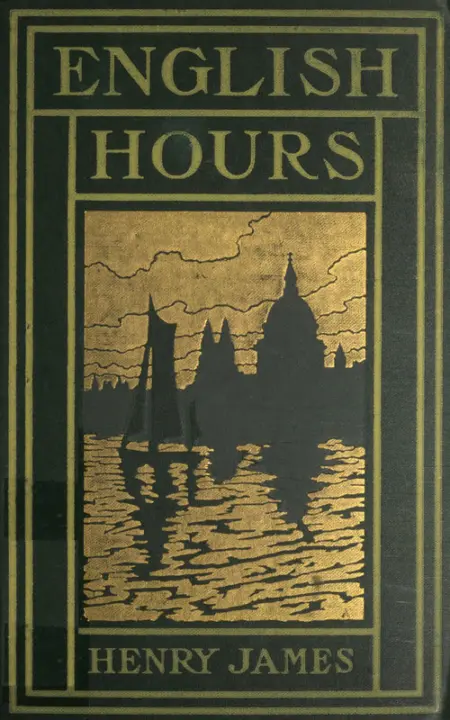
"English Hours" by Henry James is a collection of travel essays published in 1905. Drawing from more than thirty years of writing about England, James chronicles his experiences in his adopted country, from London's "greasy" streets to the pastoral countryside of Devon, Warwickshire, and Suffolk. With knowing affection, he captures both the "dreadful, delightful" British capital and the quiet charms of rural towns like Rye, offering readers an intimate portrait of Victorian and Edwardian England through American eyes.
Introduction adapted from the source catalogue; source summaries may be automatically generated.
Free to read · English · 76,282 words · No account needed
MAKE TIME FOR A GOOD BOOK
On by default. Untick to stop anonymous reading totals. Each page counts after 10 seconds in view. How this works.
Anonymous counting is on unless you have switched it off.
The way in which the example of the more luxurious classes imposes itself upon the less luxurious may of course be noticed in smaller matters than church-going; in a great many matters which it may seem trivial to mention. If one is bent upon observation nothing, however, is trivial. So I may cite the practice of banishing the servants from the room at breakfast. It is the fashion, and accordingly, through the length and breadth of England, every one who has the slightest pretension to standing high enough to feel the way the social breeze is blowing conforms to it. It is awkward, unnatural, troublesome for those at table, it involves a vast amount of leaning and stretching, of waiting and perambulating, and it has just that vice against which, in English history, all great movements have been made—it is arbitrary. But it flourishes for all that, and all genteel people, looking into each other’s eyes with the desperation of gentility, agree to endure it for gentility’s sake. My instance may seem feeble, and I speak honestly when I say I might give others, forming part of an immense body of prescriptive usage, to which a society possessing in the largest manner, both by temperament and education, the sense of the “inalienable” rights and comforts of the individual, contrives to accommodate itself. I do not mean to say that usage in England is always uncomfortable and arbitrary. On the contrary, few strangers can be unfamiliar with that sensation (a most agreeable one) which consists in perceiving in the rigidity of a tradition which has struck one at first as mechanical a reason existing in the historic “good sense” of the English race. The sensation is frequent, though in saying so I do not mean to imply that even superficially the presumption is against the usages of English society. It is not, for instance, necessarily against the custom of which I had it more especially in mind to speak in writing these lines. The stranger in London is forewarned that at Easter all the world goes out of town, and that if he have no mind to be left to some fate the universal terror of which half allures half appals his curiosity, he too had better make arrangements for a temporary absence. It must be admitted that there is a sort of unexpectedness in this prompt re-emigration of a body of people who but a week before were apparently devoting much energy to settling down for the season. Half of them have but lately come back from the country, where they have been spending the winter, and they have just had time, it may be supposed, to collect the scattered threads of town-life. Presently, however, the threads are dropped and society is dispersed as if it had taken a false start. It departs as Holy Week draws to a close, and remains absent for the following ten days. Where it goes is its own affair; a good deal of it goes to Paris. Spending last winter in that city, I remember how, when I woke up on Easter Monday and looked out of my window, I found the street covered overnight with a sort of snow-fall of disembarked Britons. They made for other people an uncomfortable week of it. One’s customary table at the restaurant, one’s habitual stall at the Théâtre Français, one’s usual fiacre on the cab-stand, were very apt to have suffered estrangement. I believe the pilgrimage to Paris was this year of the usual proportions; and you may be sure that people who did not cross the Channel were not without invitations to quiet old places in the country, where the pale fresh primroses were beginning to light up the dark turf and the purple bloom of the bare tree-masses to be freckled here and there with verdure. In England country-life is the obverse of the medal, town-life the reverse, and when an occasion comes for quitting London there are few members of what the French call the “easy class” who have not a collection of dull, moist, verdant resorts to choose from. Dull I call them, and I fancy not without reason, though at the moment I speak of their dulness must have been mitigated by the unintermittent presence of the keenest and liveliest of east winds. Even in mellow English country homes Easter-tide is a period of rawness and atmospheric acridity—the moment at which the frank hostility of winter, which has at last to give up the game, turns to peevishness and spite. This is what makes it arbitrary, as I said just now, for “easy” people to go forth to the wind-swept lawns and the shivering parks. But nothing is more striking to an American than the frequency of English holidays and the large way in which occasions for “a little change” are made use of. All this speaks to Americans of three things which they are accustomed to see allotted in scantier measure. The English have more time than we, they have more money, and they have a much higher relish for active leisure. Leisure, fortune, and the love of sport are felicities encountered in English society at every turn. It was a very small number of weeks before Easter that Parliament met, and yet a ten days’ recess was already, from the luxurious Parliamentary point of view, a necessity. A short time hence we shall be having the Whitsuntide holidays, which I am told are even more of a season of revelry than Easter, and from this point to midsummer, when everything stops, is an easy journey. The men of business and the professional men partake in equal measure of these agreeable diversions, and I was interested in hearing a lady whose husband was an active member of the bar say that, though he was leaving town with her for ten days, and though Easter was a very nice “little break,” they really amused themselves more during the later festival, which would come on toward the end of May. I thought this highly probable, and admired in their career such an effect of breeze-blown light and shade. If my phrase has a slightly ironical sound, this is purely accidental. A large appetite for holidays, the ability not only to take them but to know what to do with them when taken, is the sign of a robust people, and judged by this measure we Americans are sadly inexpert. Such holidays as we take are taken very often in Europe, where it is sometimes noticeable that our privilege is rather heavy on our hands. Acknowledgment made of English industry, however (our own stands in no need of compliments), it must be added that for those same easy classes I just spoke of things are very easy indeed. The number of persons obtainable for purely social purposes at all times and seasons is infinitely greater than among ourselves; and the ingenuity of the arrangements permanently going forward to disembarrass them of their superfluous leisure is as yet in America an undeveloped branch of civilisation. The young men who are preparing for the stern realities of life among the grey-green cloisters of Oxford are obliged to keep their terms but half the year; and the rosy little cricketers of Eton and Harrow are let loose upon the parental home for an embarrassing number of months. Happily the parental home is apt to be an affair of gardens, lawns, and parks.
Your reading position is saved on this browser. Take it to another device with a library code. Reading pages adapt to text, rather than matching a printed edition.
Henry James
Henry James
Henry James

Henry James
BEHIND THE BOOK
This eBook is for the use of anyone anywhere in the United States and most other parts of the world at no cost and with almost no restrictions whatsoever. You may copy it, give it away or re-use it under the terms of the Project Gutenberg License included with this eBook or online at www.gutenberg.org. If you are not located in the United States, you will have to check the laws of the country where you are located before using this eBook. Read the source licence.
The original source file, including credits and licence, is retained by this library. Request an original-format copy at no charge. Please include the book title and Project Gutenberg identifier #58938.
KEEP YOUR CURIOSITY GOING
Wilfrid Scawen Blunt
Wilfrid Scawen Blunt

E. W. (Edgar Watson) Howe

David Patterson (Spirit) Hatch

David Patterson (Spirit) Hatch

David Patterson (Spirit) Hatch