THE CLASSIC COLLECTION✦Hawthorne (English Men of Letters Series)CLASSIC FREE BOOKS
Hawthorne (English Men of Letters Series)
Henry James
THE CLASSIC COLLECTION · 1875
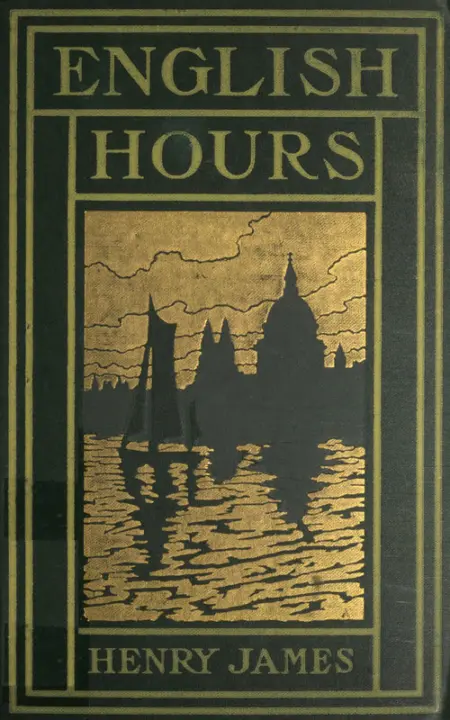
"English Hours" by Henry James is a collection of travel essays published in 1905. Drawing from more than thirty years of writing about England, James chronicles his experiences in his adopted country, from London's "greasy" streets to the pastoral countryside of Devon, Warwickshire, and Suffolk. With knowing affection, he captures both the "dreadful, delightful" British capital and the quiet charms of rural towns like Rye, offering readers an intimate portrait of Victorian and Edwardian England through American eyes.
Introduction adapted from the source catalogue; source summaries may be automatically generated.
Free to read · English · 76,282 words · No account needed
MAKE TIME FOR A GOOD BOOK
On by default. Untick to stop anonymous reading totals. Each page counts after 10 seconds in view. How this works.
Anonymous counting is on unless you have switched it off.
The Rows are as “scenic” as one could wish, and it is a pity that before the birth of their modern consciousness there was no English Balzac to introduce them into a realistic romance with a psychological commentary. But the cathedral is better still, modestly as it stands on the roll of English abbeys. It is of moderate dimensions and rather meagre in form and ornament; but to an American it expresses and answers for the type, producing thereby the proper vibrations. Among these is a certain irresistible regret that so much of its hoary substance should give place to the fine, fresh-coloured masonry with which Mr. Gilbert Scott, ruthless renovator, is so intelligently investing it. The red sandstone of the primitive structure, darkened and devoured by time, survives at many points in frowning mockery of the imputed need of tinkering. The great tower, however,—completely restored,—rises high enough to seem to belong, as cathedral towers should, to the far-off air that vibrates with the chimes and the swallows, and to square serenely, east and west and south and north, its embossed and fluted sides. English cathedrals, within, are apt at first to look pale and naked; but after a while, if the proportions be fair and the spaces largely distributed, when you perceive the light beating softly down from the cold clerestory and your eye measures caressingly the tallness of columns and the hollowness of arches, and lingers on the old genteel inscriptions of mural marbles and brasses; and, above all, when you become conscious of that sweet, cool mustiness in the air which seems to haunt these places as the very climate of Episcopacy, you may grow to feel that they are less the empty shells of a departed faith than the abodes of a faith which may still affirm a presence and awaken echoes. Catholicism has gone, but Anglicanism has the next best music. So at least it seemed to me, a Sunday or two since, as I sat in the choir at Chester awaiting a discourse from Canon Kingsley. The Anglican service had never seemed to my profane sense so much an affair of magnificent intonations and cadences—of pompous effects of resonance and melody. The vast oaken architecture of the stalls among which we nestled—somewhat stiffly and with a due apprehension of wounded ribs and knees—climbing vainly against the dizzier reach of the columns; the beautiful English voices of certain officiating canons, the little rosy “king’s scholars” sitting ranged beneath the pulpit, in white-winged surplices, which made their heads, above the pew-edges, look like rows of sleepy cherubs: every element in the scene gave it a great spectacular beauty. They suggested too what is suggested in England at every turn, that conservatism here has all the charm and leaves dissent and democracy and other vulgar variations nothing but their bald logic. Conservatism has the cathedrals, the colleges, the castles, the gardens, the traditions, the associations, the fine names, the better manners, the poetry; Dissent has the dusky brick chapels in provincial by-streets, the names out of Dickens, the uncertain tenure of the h, and the poor mens sibi conscia recti. Differences which in other countries are slight and varying, almost metaphysical, as one may say, are marked in England by a gulf. Nowhere else does the degree of one’s respectability involve such solid consequences, and I am sure I don’t wonder that the sacramental word which with us (and, in such correlatives as they possess, more or less among the continental races) is pronounced lightly and facetiously and as a quotation from the Philistines, is uttered here with a perfectly grave face. To have the courage of one’s mere convictions is in short to have a prodigious deal of courage, and I think one must need as much to be a Dissenter as one needs patience not to be a duke. Perhaps the Dissenters (to limit the question to them) manage to stay out of the church by letting it all hang on the sermon. Canon Kingsley’s discourse was one more example of the familiar truth—not without its significance to minds zealous for the good old fashion of “making an effort,”—that there is an odd link between large forms and small emanations. The sermon, beneath that triply consecrated vault, should have had a builded majesty. It had not; and I confess that a tender memory of ancient obligations to the author of “Westward Ho!” and “Hypatia” forbids my saying more of it. An American, I think, is not incapable of taking a secret satisfaction in an incongruity of this kind. He finds with relief that even mortals reared as in the ring of a perpetual circus are only mortals. His constant sense of the beautiful scenic properties of English life is apt to beget a habit of melancholy reference to the dead-blank wall which forms the background of our own life-drama; and from doubting in this fantastic humour whether we have even that modest value in the scale of beauty that he has sometimes fondly hoped, he lapses into a moody scepticism as to our place in the scale of “importance,” and finds himself wondering vaguely whether this be not a richer race as well as a lovelier land. That of course will never do; so that when after being escorted down the beautiful choir in what, from the American point of view, is an almost gorgeous ecclesiastical march, by the Dean in a white robe trimmed with scarlet and black-robed sacristans carrying silver wands, the officiating canon mounts into a splendid canopied and pinnacled pulpit of gothic stonework and proves—not an “acting” Jeremy Taylor, our poor sentimental tourist begins to hold up his head again and to reflect that so far as we have opportunities we mostly rise to them. I am not sure indeed that in the excess of his reaction he is not tempted to accuse his English neighbours of being impenetrable and uninspired, to affirm that they do not half discern their good fortune, and that it takes passionate pilgrims, vague aliens, and other disinherited persons to appreciate the “points” of this admirable country.
Your reading position is saved on this browser. Take it to another device with a library code. Reading pages adapt to text, rather than matching a printed edition.
Henry James
Henry James
Henry James

Henry James
BEHIND THE BOOK
This eBook is for the use of anyone anywhere in the United States and most other parts of the world at no cost and with almost no restrictions whatsoever. You may copy it, give it away or re-use it under the terms of the Project Gutenberg License included with this eBook or online at www.gutenberg.org. If you are not located in the United States, you will have to check the laws of the country where you are located before using this eBook. Read the source licence.
The original source file, including credits and licence, is retained by this library. Request an original-format copy at no charge. Please include the book title and Project Gutenberg identifier #58938.
KEEP YOUR CURIOSITY GOING
Wilfrid Scawen Blunt
Wilfrid Scawen Blunt

E. W. (Edgar Watson) Howe

David Patterson (Spirit) Hatch

David Patterson (Spirit) Hatch

David Patterson (Spirit) Hatch