THE CLASSIC COLLECTION✦Hawthorne (English Men of Letters Series)CLASSIC FREE BOOKS
Hawthorne (English Men of Letters Series)
Henry James
THE CLASSIC COLLECTION · 1875
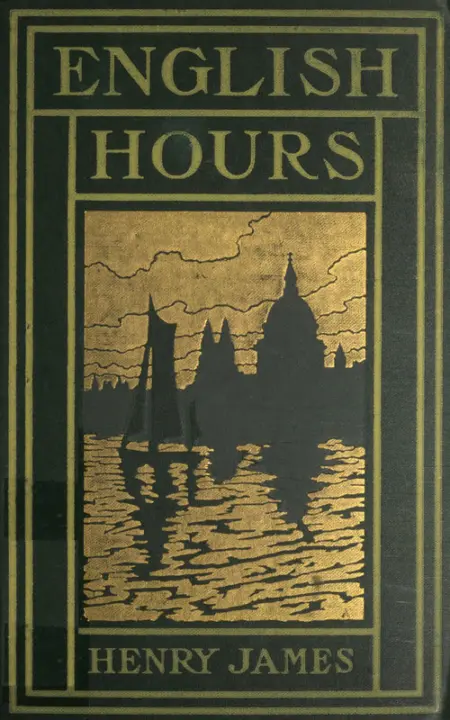
"English Hours" by Henry James is a collection of travel essays published in 1905. Drawing from more than thirty years of writing about England, James chronicles his experiences in his adopted country, from London's "greasy" streets to the pastoral countryside of Devon, Warwickshire, and Suffolk. With knowing affection, he captures both the "dreadful, delightful" British capital and the quiet charms of rural towns like Rye, offering readers an intimate portrait of Victorian and Edwardian England through American eyes.
Introduction adapted from the source catalogue; source summaries may be automatically generated.
Free to read · English · 76,282 words · No account needed
MAKE TIME FOR A GOOD BOOK
On by default. Untick to stop anonymous reading totals. Each page counts after 10 seconds in view. How this works.
Anonymous counting is on unless you have switched it off.
The glimpses I speak of are, in all directions, the constant company of the afternoon “spin.” Beginning, modestly enough, at Dunwich itself, they end, for intensity, as far inland as you have time to go; far enough—this is the great point—to have shown you, in their quiet vividness of type, a placid series of the things into which you may most read the old story of what is softest in the English complexity. I scarce know what murmur has been for weeks in my ears if it be not that of the constant word that, as a recall of the story, may serve to be put under the vignette. And yet this word is in its last form nothing more eloquent than the mere admonition to be pleased. Well, so you are, even as I was yesterday at Wesselton with the characteristic “value” that expressed itself, however shyly, in the dear old red inn at which I halted for the queer restorative—I thus discharge my debt to it—of a bottle of lemonade with a “dash.” The dash was only of beer, but the refreshment was immense. So even was that of the sight of a dim, draped, sphinx-like figure that loomed, at the end of a polished passage, out of a little dusky back parlour which had a windowful of the choked light of a small green garden—a figure proving to be an old woman desirous to dilate on all the years she had sat there with rheumatism “most cruel.” So, inveterately—and in these cases without the after-taste—is that of the pretty little park gates you pass to skirt the walls and hedges beyond which the great affair, the greatest of all, the deep, still home, sits in the midst of its acres and strikes you all the more for being, precisely, so unrenowned. It is the charming repeated lesson that the amenity of the famous seats in this country is nothing to that of the lost and buried ones. This impression in particular may bring you round again harmoniously to Dunwich and above all perhaps to where the Priory, laid, as I may say, flat on its back, rests its large outline on what was once the high ground, with the inevitable “big” house, beyond and a little above, folded, for privacy, in a neat, impenetrable wood. Here as elsewhere the cluster offers without complication just the signs of the type. At the base of the hill are the dozen cottages to which the village has been reduced, and one of which contains, to my hearing, though by no means, alas, to his own, a very ancient man who will count for you on his fingers, till they fail, the grand acres that, in his day, he has seen go the way of the rest. He likes to figure that he ploughed of old where only the sea ploughs now. Dunwich, however, will still last his time; and that of as many others as—to repeat my hint—may yet be drawn here (though not, I hope, on the instance of these prudent lines) to judge for themselves into how many meanings a few elements can compose. One never need be bored, after all, when “composition” really rules. It rules in the way the brown hamlet really disposes itself, and the grey square tower of the church, in just the right relation, peeps out of trees that remind me exactly of those which, in the frontispieces of Birket Foster, offered to my childish credulity the very essence of England. Let me put it directly for old Suffolk that this credulity finds itself here, at the end of time, more than ever justified. Let me put it perhaps also that the very essence of England has a way of presenting itself with completeness in almost any fortuitous combination of rural objects at all, so that, wherever you may be, you get, reduced and simplified, the whole of the scale. The big house and its woods are always at hand; with a “party” always, in the intervals of shooting, to bring down to the rustic sports that keep up the tradition of the village green. The russet, low-browed inn, the “ale-house” of Shakespeare, the immemorial fountain of beer, looking over that expanse, swings, with an old-time story-telling creak, the sign of the Marquis of Carabas. The pretty girls, within sight of it, alight from the Marquis’s wagonette; the young men with the one eye-glass and the new hat sit beside them on the benches supplied for their sole accommodation, and thanks to which the meditator on manners has, a little, the image, gathered from faded fictions by female hands, of the company brought over, for the triumph of the heroine, to the hunt or the county ball. And it is always Hodge and Gaffer that, at bottom, font les frais—always the mild children of the glebe on whom, in the last resort, the complex superstructure rests.
Your reading position is saved on this browser. Take it to another device with a library code. Reading pages adapt to text, rather than matching a printed edition.
Henry James
Henry James
Henry James

Henry James
BEHIND THE BOOK
This eBook is for the use of anyone anywhere in the United States and most other parts of the world at no cost and with almost no restrictions whatsoever. You may copy it, give it away or re-use it under the terms of the Project Gutenberg License included with this eBook or online at www.gutenberg.org. If you are not located in the United States, you will have to check the laws of the country where you are located before using this eBook. Read the source licence.
The original source file, including credits and licence, is retained by this library. Request an original-format copy at no charge. Please include the book title and Project Gutenberg identifier #58938.
KEEP YOUR CURIOSITY GOING
Wilfrid Scawen Blunt
Wilfrid Scawen Blunt

E. W. (Edgar Watson) Howe

David Patterson (Spirit) Hatch

David Patterson (Spirit) Hatch

David Patterson (Spirit) Hatch