THE CLASSIC COLLECTION✦Hawthorne (English Men of Letters Series)CLASSIC FREE BOOKS
Hawthorne (English Men of Letters Series)
Henry James
THE CLASSIC COLLECTION · 1875
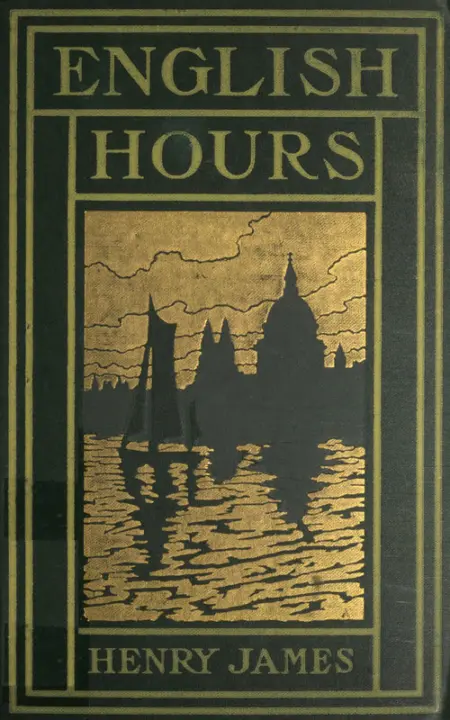
"English Hours" by Henry James is a collection of travel essays published in 1905. Drawing from more than thirty years of writing about England, James chronicles his experiences in his adopted country, from London's "greasy" streets to the pastoral countryside of Devon, Warwickshire, and Suffolk. With knowing affection, he captures both the "dreadful, delightful" British capital and the quiet charms of rural towns like Rye, offering readers an intimate portrait of Victorian and Edwardian England through American eyes.
Introduction adapted from the source catalogue; source summaries may be automatically generated.
Free to read · English · 76,282 words · No account needed
MAKE TIME FOR A GOOD BOOK
On by default. Untick to stop anonymous reading totals. Each page counts after 10 seconds in view. How this works.
Anonymous counting is on unless you have switched it off.
Close beside the east gate, so close that one of its battered towers leans heavily on the little garden, is a wonderfully perched cottage, of which the mistress is a very celebrated lady who resorts to the place in the intervals of an exacting profession—the scene of her renown, I may go so far as to mention, is the theatre—for refreshment and rest. The small grounds of this refuge, supported by the old town-wall and the steep plunge of the great hill, have a rare position and view. The narrow garden stretches away in the manner of a terrace to which the top of the wall forms a low parapet; and here it is that, when the summer days are long, the sweet old soul of all the land seems most to hang in the air. It is almost a question indeed whether this fine Winchelsea front, all silver-grey and ivy-green, is not even better when making a picture itself from below than when giving you one, with much immensity, from its brow. This picture is always your great effect, artfully prepared by an absence of prediction, when you take a friend over from Rye; and it would appear quite to settle the small discussion—that may be said to come up among us so often—of which is the happier abode. The great thing is that if you live at Rye you have Winchelsea to show; whereas if you live at Winchelsea you have nothing but Rye. This latter privilege I should be sorry to cry down; but nothing can alter the fact that, to begin with, the pedestal of Winchelsea has twice the height, by a rough measure, of that of its neighbour; and we all know the value of an inch at the end of a nose. Almost directly under the Winchelsea hill, crossing the little bridge of the Brede, you pass beyond a screen of trees and take in, at the top of the ascent, the two round towers and arch, ivied and mutilated, but still erect, of the old main gate. The road either way is long and abrupt, so that people kind to their beasts alight at the foot, and cyclists careful of their necks alight at the head. The brooding spectator, moreover, who forms a class by himself, pauses, infallibly, as he goes, to admire the way the great trees cluster and compose on the high slope, always striking, for him, as day gathers in and the whole thing melts together, a classic, academic note, the note of Turner and Claude. From the garden of the distinguished cottage, at any rate, it is a large, melancholy view—a view that an occasional perverse person whom it fails to touch finds easy, I admit, to speak of as dreary; so that those who love it and are well advised will ever, at the outset, carry the war into the enemy’s country by announcing it, with glee, as sad. Just this it must be that nourishes the sense of obliterated history as to which I a moment ago wondered. The air is like that of a room through which something has been carried that you are aware of without having seen it. There is a vast deal of level in the prospect, but, though much depends on the day and still more on the hour, it is, at the worst, all too delicate to be ugly. The best hour is that at which the compact little pyramid of Rye, crowned with its big but stunted church and quite covered by the westering sun, gives out the full measure of its old browns that turn to red and its old reds that turn to purple. These tones of evening are now pretty much all that Rye has left to give, but there are truly, sometimes, conditions of atmosphere in which I have seen the effect as fantastic. I sigh when I think, however, what it might have been if, perfectly placed as it is, the church tower—which in its more perverse moods only resembles a big central button, a knob on a pincushion—had had the grace of a few more feet of stature. But that way depression lies, and the humiliation of those moments at which the brooding spectator says to himself that both tower and hill would have been higher if the place had only been French or Italian. Its whole pleasant little pathos, in point of fact, is just that it is homely English. And even with this, after all, the imagination can play. The wide, ambiguous flat that stretches eastward from Winchelsea hill, and on the monotone of whose bosom, seen at sunset from a friendly eminence that stands nearer, Rye takes the form of a huge floating boat, its water-line sharp and its bulk defined from stem to stern—this dim expanse is the great Romney Marsh, no longer a marsh to-day, but, at the end of long years, drained and ordered, a wide pastoral of grazing, with “new” Romney town, a Port no more,—not the least of the shrunken Five,—mellowed to mere russet at the far end, and other obscure charms, revealed best to the slow cyclist, scattered over its breast: little old “bits” that are not to be described, yet are known, with a small thrill, when seen; little lonely farms, red and grey; little mouse-coloured churches; little villages that seem made only for long shadows and summer afternoons. Brookland, Old Romney, Ivychurch, Dymchurch, Lydd—they have positively the prettiest names. But the point to be made is that, comparing small things with great,—which may always be done when the small things are amiable,—if Rye and its rock and its church are a miniature Mont-Saint-Michel, so, when the summer deepens, the shadows fall, and the mounted shepherds and their dogs pass before you in the grassy desert, you find in the mild English “marsh” a recall of the Roman Campagna.
Your reading position is saved on this browser. Take it to another device with a library code. Reading pages adapt to text, rather than matching a printed edition.
Henry James
Henry James
Henry James

Henry James
BEHIND THE BOOK
This eBook is for the use of anyone anywhere in the United States and most other parts of the world at no cost and with almost no restrictions whatsoever. You may copy it, give it away or re-use it under the terms of the Project Gutenberg License included with this eBook or online at www.gutenberg.org. If you are not located in the United States, you will have to check the laws of the country where you are located before using this eBook. Read the source licence.
The original source file, including credits and licence, is retained by this library. Request an original-format copy at no charge. Please include the book title and Project Gutenberg identifier #58938.
KEEP YOUR CURIOSITY GOING
Wilfrid Scawen Blunt
Wilfrid Scawen Blunt

E. W. (Edgar Watson) Howe

David Patterson (Spirit) Hatch

David Patterson (Spirit) Hatch

David Patterson (Spirit) Hatch