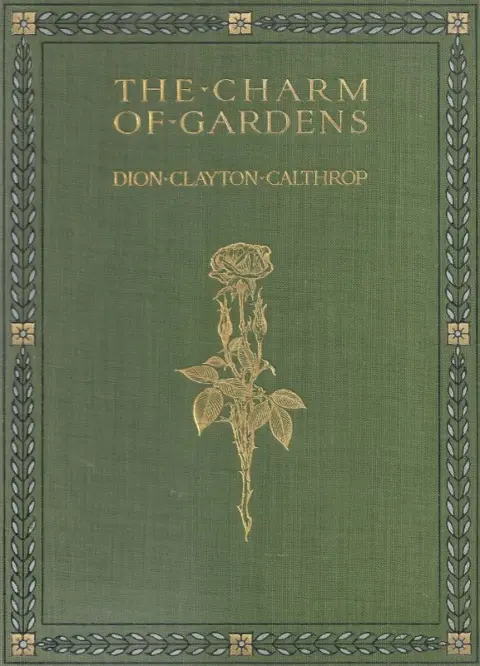
The Charm of Gardens
Dion Clayton Calthrop
THE CLASSIC COLLECTION · 1906
"English Costume" by Dion Clayton Calthrop is a historical account written in the early 20th century. The work provides an in-depth examination of the evolution of civilian clothing in England, beginning from the time of the Norman Conquest through various historical periods. Focusing on how clothing reflects societal changes and individual identity, it meticulously traces the transition of styles, materials, and cultural influences over time. The opening of "English Costume" sets the stage for a comprehensive exploration of fashion history, with the author emphasizing the integral role clothing plays in shaping a person's identity and reflecting social norms and values. Calthrop introduces the idea that fashion is intertwined with significant historical figures and events, illustrating this connection through anecdotes about notable garments from various reigns. He establishes an organized historical timeline, pairing illustrations with textual descriptions that detail the changes in men’s and women’s attire from the Norman Conquest (1066) onwards, all while asserting the importance of understanding the clothes of one's own people to fully grasp their history. The opening effectively frames the book as a unique resource that links fashion to historical narratives in a way that is both accessible and engaging.
Introduction adapted from the source catalogue; source summaries may be automatically generated.
Free to read · English · 82,856 words · No account needed
MAKE TIME FOR A GOOD BOOK
On by default. Untick to stop anonymous reading totals. Each page counts after 10 seconds in view. How this works.
Anonymous counting is on unless you have switched it off.
The Carpenter in 'Julius Caesar' is asked:
'Where is thy leather apron and thy rule?'
The mob have 'sweaty night-caps.'
Cleopatra, in 'Antony and Cleopatra,' says:
'I'll give thee an armour all of gold.'
The 'Winter's Tale,' the action of which occurs in Pagan times, is full of anachronisms. As, for instance, Whitsun pastorals, Christian burial, an Emperor of Russia, and an Italian fifteenth-century painter. Also:
'Lawn as white as driven snow;
Cyprus[B] black as ere was crow;
Gloves as sweet as damask roses;
Masks for faces and for noses;
Bugle-bracelet, necklace amber,
Perfume for a lady's chamber;
Golden quoifs and stomachers,
Pins and polking-sticks of steel.'
[B] Thin stuff for women's veils.
So, you see, Autolycus, the pedlar of these early times, is spoken of as carrying polking-sticks with which to stiffen ruffs.
Shylock, in 'The Merchant of Venice,' should wear an orange-tawny bonnet lined with black taffeta, for in this way were the Jews of Venice distinguished in 1581.
In 'The Tempest' one may hear of rye-straw hats, of gaberdines, rapiers, and a pied fool's costume.
In 'The Two Gentlemen of Verona' we hear:
'Why, then, your ladyship must cut your hair.'
'No, girl; I'll tie it up in silken strings
With twenty odd conceited true-love knot;
To be fantastic may become a youth
Of greater time than I shall show to be.'
Also:
'Since she did neglect her looking-glass,
And threw her sun-expelling mask away.'
Many ladies at this time wore velvet masks. 'The Merry Wives of Windsor' gives us a thrummed hat, a muffler or linen to hide part of the face, gloves, fans. Falstaff says:
'When Mistress Bridget lost the handle of her fan, I took it up my honour thou had'st it not.'
Also:
'The firm fashion of thy foot would give an excellent motion to thy fait in a semicircled farthingale.'
'Twelfth Night' is celebrated for us by Malvolio's cross garters. Sir Toby, who considers his clothes good enough to drink in, says:
'So be these boots too: an they be not, let them hang
themselves in their own straps.'
Sir Toby also remarks to Sir Andrew upon the excellent constitution of his leg, and Sir Andrew replied that:
'It does indifferent well in a flame-coloured stock.'
The Clown says:
'A sentence is but a cheveril[C] glove to a good wit.'
[C] 'Cheveril' is kid leather.
In 'Much Ado About Nothing' we learn of one who lies awake ten nights, 'carving the fashion of his doublet.' Also of one who is
Your reading position is saved on this browser. Take it to another device with a library code. Reading pages adapt to text, rather than matching a printed edition.
Dion Clayton Calthrop
BEHIND THE BOOK
This eBook is for the use of anyone anywhere in the United States and most other parts of the world at no cost and with almost no restrictions whatsoever. You may copy it, give it away or re-use it under the terms of the Project Gutenberg License included with this eBook or online at www.gutenberg.org. If you are not located in the United States, you will have to check the laws of the country where you are located before using this eBook. Read the source licence.
The original source file, including credits and licence, is retained by this library. Request an original-format copy at no charge. Please include the book title and Project Gutenberg identifier #33020.
KEEP YOUR CURIOSITY GOING
Cécile Tormay

Moritz Busch
John L. Ransom
Frances Wright
Cécile Tormay

Mabel Potter Daggett