THE CLASSIC COLLECTION✦An outlaw’s diary: the CommuneCLASSIC FREE BOOKS
An outlaw’s diary: the Commune
Cécile Tormay
THE CLASSIC COLLECTION · 1915
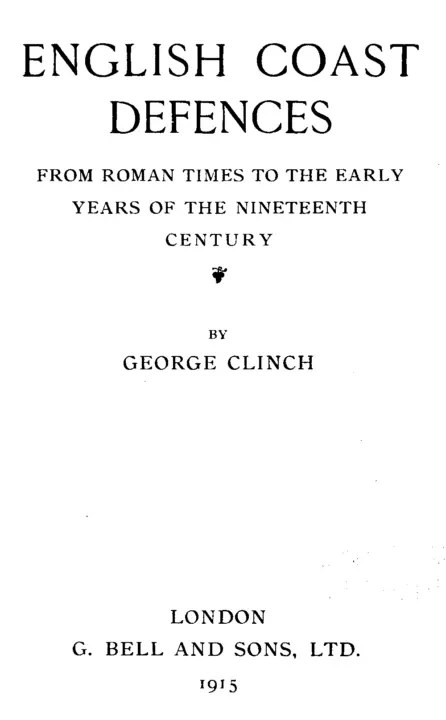
"English Coast Defences" by George Clinch is a historical account written in the early 20th century. The book explores the evolution of England's coastal defenses from Roman times to the early years of the 19th century, detailing how various fortifications and military strategies were employed to protect the nation from invaders across the seas. The opening of the work sets the stage by emphasizing the complex and vulnerable nature of England's coastlines, shaped by its insularity and geographical features. It introduces various prehistoric camps and the Roman invasion, highlighting the significant fortresses constructed by the Romans along the eastern and southern coasts of England. These defenses were pivotal for maintaining control and providing a deterrent against invaders, a theme that the author intends to expand on throughout the book as he delves into the historical methods used to fortify the English coast against foreign threats.
Introduction adapted from the source catalogue; source summaries may be automatically generated.
Free to read · English · 27,373 words · No account needed
MAKE TIME FOR A GOOD BOOK
On by default. Untick to stop anonymous reading totals. Each page counts after 10 seconds in view. How this works.
Anonymous counting is on unless you have switched it off.
Portsmouth, 142-149, 166.
Portsmouth, chain at, 145, 208-209.
Portsmouth, Tower of, 169.
Portus Itius, 5.
Portus Lemanus, 17, 50-58, 77.
Portus Magnus, 62-64.
Prehistoric camps, 3-5.
Queenborough Castle, 116-119.
Reculver, 12, 17, 19, 28-35.
Regulbium, 12, 17, 19, 28-35.
Richborough, 17, 35-42.
Rochester, 70.
Rochester, Anglo-Saxon coins, 77.
Roman forts, 12, 16-71.
Roman invasion, 5-13.
Round, Dr. J. H., 89.
Rutupiae, 17, 35-42.
Rye, 138, 191.
Rye Castle, 166.
Saltwood Castle, 133-138.
Sandgate Castle, 174-177.
Sandown (I. W.) blockhouse, 186.
Sandown (Kent) Castle, 160, 171, 174.
Sandsfort Castle (Weymouth), 187.
Sandwich, 122-127.
Sandwich, Anglo-Saxon coins, 77.
Sandwich, Anglo-Saxon defences at, 78.
Saxon Shore, Count of the, 13-16.
Saxon settlement of England, 75-80.
Scarborough Castle, 101.
Scottish invasions, 99.
Shoebury, Danish camp, 81-83.
Silchester, 76.
Southampton, 149-151.
Southampton Castle, 151.
South Coast, defences of, 182-191.
Southsea Castle, 146, 182-185.
Staithes, 70.
Straits of Dover, 13.
Swale, River, 117.
Swanscombe, Danish settlement at, 82.
Thames Estuary, defences of, 179-180.
Tilbury, bulwark at, 165.
Torne Bay, bulwark at, 165.
Tynemouth Priory and Castle, 100-101.
Upnor Castle, 179-180.
Walled Towns:
Berwick-upon-Tweed, 97-98.
Bristol, 152-153.
Canterbury, 119-122.
Carlisle, 154-156.
Colchester, 111-113.
Dover, 132.
Harwich, 111.
Hastings, 139-141.
Hull, 101-102.
Ipswich, 107-108.
King's Lynn, 102-103.
Lancaster, 153-154.
Portsmouth, 142-149.
Rochester, 117.
Rye, 138.
Sandwich, 122-127.
Southampton, 149-151.
Wareham, 151-152.
Winchester, 138.
Yarmouth (Great), 103-107.
Walmer Castle, 173.
Walmer, early defences of, 161.
Walton, 25.
Wareham Castle, etc., 78, 151-152.
Warkworth Castle, 100.
Welsh castles and walled towns, 153.
Weymouth, or Sandsfort Castle, 187.
White Bulwark, 161.
William, Duke of Normandy, 86.
Winchelsea, 138.
Wolstanbury Camp, Sussex, 5.
Wykeham, William of, 117.
Yarmouth (Great), 103-107.
Yarmouth (Great), boom at, 211.
Yarmouth (Great), chain at, 209.
Yarmouth (Little) Castle, 186-187.
[1] "Commentaries on the Gallic War"
[2] "Their way of fighting-with their chariots is this: first they drive their chariots on all sides, and throw their darts, insomuch that by the very terror of the horses, and noise of the wheels, they often break the ranks of the enemy. When they have forced their way into the midst of the cavalry, they quit their chariots and fight on foot: meanwhile the drivers retire a little from the combat, and place themselves in such a manner as to favour the retreat of their countrymen, should they be overpowered by the enemy. Thus in action they perform the part both of nimble horsemen and stable infantry; and by continual exercise and use have arrived at that expertness, that in the most steep and difficult places they can stop their horses upon a full stretch, turn them which way they please, run along the pole, rest on the harness, and throw themselves back into their chariots with incredible dexterity." ("Comm. on the Gallic War," iv, xxix).
[3] See below, page 61.
[4] "Victoria History of Suffolk," i, 282.
[5] Archaeological Institute, Norwich volume, 1851, pp. 9-16.
[6] "Victoria History of Suffolk," i, 278.
[7] Proceedings, xvi, 422-429.
[8] Vol. xx, pp. 128-136.
[9] Now occupied by the Royal Military Canal constructed as part of the defence against Napoleon's threatened invasion.
[10] Proceedings, xxi, 410.
[11] "Archaeologia," lvii, 335-352.
Your reading position is saved on this browser. Take it to another device with a library code. Reading pages adapt to text, rather than matching a printed edition.
BEHIND THE BOOK
This eBook is for the use of anyone anywhere in the United States and most other parts of the world at no cost and with almost no restrictions whatsoever. You may copy it, give it away or re-use it under the terms of the Project Gutenberg License included with this eBook or online at www.gutenberg.org. If you are not located in the United States, you will have to check the laws of the country where you are located before using this eBook. Read the source licence.
The original source file, including credits and licence, is retained by this library. Request an original-format copy at no charge. Please include the book title and Project Gutenberg identifier #45884.
KEEP YOUR CURIOSITY GOING
Cécile Tormay

Moritz Busch
John L. Ransom
Frances Wright
Cécile Tormay

Mabel Potter Daggett