THE CLASSIC COLLECTION✦An outlaw’s diary: the CommuneCLASSIC FREE BOOKS
An outlaw’s diary: the Commune
Cécile Tormay
THE CLASSIC COLLECTION · 1915
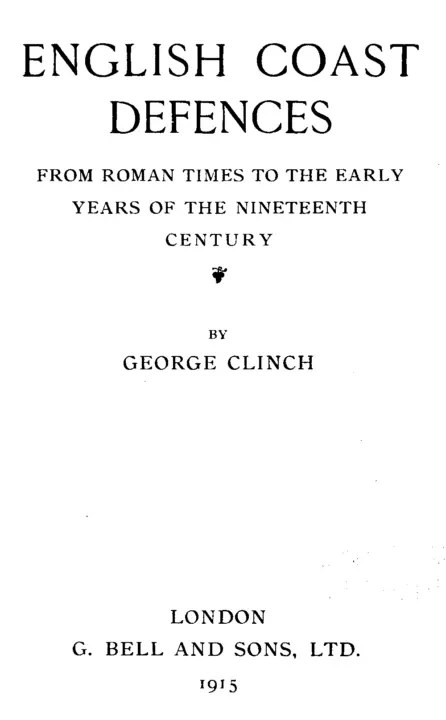
"English Coast Defences" by George Clinch is a historical account written in the early 20th century. The book explores the evolution of England's coastal defenses from Roman times to the early years of the 19th century, detailing how various fortifications and military strategies were employed to protect the nation from invaders across the seas. The opening of the work sets the stage by emphasizing the complex and vulnerable nature of England's coastlines, shaped by its insularity and geographical features. It introduces various prehistoric camps and the Roman invasion, highlighting the significant fortresses constructed by the Romans along the eastern and southern coasts of England. These defenses were pivotal for maintaining control and providing a deterrent against invaders, a theme that the author intends to expand on throughout the book as he delves into the historical methods used to fortify the English coast against foreign threats.
Introduction adapted from the source catalogue; source summaries may be automatically generated.
Free to read · English · 27,373 words · No account needed
MAKE TIME FOR A GOOD BOOK
On by default. Untick to stop anonymous reading totals. Each page counts after 10 seconds in view. How this works.
Anonymous counting is on unless you have switched it off.
From that time downward to the first few years of the nineteenth century there is every indication of decadence. The defences became more and more feeble. The "chain," as a serious bar to the progress of unwelcome shipping, reached its most absurd and ridiculous stage during the time of the Dutch invasion of the Medway in 1667, when the "Chain of Chatham" was snapped without the slightest difficulty by the Dutch ships.
As a matter of fact, as we have seen, the coast blockhouses erected by Henry VIII have never taken any important part in the defence of our coasts. This is mainly due, not to their inefficiency, but to the absence of opportunity. The same is true of the Martello towers erected along our south-eastern coast when invasion from France, under Napoleon I, was anticipated.
History is full of accounts of attempted invasions of England. Up to the period of the Norman Conquest, wellnigh every attempt to land on our shores was eventually, although not always immediately, successful. But from the Norman Conquest downward England has always been strong enough to protect herself from enemies who have attempted to make a permanent settlement. This is due to the fact that whilst we have not neglected our coast defences, we have not relied on castles, forts, and other forms of land defence. We have maintained a powerful fleet of war vessels as our first line of defence. Experience has made it abundantly clear that coast defence without the aid of a powerful navy would be inadequate to protect our shores. Our navy is, and always must be, the first and most important of our defences, and its special business is not to act as a simple coastguard force, but to seek out the enemy's naval force where-ever it may be, and destroy it.
Alfred, King, 79-80.
Anderida, 17, 58-62.
Angles, The, 75.
Anglo-Saxon buildings, 77-78.
Anglo-Saxon burhs, 88-89.
Anglo-Saxon Chronicle, 75, 84-85.
Anglo-Saxon defensive works, 79.
Anglo-Saxon mints, 77.
Appledore, 191.
Arckcliffe Bulwark, 131.
Armitage, Mrs. E. S., 89.
Avon, River (Bristol), 153.
Bamborough Castle, 98-99.
Barbican (Gate), Sandwich, 126-127.
Bayeux tapestry, 89.
Beblowe Fort (Holy Island), 188.
Benfleet, Danish settlement at, 82.
Berwick-upon-Tweed, 97-98.
Black Bulwark, 132, 161.
Booms, 210-211.
Boulogne, 5.
Bradwell-on-Sea, 25-28.
Bramber Castle, 141-142.
Bramber, Danish settlement at, 82.
Brancaster, 17, 19-22.
Branodunum, 17, 19-22.
Breding-Stone, Dover, 201.
Brighton, defences and gates of, 181-182.
British fastnesses, 5.
Broadstairs, 122.
Burgh Castle, 19, 23-25.
Caesar, 5.
Caesar's Camp, 3-5.
Calshot ("Calste Point") Castle, 169-186.
Camber Castle, 119, 177-178.
Camps, prehistoric, 3-5.
Canterbury, 70.
Canterbury, Anglo-Saxon coins, 77.
Canterbury Castle, 119-122.
Carausius, 14.
Cardiff Castle, 67-69.
Carlisle Castle, 154-156.
Carrnase, 70.
Your reading position is saved on this browser. Take it to another device with a library code. Reading pages adapt to text, rather than matching a printed edition.
BEHIND THE BOOK
This eBook is for the use of anyone anywhere in the United States and most other parts of the world at no cost and with almost no restrictions whatsoever. You may copy it, give it away or re-use it under the terms of the Project Gutenberg License included with this eBook or online at www.gutenberg.org. If you are not located in the United States, you will have to check the laws of the country where you are located before using this eBook. Read the source licence.
The original source file, including credits and licence, is retained by this library. Request an original-format copy at no charge. Please include the book title and Project Gutenberg identifier #45884.
KEEP YOUR CURIOSITY GOING
Cécile Tormay

Moritz Busch
John L. Ransom
Frances Wright
Cécile Tormay

Mabel Potter Daggett