THE CLASSIC COLLECTION✦Uncooked foods & how to use themCLASSIC FREE BOOKS
Uncooked foods & how to use them
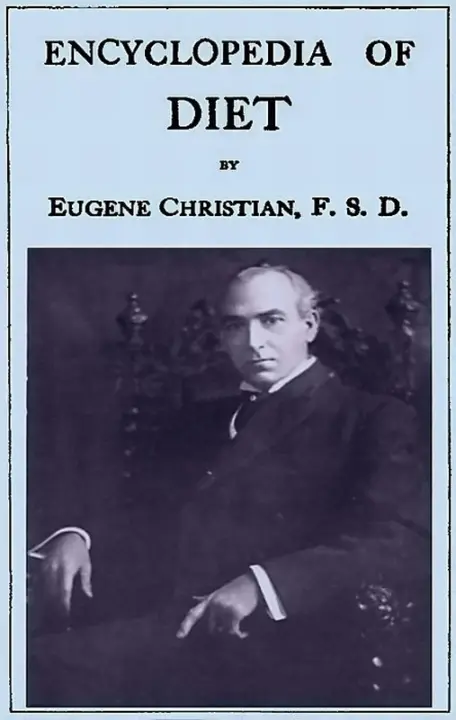
Eugene Christian & Mollie Griswold Christian
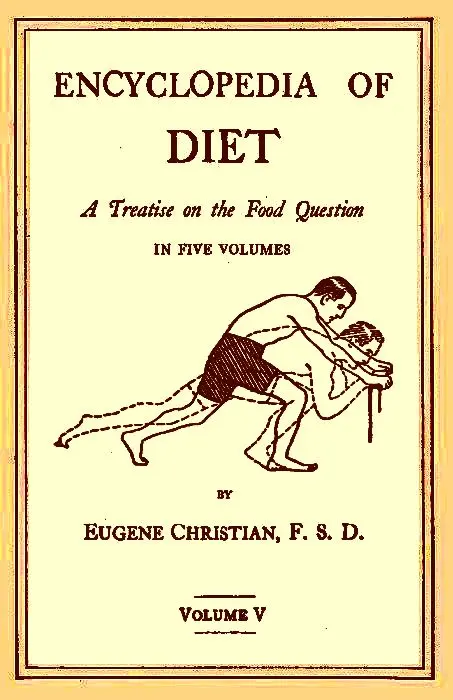
THE CLASSIC COLLECTION · 1914
"Encyclopedia of Diet: A Treatise on the Food Question, Vol. 5" by Eugene Christian is a scientific publication written in the early 20th century. This volume focuses on the principles of diet, specifically addressing how food choices can be tailored to various life stages and conditions, such as infancy, old age, and athleticism. It aims to provide clear guidance for establishing healthy eating practices that promote optimal digestion and assimilation of nutrients, which are vital for maintaining overall health." "At the start of this volume, the text lays the groundwork for understanding the importance of adapting one's diet to unique circumstances, emphasizing the need to consider factors such as age, physical activity, and environmental conditions. It introduces key concepts of selecting foods that balance nutritional needs while avoiding common dietary pitfalls. The author discusses how dietary habits influence health, particularly in relation to age categories ranging from infants to the elderly, making it clear that the work aims to empower readers with knowledge for better nutritional choices."
Introduction adapted from the source catalogue; source summaries may be automatically generated.
Free to read · English · 31,879 words · No account needed
MAKE TIME FOR A GOOD BOOK
On by default. Untick to stop anonymous reading totals. Each page counts after 10 seconds in view. How this works.
Anonymous counting is on unless you have switched it off.
For a person undergoing a reasonable amount of exposure, and working in a climate where the temperature is ranging between 20° and 30° Fahrenheit, the following menus, covering one day, may be suggested:
Immediately on rising, drink a cup of hot water, then take vigorous deep breathing exercises, followed by a cool sponge bath and rub down.
(An hour later)
Add half an ounce of sugar to two or three eggs, and whip five minutes; add a tablespoonful of lemon juice while whipping; mix with this two glasses of rich milk A tablespoonful of nuts One very ripe banana, with cream
One fresh vegetable
Lima or navy beans
A salad, with either olive-oil or nuts
A baked potato or boiled wheat (A liberal supply of butter or
cream)
A baked sweet potato
One or two vegetables
Eggs, or buttermilk, unskimmed
A baked white potato, with either olive-oil or butter
Dates, with cream cheese, or gelatin, with cream
As the temperature becomes lower, the amount of fats and proteids should be increased according to exposure and activity.
The student should bear in mind that carbohydrates, proteids, and fats are the most important factors in the winter dietary. Other articles can be held level over a wide range of temperature, provided these three staple nutrients are taken in the requisite proportions.
[Sidenote: Summer diet requires scientific consideration]
Nearly all people in normal health instinctively avoid heat-producing foods in hot weather, and as in warm or hot climates people live more in the open air, oxidation is therefore more perfect, and has a tendency to aid elimination, so the errors of diet are not so serious. Nevertheless, the food to be taken in hot climates, or the heated term of summer, should receive scientific consideration.
Anthropoid life, of which man is the highest type, originated in the tropics, and nearly everything necessary for his highest physical development grew prodigally in that country. His natural or primitive diet was nuts, fruits, and salads (edible plants).
Civilization has transplanted him in the north, and has laid heavier burdens upon him, therefore he needs, in many instances, heavier and different foods, such as the carbohydrates, proteids, fats, and the albumin and the phosphorus in eggs.
As the temperature becomes warmer, the heat-producing factors, such as fats and carbohydrates (starch and sugar), should be gradually reduced.
The following menus are suitable for the average person, in normal health, between the ages of thirty and sixty, when the temperature is ranging from 70° to 90° Fahrenheit:
Cantaloup, peaches, or berries
Very ripe bananas, with grated nuts and cream
A glass of milk
Your reading position is saved on this browser. Take it to another device with a library code. Reading pages adapt to text, rather than matching a printed edition.
Eugene Christian & Mollie Griswold Christian
Eugene Christian
Eugene Christian
Eugene Christian
BEHIND THE BOOK
This eBook is for the use of anyone anywhere in the United States and most other parts of the world at no cost and with almost no restrictions whatsoever. You may copy it, give it away or re-use it under the terms of the Project Gutenberg License included with this eBook or online at www.gutenberg.org. If you are not located in the United States, you will have to check the laws of the country where you are located before using this eBook. Read the source licence.
The original source file, including credits and licence, is retained by this library. Request an original-format copy at no charge. Please include the book title and Project Gutenberg identifier #50660.
KEEP YOUR CURIOSITY GOING

Charles G. (Charles Griffith) Ross
Hannah Webster Foster

Emily Lawless
Edwin Hamlin Carr

Charles De Lano Hine
Andrew Ure