THE CLASSIC COLLECTION✦Uncooked foods & how to use themCLASSIC FREE BOOKS
Uncooked foods & how to use them
Eugene Christian & Mollie Griswold Christian
THE CLASSIC COLLECTION · 1914
"Encyclopedia of Diet: A Treatise on the Food Question, Vol. 3" by Eugene Christian is a scientific publication written in the early 20th century. The volume focuses on the chemistry of food and the human body, discussing the art of combining foods in ways that promote proper digestion and elimination, with the goal of improving health and addressing digestive disorders. This work is part of a multi-volume series intended to educate readers on nutritional science and optimal dietary practices. The opening portion of the text introduces fundamental concepts regarding food chemistry and its implications for digestion and nutrition. It explores the historical context of cooking, detailing the effects of heat on various food types, including carbohydrates, fats, and proteins. The author emphasizes the significance of understanding these chemical changes and outlines the misconceptions surrounding cooked versus uncooked food. In particular, he lays the groundwork for lessons on food combinations and presents tables that detail harmonious and discordant food pairings. This section sets the stage for a deeper exploration of how dietary choices can influence physical well-being.
Introduction adapted from the source catalogue; source summaries may be automatically generated.
Free to read · English · 25,481 words · No account needed
MAKE TIME FOR A GOOD BOOK
On by default. Untick to stop anonymous reading totals. Each page counts after 10 seconds in view. How this works.
Anonymous counting is on unless you have switched it off.
In order to simplify the making of harmonious combinations, I have grouped the foods whose use I recommend in nine different divisions. A further subdivision of vegetables and fruits might have been made, but this would have increased the number of groups, making them more complicated and less practical.
In order to ascertain the articles with which any special food will combine, the student should turn to the table headed with the desired article of that group. If foods from three groups are to be considered, the student will look for two of them in the first vertical column on the left-hand side of the page, and will then follow across to the vertical column for the third article.
Figure (1) means especially beneficial
Figure (2) means good combinations
Figure (3) means somewhat undesirable
Figure (4) means particularly harmful
(a) "Fats with" figure (1), under the heading Grains, first table, page 609, means that the combination of "fats with grains" would be "especially beneficial."
(b) "Fats and eggs with" figure (2), under the heading Milk, page 609, means that "fats and eggs with milk" make a good combination.
(c) "Fats and milk with" figure (3), page 609, under column headed Nuts, means a "somewhat undesirable" combination.
(d) "Fats and acid fruits with" figure (4), under heading Milk, page 609, means that this combination would be "particularly harmful," etc.
It is impractical to print ready reference tables showing the harmony of more than three articles, but the student can judge this sufficiently well for himself by comparing the respective harmonies of the several foods of the group.
1 Especially beneficial 3 Somewhat undesirable 2 Good combinations 4 Particularly harmful
(Such as Butter, Salad Oils, Cream, etc.)
Acid Sweet
Eggs Milk Nuts Grains Vegetables Fruits Fruits Sugars
Fats with 2 2 3 1 1 2 2 2
Fats and
Eggs with -- 2 3 2 2 2 2 2
Fats and
Milk with 2 -- 3 2 2 4 2 2
Fats and
Nuts with 3 3 -- 2 2 3 3 2
Fats and
Grains with 2 2 2 -- 1 2 2 2
Fats and
Veget. with 2 2 1 1 -- 3 2 2
Fats and acid
fruits with 2 4 2 2 3 -- 2 3
Fats and sweet
fruits with 2 2 2 2 2 3 -- 3
Fats and
Sugars with 2 2 2 2 2 2 3 --
1 Especially beneficial 3 Somewhat undesirable 2 Good combinations 4 Particularly harmful
Acid Sweet
Fats Milk Nuts Grains Vegetables Fruits Fruits Sugars
Eggs with 2 1 3 2 2 2 1 2
Eggs and
Fats with -- 2 3 2 2 2 2 3
Eggs and
Milk with 2 -- 2 1 3 4 1 2
Eggs and
Nuts with 3 2 -- 1 1 1 1 2
Eggs and
Grains with 2 1 1 -- 2 2 2 2
Eggs and
Veget. with 2 2 1 2 -- 3 1 2
Eggs and acid
fruits with 2 4 1 2 3 -- 4 2
Eggs and sweet
fruits with 2 1 1 2 2 2 -- 3
Eggs and
Sugars with 2 2 2 2 2 2 3 --
1 Especially beneficial 3 Somewhat undesirable 2 Good combinations 4 Particularly harmful
(Including skimmed and clabbered milk, buttermilk and fresh cheese)
Acid Sweet
Fats Eggs Nuts Grains Vegetables Fruits Fruits Sugars
Milk with 2 1 2 1 4 4 1 3
Milk and
Fats with -- 2 3 2 2 4 2 2
Milk and
Eggs with 2 -- 2 1 2 4 1 2
Your reading position is saved on this browser. Take it to another device with a library code. Reading pages adapt to text, rather than matching a printed edition.
Eugene Christian & Mollie Griswold Christian
Eugene Christian
Eugene Christian
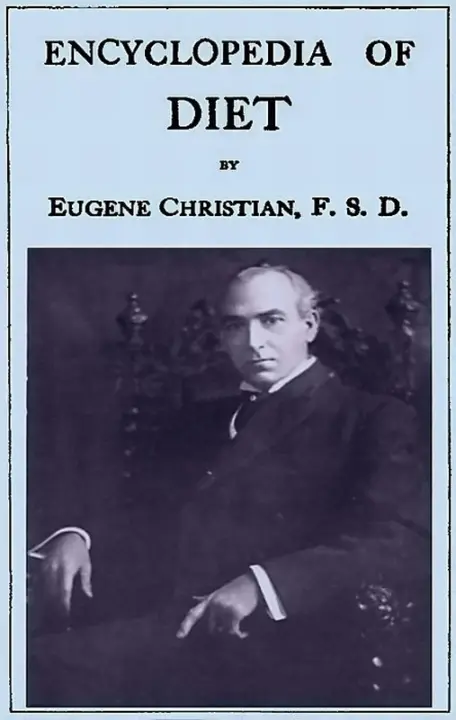
Eugene Christian
BEHIND THE BOOK
This eBook is for the use of anyone anywhere in the United States and most other parts of the world at no cost and with almost no restrictions whatsoever. You may copy it, give it away or re-use it under the terms of the Project Gutenberg License included with this eBook or online at www.gutenberg.org. If you are not located in the United States, you will have to check the laws of the country where you are located before using this eBook. Read the source licence.
The original source file, including credits and licence, is retained by this library. Request an original-format copy at no charge. Please include the book title and Project Gutenberg identifier #50213.
KEEP YOUR CURIOSITY GOING

Charles G. (Charles Griffith) Ross
Hannah Webster Foster

Emily Lawless
Edwin Hamlin Carr

Charles De Lano Hine
Andrew Ure