THE CLASSIC COLLECTION✦Uncooked foods & how to use themCLASSIC FREE BOOKS
Uncooked foods & how to use them
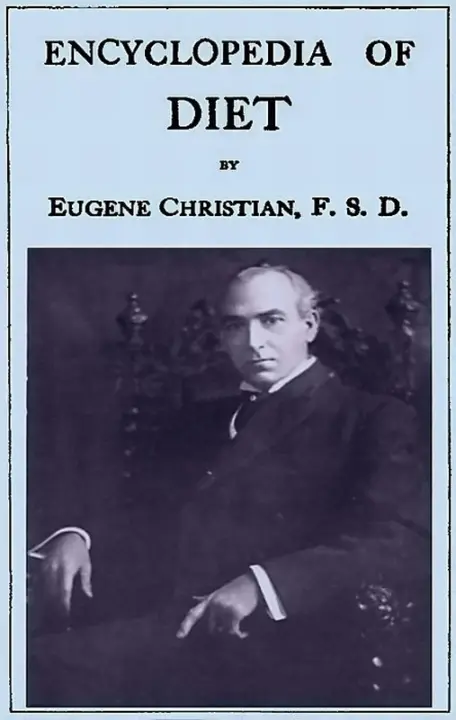
Eugene Christian & Mollie Griswold Christian
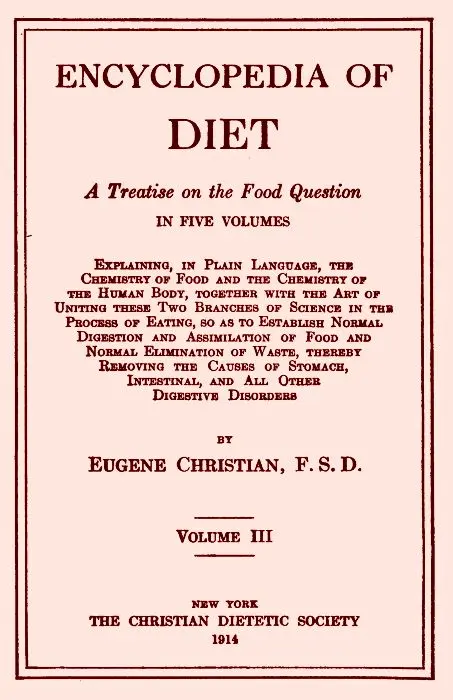
THE CLASSIC COLLECTION · 1914
"Encyclopedia of Diet: A Treatise on the Food Question, Vol. 3" by Eugene Christian is a scientific publication written in the early 20th century. The volume focuses on the chemistry of food and the human body, discussing the art of combining foods in ways that promote proper digestion and elimination, with the goal of improving health and addressing digestive disorders. This work is part of a multi-volume series intended to educate readers on nutritional science and optimal dietary practices. The opening portion of the text introduces fundamental concepts regarding food chemistry and its implications for digestion and nutrition. It explores the historical context of cooking, detailing the effects of heat on various food types, including carbohydrates, fats, and proteins. The author emphasizes the significance of understanding these chemical changes and outlines the misconceptions surrounding cooked versus uncooked food. In particular, he lays the groundwork for lessons on food combinations and presents tables that detail harmonious and discordant food pairings. This section sets the stage for a deeper exploration of how dietary choices can influence physical well-being.
Introduction adapted from the source catalogue; source summaries may be automatically generated.
Free to read · English · 25,481 words · No account needed
MAKE TIME FOR A GOOD BOOK
On by default. Untick to stop anonymous reading totals. Each page counts after 10 seconds in view. How this works.
Anonymous counting is on unless you have switched it off.
Take a spoonful or two of wheat bran and a spoonful of pineapple juice at the close of this meal, either cooked, or in hot water, uncooked.
The above menus are the minimum of food for this condition. The quantity may be increased according to the demands of normal hunger. Hunger, however, should be determined by labor or exercise. Abnormal appetite, caused by supersecretion of acid in the stomach, is very often mistaken for hunger. In such cases, the patient should cease eating before the appetite is satisfied.
In nearly all cases of acute indigestion, food should be omitted. The patient should be given hot water morning, noon, and evening, and, if possible, a stomach tube should be inserted, and the hot water and stomach contents removed. If this cannot be done, the patient should drink copiously of hot water, and vomit as much of it as possible. After the stomach has been cleansed, a cup of coarse wheat bran, or a large bunch of Concord or blue grapes may be given (if they are in season), swallowing skins, seeds, and pulp. Both bran and grapes are preferable to laxative medicines, and much more effective. The high enema should be administered, thus removing the contents of the lower bowels. After the stomach and the bowels have been thoroughly cleansed, if the patient is not able to exercise, artificial manipulation of the abdomen should be administered for a period of half an hour three times a day. These suggestions may be repeated until the patient is relieved, when the diet for chronic indigestion may be followed in rather modified form, omitting the heavier vegetables, and increasing the lighter foods.
Supersecretion of bile by the liver is termed biliousness. This may be expressed by the presence of bile in the stomach, which usually causes headache, beginning at the base of the brain, and after five or six hours settling over the eyes. This is sometimes associated with nausea or sick headache.
Again, the excess of bile is absorbed into the blood, causing the skin to become yellow and spotted, and sometimes it assumes the appearance of jaundice.
Biliousness is caused by taking an excess of sweets, coffee, liquors, fats, and sometimes starches--cereal, bread, etc. The remedy, therefore, is a very simple one, and largely confined to elimination, vigorous exercise, deep breathing, and copious drinking of water.
The following menus are suggestive. The diet may consist of any group of fresh, natural foods which are in season.
Grapefruit, oranges, pineapple, or berries Eggs, whipped, flavored with fruit-juice, and a bit of sugar A banana, baked, or eaten uncooked, if very ripe
Your reading position is saved on this browser. Take it to another device with a library code. Reading pages adapt to text, rather than matching a printed edition.
Eugene Christian & Mollie Griswold Christian
Eugene Christian
Eugene Christian
Eugene Christian
BEHIND THE BOOK
This eBook is for the use of anyone anywhere in the United States and most other parts of the world at no cost and with almost no restrictions whatsoever. You may copy it, give it away or re-use it under the terms of the Project Gutenberg License included with this eBook or online at www.gutenberg.org. If you are not located in the United States, you will have to check the laws of the country where you are located before using this eBook. Read the source licence.
The original source file, including credits and licence, is retained by this library. Request an original-format copy at no charge. Please include the book title and Project Gutenberg identifier #50213.
KEEP YOUR CURIOSITY GOING

Charles G. (Charles Griffith) Ross
Hannah Webster Foster

Emily Lawless
Edwin Hamlin Carr

Charles De Lano Hine
Andrew Ure