THE CLASSIC COLLECTION✦With Zola in England: A Story of ExileCLASSIC FREE BOOKS
With Zola in England: A Story of Exile
Ernest Alfred Vizetelly
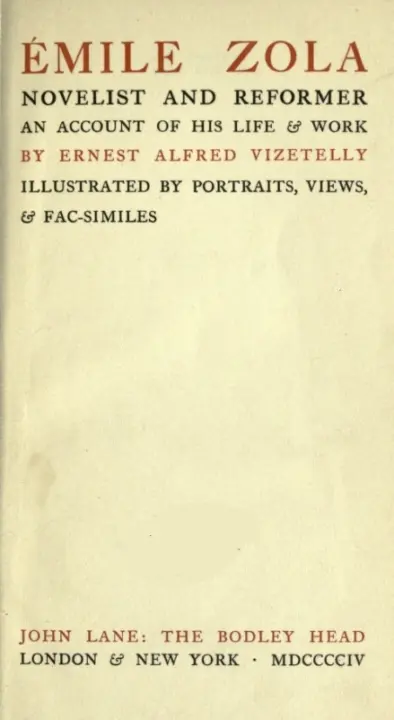
THE CLASSIC COLLECTION · 1904
"Émile Zola, Novelist and Reformer: An Account of His Life & Work" by Ernest Alfred Vizetelly is a biographical account written in the early 20th century. This work delves into the significant life events and achievements of the influential French novelist Émile Zola, highlighting his relentless commitment to social reform and the literary contributions that marked his career. The book aims to provide insights into Zola's motivations and the context in which he worked, revealing how his dual identity as a novelist and a reformer shaped his legacy. At the start of the biography, the author introduces the Zola family background, including François Zola's career as an engineer and the family's struggles, particularly after François's untimely death. It discusses Émile Zola's early childhood in Paris, the influence of his father's engineering ambitions, and hints at the hardships faced by his mother, Françoise Émilie Zola. This beginning sets a tone of familial pride and struggle, establishing the context for the development of Émile Zola's character as a prominent figure in literature and social justice. The narrative talks about his birth, early years, and the environment that nurtured his later motivations as a writer and social critic.
Introduction adapted from the source catalogue; source summaries may be automatically generated.
Free to read · English · 163,641 words · No account needed
MAKE TIME FOR A GOOD BOOK
On by default. Untick to stop anonymous reading totals. Each page counts after 10 seconds in view. How this works.
Anonymous counting is on unless you have switched it off.
The victim of the military and clerical factions had naturally been admitted to view the remains of the man who had so ably championed his cause, and it was also natural that he should desire to attend the funeral. But every effort was now being made to rouse anti-Semitic passions, and Madame Zola dreaded lest the interment should be disturbed by some horrible riot. She therefore begged M. Dreyfus to refrain from attending, pointing out to him that the police authorities, like herself, were of opinion that his presence would give rise to great disturbances. M. Dreyfus was deeply affected by the request; he regarded his attendance at the obsequies as a matter of duty to his defender, and felt that everybody would accuse him of cowardice should he hide himself away. At last Madame Zola's entreaties prevailed, and he consented to do as she desired. The reports of this interview which appeared in the newspapers checked the Nationalist outcry, and on the eve of the funeral, when it had been ascertained that the authorities had decided to take every possible precaution to preserve order, it was felt that the decision with respect to M. Dreyfus might be altered. He was therefore informed that he might attend, and he gladly availed himself of the permission.
The obsequies were celebrated on Sunday, October 5, in the presence of a vast concourse of people. The distance from the Rue de Bruxelles to the place of interment, the Montmartre cemetery, was fortunately short, and to keep the crowd in check the Place Moncey and the Boulevard de Clichy were lined with police and municipal guards. Two squadrons of cavalry were also kept in readiness, though virtually out of sight, one assembling on the Place Vintimille, within a stone's-throw of the Rue de Bruxelles. Access to that street was afforded only to the bearers of special "laissez-passers," the numerous deputations assembling in neighboring thoroughfares and joining the procession on the road. In front of the house in the Rue de Bruxelles a detachment of the Twenty-eighth Infantry of the Line was mustered, under the command of Captain Olivier, an officer who had always believed in the innocence of Dreyfus, and who after refusing to participate in a subscription in honour of the forger Henry had fought a duel with one of the latter's partisans. Three cars bearing a profusion of wreaths, many extremely large,--splendid chrysanthemums of various hues being the predominant flowers,--preceded the hearse, on which a few other wreaths were placed. The drums beat and the soldiers presented arms when the coffin was brought from the house, escorted by the pall-bearers and followed by relatives and intimate friends. The pall-bearers were MM. Ludovic Halévy and Abel Hermant, respectively Presidents of the Société des Auteurs Dramatiques and the Société des Gens de Lettres, MM. Charpentier and Fasquelle, Zola's publishers, M. Théodore Duret, the historian, M. Alfred Bruneau, the composer, M. Octave Mirbeau, the novelist and playwright, who had held Zola's power of attorney during his exile in England, and M. Briat, the secretary of the Labour Exchange. Immediately behind the hearse walked MM. Laborde and Loiseau, relatives of the deceased, M. Fernand Desmoulin and Dr. Larat, intimate friends, followed by M. Anatole France and a few others. Then came Dr. Le Prince and Vizetelly, between whom, with his hands in theirs, was little Jacques.... The representatives of the Government followed. All the state departments were represented, and M. Chaumié, Minister of Public Instruction, attended in person. Then, after a crowd of celebrities in literature, science, art, politics, and law, came innumerable deputations, many of them carrying wreaths and coronals, a cortège of fifty thousand persons, advancing amid the concourse of spectators whom the military and police held back. The order was perfect, all heads were uncovered, all voices stilled. As the hearse passed on, the police saluted, the military presented arms. Again, inside the cemetery, on either hand, all along the Avenue St. Charles, and the Avenue de Montmorency, men of the Garde Républicaine stood at attention and presented arms until the cortège at last halted on an open space, where a tribune had been erected for the funeral orations.
Your reading position is saved on this browser. Take it to another device with a library code. Reading pages adapt to text, rather than matching a printed edition.
Ernest Alfred Vizetelly
Ernest Alfred Vizetelly
BEHIND THE BOOK
This eBook is for the use of anyone anywhere in the United States and most other parts of the world at no cost and with almost no restrictions whatsoever. You may copy it, give it away or re-use it under the terms of the Project Gutenberg License included with this eBook or online at www.gutenberg.org. If you are not located in the United States, you will have to check the laws of the country where you are located before using this eBook. Read the source licence.
The original source file, including credits and licence, is retained by this library. Request an original-format copy at no charge. Please include the book title and Project Gutenberg identifier #57546.
KEEP YOUR CURIOSITY GOING

Charles G. (Charles Griffith) Ross
Hannah Webster Foster

Emily Lawless
Edwin Hamlin Carr

Charles De Lano Hine
Andrew Ure