THE CLASSIC COLLECTION✦With Zola in England: A Story of ExileCLASSIC FREE BOOKS
With Zola in England: A Story of Exile
Ernest Alfred Vizetelly
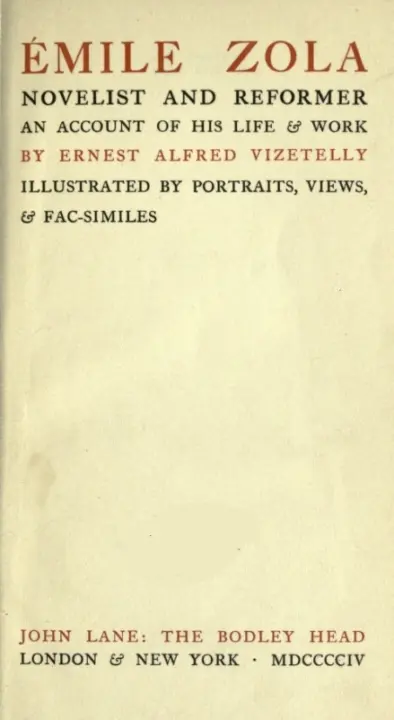
THE CLASSIC COLLECTION · 1904
"Émile Zola, Novelist and Reformer: An Account of His Life & Work" by Ernest Alfred Vizetelly is a biographical account written in the early 20th century. This work delves into the significant life events and achievements of the influential French novelist Émile Zola, highlighting his relentless commitment to social reform and the literary contributions that marked his career. The book aims to provide insights into Zola's motivations and the context in which he worked, revealing how his dual identity as a novelist and a reformer shaped his legacy. At the start of the biography, the author introduces the Zola family background, including François Zola's career as an engineer and the family's struggles, particularly after François's untimely death. It discusses Émile Zola's early childhood in Paris, the influence of his father's engineering ambitions, and hints at the hardships faced by his mother, Françoise Émilie Zola. This beginning sets a tone of familial pride and struggle, establishing the context for the development of Émile Zola's character as a prominent figure in literature and social justice. The narrative talks about his birth, early years, and the environment that nurtured his later motivations as a writer and social critic.
Introduction adapted from the source catalogue; source summaries may be automatically generated.
Free to read · English · 163,641 words · No account needed
MAKE TIME FOR A GOOD BOOK
On by default. Untick to stop anonymous reading totals. Each page counts after 10 seconds in view. How this works.
Anonymous counting is on unless you have switched it off.
"I have never consulted the tastes of the public, and I am too old nowadays to modify my work in order to please it. I am writing these books with a certain purpose before me, a purpose in which the question of form is of secondary importance. I have no intention of trying to amuse people or thrill them with excitement. I am merely placing certain problems before them, and suggesting in some respects certain solutions, showing what I hold to be wrong and what I think would be right. When I have finished these 'Évangiles,' when 'Vérité' and 'Justice' are written, it is quite possible that I shall write shorter and livelier books. Personally I should have everything to gain by doing so, but for the present I am fulfilling a duty which the state of my country imposes on me."
Most of "Travail" was written in 1900, in December of which year it began to appear in "L'Aurore." In April, 1901, it was published as a volume.[2] A little later in the same year, the virulence of the Dreyfus agitation having subsided and public attention being turned to the Assumptionists and other religious orders, in connection with M. Waldeck-Rousseau's Association Bill, the director of the Opéra Comique in Paris thought the moment favourable for the production of a one-act lyrical drama, entitled "L'Ouragan," the prose libretto of which, set to music by M. Bruneau, had been written by Zola some years previously. "L'Ouragan" was not a particularly ambitious work and the moderate success it achieved was perhaps all that could have been expected for it.
After the production of that piece Zola began to consider the subject of his next book, "Vérité," which gave him no little trouble. It seems likely that when he first planned his series he had thought of showing in this particular volume that scientific truth, and not the assertions, delusions, and errors of religious systems, should be taken as the guiding principle of life. But the Dreyfus case, which had intruded into a few pages of "Travail," haunted him. He knew that it had supplied one of the most shocking exhibitions of mendacity that the world had ever witnessed; and it followed that "Vérité" ought not merely to inculcate a belief in scientific truth. It also ought to recall people to the practice of truthfulness in their every-day life. Thus Zola's subject expanded. He had always intended to show the evil effects of the training given to children in certain so-called religious schools, where, according to his view, their minds were perverted, deprived of all self-reliance by the intrusion of the supernatural. But the Dreyfus case had shown him there was more than that. The mendacity so current throughout the period of the Affair had come almost entirely from men trained by the Roman Church. Moreover that Church's share in the Affair, its hostility and its intrigues against the Republic under cover of the anti-Semitic agitation, were now every day more apparent. Zola had repeatedly declared that he would write no novel on the Dreyfus case, for he did not wish anybody to say that he had earned a single sou, directly or indirectly, by the Affair. But it was ever beside him, with its influence, its revelations, its lessons. And it seemed to him fit that everybody should understand that in one way and another such turmoil, frenzy, and mendacity would never have been possible if it had not been for the Roman Church. The case haunting him more and more, he gradually yielded to the obsession, resolving, however, to cast the military men on one side, for after all they had only been agents, in some degree the victims of their training. In lieu of them he would depict those whom he regarded as the real culprits. It had been settled that the book should deal with school life; and it would be easy to adapt a kind of Dreyfus case to such surroundings. A Jewish schoolmaster might be substituted for a Jewish officer, while as for the crime which it would be necessary to impute to him, there had been a terrible affair at Lille, not long previously, the murder of a little boy, in which a certain Brother Flamidien--who was spirited away by his colleagues--had been implicated. Some such brother would represent Esterhazy in Zola's work, Dreyfus being represented by Simon, the Jewish schoolmaster.
Your reading position is saved on this browser. Take it to another device with a library code. Reading pages adapt to text, rather than matching a printed edition.
Ernest Alfred Vizetelly
Ernest Alfred Vizetelly
BEHIND THE BOOK
This eBook is for the use of anyone anywhere in the United States and most other parts of the world at no cost and with almost no restrictions whatsoever. You may copy it, give it away or re-use it under the terms of the Project Gutenberg License included with this eBook or online at www.gutenberg.org. If you are not located in the United States, you will have to check the laws of the country where you are located before using this eBook. Read the source licence.
The original source file, including credits and licence, is retained by this library. Request an original-format copy at no charge. Please include the book title and Project Gutenberg identifier #57546.
KEEP YOUR CURIOSITY GOING

Charles G. (Charles Griffith) Ross
Hannah Webster Foster

Emily Lawless
Edwin Hamlin Carr

Charles De Lano Hine
Andrew Ure