THE CLASSIC COLLECTION✦With Zola in England: A Story of ExileCLASSIC FREE BOOKS
With Zola in England: A Story of Exile
Ernest Alfred Vizetelly
THE CLASSIC COLLECTION · 1904
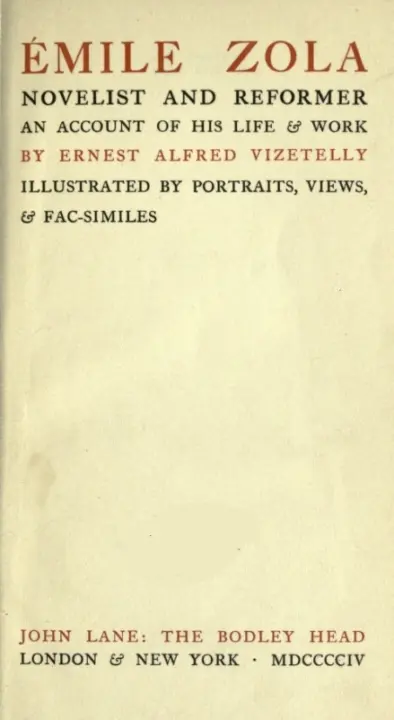
"Émile Zola, Novelist and Reformer: An Account of His Life & Work" by Ernest Alfred Vizetelly is a biographical account written in the early 20th century. This work delves into the significant life events and achievements of the influential French novelist Émile Zola, highlighting his relentless commitment to social reform and the literary contributions that marked his career. The book aims to provide insights into Zola's motivations and the context in which he worked, revealing how his dual identity as a novelist and a reformer shaped his legacy. At the start of the biography, the author introduces the Zola family background, including François Zola's career as an engineer and the family's struggles, particularly after François's untimely death. It discusses Émile Zola's early childhood in Paris, the influence of his father's engineering ambitions, and hints at the hardships faced by his mother, Françoise Émilie Zola. This beginning sets a tone of familial pride and struggle, establishing the context for the development of Émile Zola's character as a prominent figure in literature and social justice. The narrative talks about his birth, early years, and the environment that nurtured his later motivations as a writer and social critic.
Introduction adapted from the source catalogue; source summaries may be automatically generated.
Free to read · English · 163,641 words · No account needed
MAKE TIME FOR A GOOD BOOK
On by default. Untick to stop anonymous reading totals. Each page counts after 10 seconds in view. How this works.
Anonymous counting is on unless you have switched it off.
At the suit of Zola and his fellow-defendant nearly a hundred witnesses--ministers, officers, deputies, senators, diplomatists, authors, journalists, handwriting experts, and others--were summoned to appear at the approaching trial; but great efforts were made to prevent many from attending. Directly the jury-roll was issued, the names and addresses of those who might have to pronounce on the case were published by "Le Petit Journal" and other scurrilous prints; and numerous threatening letters were sent to these men, intimating that vengeance would follow if they should dare to acquit "the Italian." Moreover the Nationalist and Clerical leaders prepared for demonstrations on a large scale. A kind of employment office was established on the boulevards, where hirelings were engaged at the rate of five francs a day or two francs an evening to shout "Vive l'armée," "À bas les Juifs," and "Conspuez Zola!" These men met with little or no interference from the authorities, who contented themselves with massing police and municipal guards in and around the Palais de Justice.
The trial began on February 7. The Assize Court was crowded, Nationalists and anti-Semites preponderating among the audience. There were fifteen sittings altogether, the last being held on February 23. The presiding judge, M. Delegorgue,[19] did his utmost to prevent the witnesses from giving evidence respecting the Dreyfus case; and again and again, when Maître Labori wished to ask a question, Delegorgue snappishly exclaimed: "The question shall not be put!" Nevertheless the judge could not prevent the witnesses and Labori from establishing a number of facts--among others the illegality of Dreyfus's condemnation, the insignificance of the evidence upon which he had been officially condemned, the error committed by the military judges in respect of the bordereau, and the certainty that it was Esterhazy's work. The evidence was, indeed, of such immense significance that the General Staff thought it necessary to strike a decisive blow. General de Pellieux gave the jury a summary of a forged correspondence between Colonels von Schwarzkoppen and Panizzardi, the former German and Italian military attachés, this correspondence, in which Dreyfus was mentioned, having been manufactured by a certain Lemercier-Picard with the knowledge of the notorious Colonel Henry. General de Boisdeffre, however, virtually certified its authenticity, and at the same time threatened the jury with the resignation of the whole General Staff if Zola were acquitted. Then Colonel Henry and Major Lauth accused Picquart of having asserted Dreyfus's innocence without knowledge of the papers in the case, and of having invented one of them in order to ruin Esterhazy. Maître Labori was not allowed to question the generals, or answer them. Great indignation was expressed when Picquart had the courage to say that a Panizzardi-Schwarzkoppen letter mentioned by General de Pellieux was a forgery. Yet not only was such the case, but some weeks previously the forgery had been revealed to the embassies of Italy and Germany, most probably by Lemercier-Picard, the forger himself. Count Tornielli and Count Münster in their turn had revealed it to M. Hanotaux, the French Foreign Minister, demanding his word of honour that no use should be made of it. M. Hanotaux communicated this revelation to his colleagues, and even sent a written note about it to the Ministry of War. It has been said, too, that on the day after General de Pellieux's deposition M. Hanotaux proposed to suspend the proceedings in Zola's trial in order to look for and prosecute the forgers, but that his fellow-ministers hesitated from fear of a military movement. Anyhow, the episode ended disastrously for Lemercier-Picard. On March 3 he was found hanging in his room, his feet dangling on the floor. All his papers had disappeared before the police came to take possession of the corpse. Yet, according to the authorities, it was a case of suicide![20] The trial was full of stirring episodes. The Nationalists who crowded the court vented their passions freely, shouting, jeering, and groaning at almost everybody who expressed any view favourable to Dreyfus or derogatory to the swaggering, gold-laced officers, who when questioned either refused to answer or perjured themselves with the audacity of men confident of impunity. Zola, who was insulted day after day, put a brave face on it all, and only on a few occasions did he give utterance to his disgust, protesting against the manner in which he was mobbed in the streets, and against the denial of justice which he encountered in court, where he claimed the same liberty to defend himself as was accorded to thieves and assassins. At one sitting, when General de Pellieux made a slighting remark, the novelist turned on him haughtily: "There are several ways of serving France," said he. "A man may do so with the sword or with the pen. If you have won victories, so have I. I bequeath the name of Émile Zola to posterity, which will choose between us!" De Pellieux made no retort to those proud words. In that hour of mendacious triumph he did not foresee the day when he would be virtually disgraced, consigned to an obscure garrison in Brittany, to die there, tortured, as we know, by the deepest remorse. Again, at one moment towards the close of the trial, when the storm of execration thundered more loudly than usual in Zola's ears, the novelist turned towards the bellowers, and with one word branded them: "You cannibals!" he cried, "you cannibals!"
Your reading position is saved on this browser. Take it to another device with a library code. Reading pages adapt to text, rather than matching a printed edition.
Ernest Alfred Vizetelly
Ernest Alfred Vizetelly
BEHIND THE BOOK
This eBook is for the use of anyone anywhere in the United States and most other parts of the world at no cost and with almost no restrictions whatsoever. You may copy it, give it away or re-use it under the terms of the Project Gutenberg License included with this eBook or online at www.gutenberg.org. If you are not located in the United States, you will have to check the laws of the country where you are located before using this eBook. Read the source licence.
The original source file, including credits and licence, is retained by this library. Request an original-format copy at no charge. Please include the book title and Project Gutenberg identifier #57546.
KEEP YOUR CURIOSITY GOING

Charles G. (Charles Griffith) Ross
Hannah Webster Foster

Emily Lawless
Edwin Hamlin Carr

Charles De Lano Hine
Andrew Ure