THE CLASSIC COLLECTION✦With Zola in England: A Story of ExileCLASSIC FREE BOOKS
With Zola in England: A Story of Exile
Ernest Alfred Vizetelly
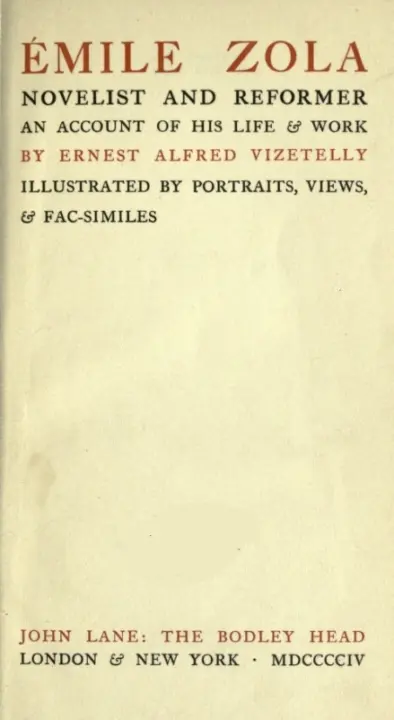
THE CLASSIC COLLECTION · 1904
"Émile Zola, Novelist and Reformer: An Account of His Life & Work" by Ernest Alfred Vizetelly is a biographical account written in the early 20th century. This work delves into the significant life events and achievements of the influential French novelist Émile Zola, highlighting his relentless commitment to social reform and the literary contributions that marked his career. The book aims to provide insights into Zola's motivations and the context in which he worked, revealing how his dual identity as a novelist and a reformer shaped his legacy. At the start of the biography, the author introduces the Zola family background, including François Zola's career as an engineer and the family's struggles, particularly after François's untimely death. It discusses Émile Zola's early childhood in Paris, the influence of his father's engineering ambitions, and hints at the hardships faced by his mother, Françoise Émilie Zola. This beginning sets a tone of familial pride and struggle, establishing the context for the development of Émile Zola's character as a prominent figure in literature and social justice. The narrative talks about his birth, early years, and the environment that nurtured his later motivations as a writer and social critic.
Introduction adapted from the source catalogue; source summaries may be automatically generated.
Free to read · English · 163,641 words · No account needed
MAKE TIME FOR A GOOD BOOK
On by default. Untick to stop anonymous reading totals. Each page counts after 10 seconds in view. How this works.
Anonymous counting is on unless you have switched it off.
There is not space here to pass all the Rougon-Macquart volumes in review from a critical point of view. One may say, however, that generally, though not invariably, those dealing with a multiplicity of characters are superior to those in which Zola analyses the feelings and actions of a few. It is acknowledged he excelled in portraying the "crowd." Structural faults are to be found in various volumes. For instance, the long idyll of Silvère and Miette interrupts the narrative of "La Fortune des Rougon" unduly; and the poetical Paradou portion of "La Faute de l'Abbé Mouret" is hardly compatible with the realism of the opening and concluding chapters. Then "Le Rêve" is almost out of place in the series, for though the Naturalist writer must take account of the dreamy aspirations and imaginings of certain hearts and minds, it is perhaps excessive to picture those dreams fulfilled in actual happenings. Again, there is some artificiality in "Une Page d'Amour." Innumerable as are the love intrigues in French society one may well doubt if an analysis of any would yield the psychology of Zola's work. "La Curée," on the other hand, within the limitations imposed on the author by circumstances and personal knowledge, is a sound piece of work, quite irrespective of the poetical intentions which some critics have ascribed to it. Passing to such volumes as "La Conquête de Plassans," "Le Ventre de Paris," and "Son Excellence," one finds that though they may be minor works they are very near to life and historical truth. Then "Nana," a great book from the social standpoint, is almost one in the literary sense also. But while freely admitting the greatness of "L'Assommoir" and "Germinal," the volume which particularly appeals to the present writer is "Le Docteur Pascal," perhaps because Zola therein expounds and defends his theory of life. The love of uncle and niece, pictured in this book, may offend the feelings of English and American Protestants, but they ought to remember that in Catholic countries marriages often take place between people connected by that tie of relationship. The writer, for his part, has nothing whatever to say against them from the moral standpoint; he deprecates them, even as he deprecates all marriages between relations, on physiological grounds. But the affections bow neither to legal enactments nor to scientific rules; love, as we are all aware, has no master; and if, therefore, one accept the position of Dr. Pascal and his niece Clotilde, Zola's work will be found one of absorbing interest for the thinking mind. True, it is disfigured by an error which the reader must set aside: the death of the old drunkard Macquart by spontaneous combustion, for scientists have declared such a death to be impossible. Zola, however, long before writing "Le Docteur Pascal," had found a case of the kind recorded in a scientific work; and for years, as several of his letters and utterances show, he had nursed the idea of bringing it into his final volume. Nobody then warned him of his error, but directly his book appeared several scientists protested that, whatever might be the effects of alcoholism, it could not lead to a death like Macquart's. That episode, then, must be dismissed, but the bulk of the book remains, with its terrible lessons, its pages of vivid and merciless analysis, its pictures of the evils of life relieved by a glowing faith in nature's power for good, an optimism which nothing dismays, which points to the dawn of a brighter day for humanity, whatever may be its present condition. And from the purely literary standpoint "Le Docteur Pascal" is admirable. Its style is perfect. The descriptive and the analytical passages are replete with beauty, depth, and force of expression. Poetry is here so thoroughly welded with prose that one cannot object to it as one may in some other volumes, such, for instance, as "Une Page d'Amour," where it seems merely a beautiful excrescence. The psychology of the characters in "Le Docteur Pascal" is also good. In point of fact, no doubt, this was a long meditated work. Almost from the time when Zola began his series--at least as soon as the Empire had fallen--he pictured the finale ahead of him, he thought of it during all the years when he was writing the intervening volumes, he gradually planned and perfected it in his mind long before he actually wrote it. It is not a book for the vulgar, who come and go, heedless of the problems, possibilities, and purposes of life; but though the love of Pascal and Clotilde may offend moral prejudices, though from the standpoint of scientific accuracy the narrative may be disfigured by the error of Macquart's death, we hold this to be the noblest, the most convincing, the most consoling book that Zola ever wrote. Such an opinion, however, may not find much acceptance in England and America where the bias in favour of revealed religion is so strong.
Your reading position is saved on this browser. Take it to another device with a library code. Reading pages adapt to text, rather than matching a printed edition.
Ernest Alfred Vizetelly
Ernest Alfred Vizetelly
BEHIND THE BOOK
This eBook is for the use of anyone anywhere in the United States and most other parts of the world at no cost and with almost no restrictions whatsoever. You may copy it, give it away or re-use it under the terms of the Project Gutenberg License included with this eBook or online at www.gutenberg.org. If you are not located in the United States, you will have to check the laws of the country where you are located before using this eBook. Read the source licence.
The original source file, including credits and licence, is retained by this library. Request an original-format copy at no charge. Please include the book title and Project Gutenberg identifier #57546.
KEEP YOUR CURIOSITY GOING

Charles G. (Charles Griffith) Ross
Hannah Webster Foster

Emily Lawless
Edwin Hamlin Carr

Charles De Lano Hine
Andrew Ure