THE CLASSIC COLLECTION✦With Zola in England: A Story of ExileCLASSIC FREE BOOKS
With Zola in England: A Story of Exile
Ernest Alfred Vizetelly
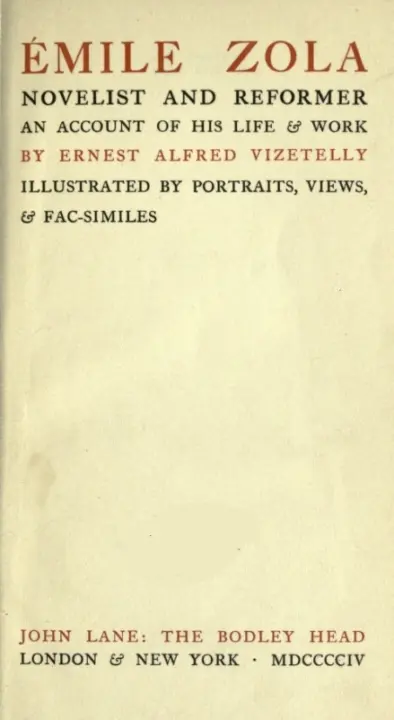
THE CLASSIC COLLECTION · 1904
"Émile Zola, Novelist and Reformer: An Account of His Life & Work" by Ernest Alfred Vizetelly is a biographical account written in the early 20th century. This work delves into the significant life events and achievements of the influential French novelist Émile Zola, highlighting his relentless commitment to social reform and the literary contributions that marked his career. The book aims to provide insights into Zola's motivations and the context in which he worked, revealing how his dual identity as a novelist and a reformer shaped his legacy. At the start of the biography, the author introduces the Zola family background, including François Zola's career as an engineer and the family's struggles, particularly after François's untimely death. It discusses Émile Zola's early childhood in Paris, the influence of his father's engineering ambitions, and hints at the hardships faced by his mother, Françoise Émilie Zola. This beginning sets a tone of familial pride and struggle, establishing the context for the development of Émile Zola's character as a prominent figure in literature and social justice. The narrative talks about his birth, early years, and the environment that nurtured his later motivations as a writer and social critic.
Introduction adapted from the source catalogue; source summaries may be automatically generated.
Free to read · English · 163,641 words · No account needed
MAKE TIME FOR A GOOD BOOK
On by default. Untick to stop anonymous reading totals. Each page counts after 10 seconds in view. How this works.
Anonymous counting is on unless you have switched it off.
Such, then, is Zola's great series: one work in twenty volumes, in whose pages appear twelve hundred human characters besides many others, such as La Lison, the engine which Jacques Lantier worships and which seems to be endowed with life; such, too, as old Bonhomme, Pascal's horse; Bataille and Trompette, the horses of the coal-pit; Zephyr, who falls in the great cavalry charge at Sedan; Mathieu and Bertrand, the two big dogs; Pologne, the unlucky rabbit; Minouche, the egotistical cat; Gédéon, the comical donkey who gets drunk in the vintage scene of "La Terre"; César, the great bull at La Borderie; La Coliche and her calves; Mathieu, Désirée's pig; Alexandre, her big lusty rooster, and a score of others. Zola always loved animals; he put them into his books, and they entered largely into his life. As for the human characters of his great series these are of all classes, all kinds. Napoleon III appears in various volumes, at the Tuileries, at Compiègne, at St. Cloud, and again and again during the war of 1870. The Empress is seen also, like the Duke de Morny and other high personages of state. Members of one and another aristocracy, politicians and functionaries, judges and lawyers, medical men and other scientists, bishops and priests, generals and soldiers, company promoters, speculators and shareholders, schoolmasters and revolutionaries, bourgeois of Paris and the provinces, artists and shopkeepers, street hawkers, peasants and miners, workmen of innumerable callings, pass across Zola's stage. The reader enters the homes of all those classes; he goes from the palace to the hovel, from the dancing-hall to the coal-pit, from the cathedral to the boozing-ken, from the artist's studio to the Chamber of Deputies, from the great drapery shop to the harlot's boudoir; he sees Paris, her boulevards, her slums, her promenades, her theatres, her quays, under twenty different aspects, at dawn, at noon, at night, in shine and rain and snow; he travels to the rocky shore of a boisterous and predatory sea; he finds fairyland in the magic garden of the Paradou, he roams the bleak coal country of the north; he is buffeted by the mistral and scorched by the blazing sun of Provence; he gazes on La Beauce, an ocean of waving corn, and on the battlefield of Sedan, strewn with the dead and dying. Religion, politics, sociology, art, science, trade, agriculture, military affairs, life's characteristics, duties, functions, errors and aims, love, marriage, eating, drinking, and a hundred other matters are discussed before him. Beautiful friendships, confiding loves, ardent passions, terrible jealousies and rivalries, lofty aspirations, horrid lusts, generous sacrifices, deeds of bravery and virtue, cruelty and vengeance, greed, craft, and cowardice,--in a word, both the nobility and the mire of life in turn confront one, in such wise that this Rougon-Macquart series is like a miniature world.
Your reading position is saved on this browser. Take it to another device with a library code. Reading pages adapt to text, rather than matching a printed edition.
Ernest Alfred Vizetelly
Ernest Alfred Vizetelly
BEHIND THE BOOK
This eBook is for the use of anyone anywhere in the United States and most other parts of the world at no cost and with almost no restrictions whatsoever. You may copy it, give it away or re-use it under the terms of the Project Gutenberg License included with this eBook or online at www.gutenberg.org. If you are not located in the United States, you will have to check the laws of the country where you are located before using this eBook. Read the source licence.
The original source file, including credits and licence, is retained by this library. Request an original-format copy at no charge. Please include the book title and Project Gutenberg identifier #57546.
KEEP YOUR CURIOSITY GOING

Charles G. (Charles Griffith) Ross
Hannah Webster Foster

Emily Lawless
Edwin Hamlin Carr

Charles De Lano Hine
Andrew Ure