THE CLASSIC COLLECTION✦With Zola in England: A Story of ExileCLASSIC FREE BOOKS
With Zola in England: A Story of Exile
Ernest Alfred Vizetelly
THE CLASSIC COLLECTION · 1904
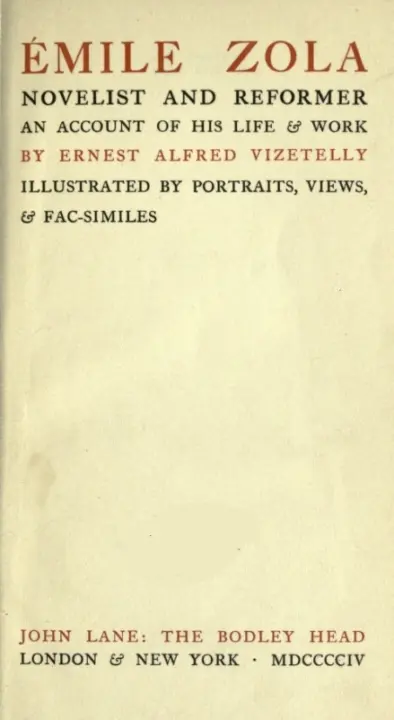
"Émile Zola, Novelist and Reformer: An Account of His Life & Work" by Ernest Alfred Vizetelly is a biographical account written in the early 20th century. This work delves into the significant life events and achievements of the influential French novelist Émile Zola, highlighting his relentless commitment to social reform and the literary contributions that marked his career. The book aims to provide insights into Zola's motivations and the context in which he worked, revealing how his dual identity as a novelist and a reformer shaped his legacy. At the start of the biography, the author introduces the Zola family background, including François Zola's career as an engineer and the family's struggles, particularly after François's untimely death. It discusses Émile Zola's early childhood in Paris, the influence of his father's engineering ambitions, and hints at the hardships faced by his mother, Françoise Émilie Zola. This beginning sets a tone of familial pride and struggle, establishing the context for the development of Émile Zola's character as a prominent figure in literature and social justice. The narrative talks about his birth, early years, and the environment that nurtured his later motivations as a writer and social critic.
Introduction adapted from the source catalogue; source summaries may be automatically generated.
Free to read · English · 163,641 words · No account needed
MAKE TIME FOR A GOOD BOOK
On by default. Untick to stop anonymous reading totals. Each page counts after 10 seconds in view. How this works.
Anonymous counting is on unless you have switched it off.
[2] His play "Madeleine" (originally called "La Madeleine") which he had vainly offered to the Gymnase and Vaudeville theatres in 1866, and which he had afterwards turned into a novel, "Madeleine Férat" (see ante, pp. 99 and 107) was produced with indifferent success at the Théâtre Libre in 1889--first performance, May 2.
[3] The writer believes it is called the Schveninger cure.
[4] About $600.
[5] "Le Rêve," Paris, Charpentier, 1893, 18mo, 310 pages. Some copies on Dutch, India, and Japanese papers. Eighty-eighth thousand in 1893; one hundred and sixteenth thousand in 1903. Illustrated edition: Flammarion, 1888, 4to; illustrations by Carlos Schwob and Métivet; one hundred and fifty copies on Dutch paper. Was sold in parts at 10 centimes. Jeanniot had illustrated the story in "La Revue Illustrée," which paid Zola one thousand pounds for the serial rights.
[6] First performed at the Opéra Comique, June 18, 1891.
[7] M. Eugène Fasquelle had now acquired an interest in M. Charpentier's publishing business, which he ultimately purchased.
[8] This was the result of having rid himself of his obesity.
[9] The allusion is to the house in the Rue de Bruxelles (21 bis), which Zola made his Paris home until his death.
[10] In his later years Zola kept Christmas and New Year's Day at Médan, and then usually had a house-party there.
[11] "La Bête Humaine," Paris, Charpentier, 1890, 18mo, 419 pages. Some copies on Dutch, India, and Japanese papers. Eighty-eighth thousand in 1893; ninety-ninth thousand in 1903.
[12] It is notorious that Taine, who led a section of the Academicians, that of the "university men," opposed Zola because he used vulgar and even slang words in some of his writings. Taine, moreover, was in full sympathy with the aristocratic element in the Academy with respect to its endeavours to make the institution a kind of deadly-lively social club.
[13] At subsequent elections he was defeated by Pierre Loti, Henri de Bornier, Thureau-Dangin, Ferdinand Brunetière, etc.
[14] "L'Argent," Charpentier, 1891, 18mo, 451 pages. Some copies on Dutch, India, and Japanese papers; eighty-third thousand in 1893; eighty-ninth thousand in 1903.
[15] "Journal des Goncourt," Vol. VIII, p. 141.
[16] Towards the close of the summer he allowed himself a holiday and repaired to the Pyrenees with his wife. It was then (September) that he first visited Lourdes and was struck by the sight of the pilgrimages. It immediately occurred to him that they would supply a good subject for a book, and to study them more closely he returned to Lourdes in the summer of 1892.
[17] The writer must admit that he has seen neither, but he has found one catalogued under the names of M. Claretie, the other under that of M. Camille Etievant. Both had appeared before 1885. It is of course possible that Zola had never heard of them.
Your reading position is saved on this browser. Take it to another device with a library code. Reading pages adapt to text, rather than matching a printed edition.
Ernest Alfred Vizetelly
Ernest Alfred Vizetelly
BEHIND THE BOOK
This eBook is for the use of anyone anywhere in the United States and most other parts of the world at no cost and with almost no restrictions whatsoever. You may copy it, give it away or re-use it under the terms of the Project Gutenberg License included with this eBook or online at www.gutenberg.org. If you are not located in the United States, you will have to check the laws of the country where you are located before using this eBook. Read the source licence.
The original source file, including credits and licence, is retained by this library. Request an original-format copy at no charge. Please include the book title and Project Gutenberg identifier #57546.
KEEP YOUR CURIOSITY GOING

Charles G. (Charles Griffith) Ross
Hannah Webster Foster

Emily Lawless
Edwin Hamlin Carr

Charles De Lano Hine
Andrew Ure