Arrowsmith
Sinclair Lewis
THE CLASSIC COLLECTION · 1927
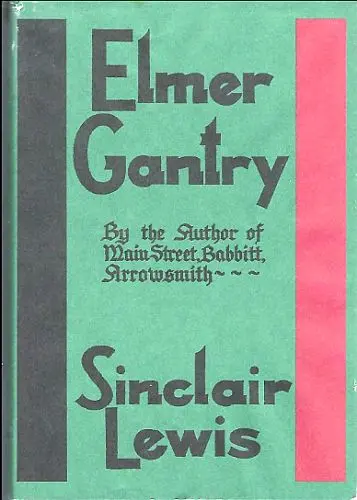
"Elmer Gantry" by Sinclair Lewis is a satirical novel published in 1927. It follows a charismatic but morally corrupt preacher who rises through American evangelical and fundamentalist circles despite his hypocrisy, womanizing, and thirst for power. As Gantry climbs from small fringe churches to become a major force in the Methodist Church, his manipulations and scandals destroy lives around him while he barely escapes ruin himself. The novel offers a biting critique of 1920s religious culture and created enormous controversy upon publication.
Introduction adapted from the source catalogue; source summaries may be automatically generated.
Free to read · English · 157,003 words · No account needed
MAKE TIME FOR A GOOD BOOK
On by default. Untick to stop anonymous reading totals. Each page counts after 10 seconds in view. How this works.
Anonymous counting is on unless you have switched it off.
Patiently, trying to puzzle it out, she sat beside him and pleaded, “I don’t know what I’ve done. I just don’t know. Won’t you please—oh, please explain, and give me a chance to make up for it!”
“Oh, hell!” He sprang up, hat in hand, groping for his overcoat. “If you can’t understand, I can’t waste my time explaining!” And was gone, relieved but not altogether proud.
But by Tuesday he admired himself for his resolution.
Tuesday evening came her apology; not a very good note, blurry, doubtful of spelling, and, as she had no notion what she was apologizing about, not very lucid.
He did not answer it.
During his sermon the next Sunday she looked up at him waiting to smile, but he took care not to catch her eye.
While he was voluminously explaining the crime of Nadab and Abihu in putting strange fire in their censers, he was thinking with self-admiration, “Poor little thing. I’m sorry for her. I really am.”
He saw that she was loitering at the door, behind her parents, after the service, but he left half his congregation unhandshaken and unshriven, muttered to Deacon Bains, “Sorry gotta hurry ’way,” and fled toward the railroad tracks.
“If you’re going to act this way and deliberately persecute me,” he raged, “I’ll just have to have a good talk with you, my fine young lady!”
He waited, this new Tuesday, for another note of apology. There was none, but on Thursday, when he was most innocently having a vanilla milk-shake at Bombery’s Drug Store, near the seminary, when he felt ever so good and benign and manly, with his Missions theme all finished and two fine five-cent cigars in his pocket, he saw her standing outside peering in at him.
He was alarmed. She looked not quite sane.
“Suppose she’s told her father!” he groaned.
He hated her.
He swaggered out gallantly, and he did most magniloquently the proper delight at encountering her here in town.
“Well, well, well, Lulu, this is a pleasant surprise! And where’s
Papa?”
“He and Ma are up in the doctor’s office—about Ma’s earache. I said I’d meet them at the Boston Bazaar. Elmer!” Her voice was like stretched quivering wire. “I’ve got to talk to you! You’ve got to—— Walk down the street with me.”
He saw that she had tried to rouge her cheeks. It was not customary in rural Midwest in 1906. She had done it badly.
Your reading position is saved on this browser. Take it to another device with a library code. Reading pages adapt to text, rather than matching a printed edition.
Sinclair Lewis
Sinclair Lewis
Sinclair Lewis
Sinclair Lewis
BEHIND THE BOOK
This eBook is for the use of anyone anywhere in the United States and most other parts of the world at no cost and with almost no restrictions whatsoever. You may copy it, give it away or re-use it under the terms of the Project Gutenberg License included with this eBook or online at www.gutenberg.org. If you are not located in the United States, you will have to check the laws of the country where you are located before using this eBook. Read the source licence.
The original source file, including credits and licence, is retained by this library. Request an original-format copy at no charge. Please include the book title and Project Gutenberg identifier #72609.
KEEP YOUR CURIOSITY GOING
Coulson Kernahan

Maurice Baring
Frances Wright
Cécile Tormay

Frederic Jesup Stimson

W. H. P. (William Henry Pope) Jarvis