
Love
Elizabeth Von Arnim
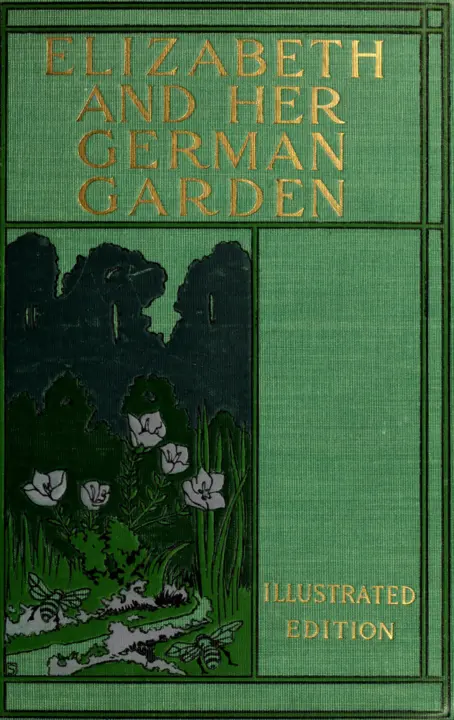
THE CLASSIC COLLECTION · 1898
"Elizabeth and Her German Garden" by Elizabeth von Arnim is a novel published in 1898. Written as a year's diary, it follows Elizabeth as she cultivates a garden on her husband's Pomeranian estate while gently satirizing German bourgeois society and those around her. This semi-autobiographical work combines observations on nature with humor drawn from Elizabeth's gardening misadventures and unconventional views on life. Originally published anonymously to protect the author's identity, it became an immediate bestseller with twenty-one reprints by 1899.
Introduction adapted from the source catalogue; source summaries may be automatically generated.
Free to read · English · 48,968 words · No account needed
MAKE TIME FOR A GOOD BOOK
On by default. Untick to stop anonymous reading totals. Each page counts after 10 seconds in view. How this works.
Anonymous counting is on unless you have switched it off.
Why I have to have Minora I don’t know, for I was not even aware of her existence a fortnight ago. Then coming down cheerfully one morning to breakfast—it was the very day after my return from England—I found a letter from an English friend, who up till then had been perfectly innocuous, asking me to befriend Minora. I read the letter aloud for the benefit of the Man of Wrath, who was eating Spickgans, a delicacy much sought after in these parts. “Do, my dear Elizabeth,” wrote my friend, “take some notice of the poor thing. She is studying art in Dresden, and has nowhere literally to go for Christmas. She is very ambitious and hardworking—”
“Then,” interrupted the Man of Wrath, “she is not pretty. Only ugly
girls work hard.”
“—and she is really very clever—”
“I do not like clever girls, they are so stupid,” again interrupted the
Man of Wrath.
“—and unless some kind creature like yourself takes pity on her she
will be very lonely.”
“Then let her be lonely.”
“Her mother is my oldest friend, and would be greatly distressed to think that her daughter should be alone in a foreign town at such a season.”
“I do not mind the distress of the mother.”
“Oh, dear me,” I exclaimed impatiently, “I shall have to ask her to
come!”
“If you should be inclined,” the letter went on, “to play the good Samaritan, dear Elizabeth, I am positive you would find Minora a bright, intelligent companion—”
“Minora?” questioned the Man of Wrath.
The April baby, who has had a nursery governess of an altogether alarmingly zealous type attached to her person for the last six weeks, looked up from her bread and milk.
“It sounds like islands,” she remarked pensively.
The governess coughed.
“Majora, Minora, Alderney, and Sark,” explained her pupil.
I looked at her severely.
“If you are not careful, April,” I said, “you’ll be a genius when you grow up and disgrace your parents.”
Miss Jones looked as though she did not like Germans. I am afraid she despises us because she thinks we are foreigners—an attitude of mind quite British and wholly to her credit; but we, on the other hand, regard her as a foreigner, which, of course, makes things complicated.
“Shall I really have to have this strange girl?” I asked, addressing nobody in particular and not expecting a reply.
“You need not have her,” said the Man of Wrath composedly, “but you will. You will write to-day and cordially invite her, and when she has been here twenty-four hours you will quarrel with her. I know you, my dear.”
Your reading position is saved on this browser. Take it to another device with a library code. Reading pages adapt to text, rather than matching a printed edition.
Elizabeth Von Arnim

Elizabeth Von Arnim
Elizabeth Von Arnim
Elizabeth Von Arnim
BEHIND THE BOOK
This eBook is for the use of anyone anywhere in the United States and most other parts of the world at no cost and with almost no restrictions whatsoever. You may copy it, give it away or re-use it under the terms of the Project Gutenberg License included with this eBook or online at www.gutenberg.org. If you are not located in the United States, you will have to check the laws of the country where you are located before using this eBook. Read the source licence.
The original source file, including credits and licence, is retained by this library. Request an original-format copy at no charge. Please include the book title and Project Gutenberg identifier #1327.
KEEP YOUR CURIOSITY GOING
Coulson Kernahan

Maurice Baring
Frances Wright
Cécile Tormay

Frederic Jesup Stimson

W. H. P. (William Henry Pope) Jarvis