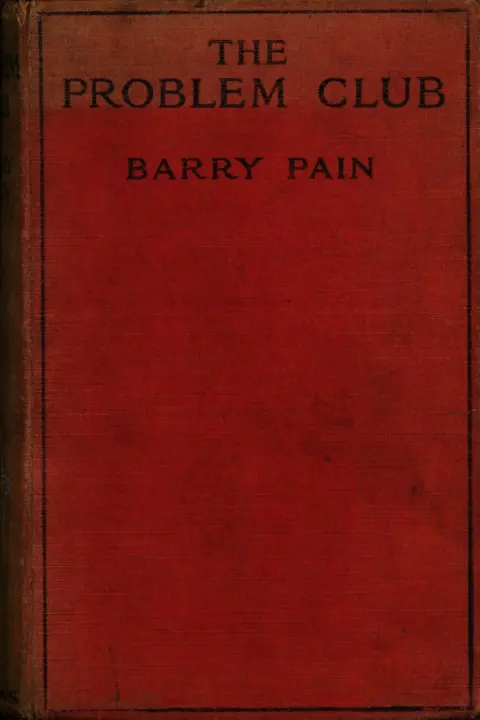
The Problem Club
Barry Pain
THE CLASSIC COLLECTION · 1904
"Eliza" by Barry Pain is a fictional work written in the early 20th century. The narrative centers around the lives of Eliza and her husband, presenting a humorous exploration of their domestic life and the complexities of their relationship. Through the perspective of the husband, the reader experiences the couple's interactions with each other and their attempts to navigate societal expectations, financial struggles, and personal quirks. The opening of the book establishes the husband's introspective nature as he investigates his own identity and the dynamics of his marriage. He reflects on his aspirations for a respectable life, highlighting his care for taste and decorum, although he feels challenged by Eliza's practical and sometimes opposite outlook. The narrative is marked by witty exchanges, such as the discussion about visiting cards and their significance or lack thereof, underscoring the comedic elements of misunderstanding and differing priorities in their relationship. This humorous examination of ordinary life suggests that the book will explore themes of love, identity, and the absurdities of domesticity with a light-hearted but insightful touch.
Introduction adapted from the source catalogue; source summaries may be automatically generated.
Free to read · English · 22,040 words · No account needed
MAKE TIME FOR A GOOD BOOK
On by default. Untick to stop anonymous reading totals. Each page counts after 10 seconds in view. How this works.
Anonymous counting is on unless you have switched it off.
To prevent the conversation from flagging, I said, "Eliza, dear, what
are you making?"
She frowned hard at me, shook her head slightly, and asked Miss Sakers about the special preacher for Epiphany Sunday.
I at once guessed that Eliza was doing something for Miss Sakers' stall at the bazaar, and had intended to keep it secret.
I smiled. "Miss Sakers," I said, "I do not know what Eliza is making, but I am quite sure it is for you."
There was a dead silence. Miss Sakers and Eliza both blushed. Then Miss Sakers said, without looking at me, "I think you are mistaken."
I felt so sure that I was mistaken that I blushed, too.
Eliza hurriedly hid her work in the work-basket, and said, "It is very close in here. Let me show you round our little garden."
They both went out, without taking any notice of me. Not having had much tea, I cut myself another slice of cake. While I was in the middle of it, Miss Sakers and Eliza came back, and Miss Sakers said good-bye to me very coldly. I offered to raise my bazaar donation to ten shillings, but she did not seem to have heard me.
"How could you say that?" said Eliza, when Miss Sakers had gone. "It was most tactless--and not very nice."
"I thought you were doing something for the bazaar. What were you
making, then?"
She did not actually tell me, but she implied it in a delicate way.
"Well," I said, "of course I wouldn't have called attention to it if I had known, but I don't think you ought to have been doing that work when Miss Sakers was here."
"I've no time to waste, and I always make mine myself. I was most careful to keep them hidden. You are very tactless."
"I don't think much of that Miss Sakers," I said. "Why should we go to this expense," pointing to the cakes, "for a woman of that kind?"
The orchestrome was on Lady Sandlingbury's stall at the bazaar. Her ladyship came up to Eliza in the friendliest way, and said, "My dear lady, I am convinced that you need an orchestrome. It's the sweetest instrument in the world, worth at least five pounds, and for one shilling you have a chance of getting it. It is to be raffled." Eliza objects, on principle, to anything like gambling; but as this was for the Deserving Inebriates, which is a good cause, she paid her shilling. She won the orchestrome, and I carried it home for her.
Your reading position is saved on this browser. Take it to another device with a library code. Reading pages adapt to text, rather than matching a printed edition.
BEHIND THE BOOK
This eBook is for the use of anyone anywhere in the United States and most other parts of the world at no cost and with almost no restrictions whatsoever. You may copy it, give it away or re-use it under the terms of the Project Gutenberg License included with this eBook or online at www.gutenberg.org. If you are not located in the United States, you will have to check the laws of the country where you are located before using this eBook. Read the source licence.
The original source file, including credits and licence, is retained by this library. Request an original-format copy at no charge. Please include the book title and Project Gutenberg identifier #23783.
KEEP YOUR CURIOSITY GOING
Coulson Kernahan

Maurice Baring
Frances Wright
Cécile Tormay

Frederic Jesup Stimson

W. H. P. (William Henry Pope) Jarvis