
Old People and the Things That Pass
Louis Couperus
THE CLASSIC COLLECTION · 1892
"Eline Vere" by Louis Couperus is a novel written in the late 19th century. The book explores themes of beauty, youth, and societal roles through the life of the main character, Eline Vere, a sensitive and dreamy young woman navigating her relationships and ambitions in a social milieu that often feels stifling and unkind. The narrative offers a richly detailed look at the intricacies of her world, where social expectations clash with personal desires. The opening of "Eline Vere" introduces readers to a vibrant setting of a grand social event where various characters prepare for a tableau performance. Frédérique van Erlevoort, one of the performers, is assisted by Paul van Raat as she readies herself. The atmosphere is filled with excitement and a flurry of activity. Through insightful descriptions, we learn about Eline, who is later revealed as a more introspective character, feeling somewhat isolated due to her melancholic nature and her struggles with identity and purpose. Tender moments are interspersed with observations on the superficiality of social interactions, setting the stage for Eline's deeper emotional journey.
Introduction adapted from the source catalogue; source summaries may be automatically generated.
Free to read · English · 128,052 words · No account needed
MAKE TIME FOR A GOOD BOOK
On by default. Untick to stop anonymous reading totals. Each page counts after 10 seconds in view. How this works.
Anonymous counting is on unless you have switched it off.
Freddie ran off, and as Madame van Erlevoort was asleep, Mathilde could for once exert her influence, and the four of them were bundled off up the stairs, with an admonition on each step, as Nico wanted to run down again, and Lientje remained sitting on the floor, playing with Hector.
“I am coming directly, Freddie!” cried Mathilde; “as soon as the children are up-stairs.”
Freddie was already in her room, brushing out the wavy masses of her hair. Mathilde was to dress it: she did it so deftly. And she set about arranging everything—her fan, her gloves, her handkerchief, her pale-blue satin shoes. A nervous blush suffused her clear pale face, as she looked at herself in the mirror and smiled, until in each cheek there formed a little dimple. “Yes; it would be all right,” she said. In half an hour Mathilde came back with Martha, the chamber-maid, and Frédérique sat down in front of the glass, in her white under-bodice and blue shoes.
“Just as simple and fetching as last time you did it, Tilly,” coaxed Frédérique, as Martha handed her the comb, the curling-tongs, or a hairpin, as they were wanted. “Oh! it’s quite cold here! Do wrap something round my shoulders, Martha!”
Martha wrapt a fur cape about her. With deft fingers, Mathilde had soon
completed her task.
“There!” said she, and arranged the frizzy fringe in front. “Simple, tasteful, and fetching—are you satisfied?”
Frédérique looked at herself, and with the tips of her fingers she just
touched her hair.
“Rather!” she said. “And now—my flot de tulle.”
The fur cape was thrown on the floor, and Martha arranged the confused mass of garments which were spread about the room. Mathilde lifted up the cloud of delicate azure, and light as a sigh she let it glide about Freddie’s shoulders.
“There’s something fairy, something naiad-like about me!” said Freddie, raising her arms, and Tilly and Martha knelt down and drew open the folds of silky gauze. “La, la, la——” and Freddie’s little feet kept time to the tune she hummed.
“Freddie, Freddie, do be quiet now! Martha, a pin; here, that bow is
undone.”
“How do I look, Martha?”
“Sweetly pretty, miss.”
“Doesn’t it look bare at the side, Tilly?”
“Oh, dear, no; ’tis all bows and ribbons. Come, Freddie, do sit still a
moment, now.”
All at once the door opened slowly, with a creaking sound.
“What now?” cried Mathilde impatiently, and her anger rose when she caught sight of Ernestine, shivering in her white nightgown, making her appearance behind the door, a little frightened, but with an elf-like impudence.
Your reading position is saved on this browser. Take it to another device with a library code. Reading pages adapt to text, rather than matching a printed edition.
Louis Couperus
Louis Couperus

Louis Couperus
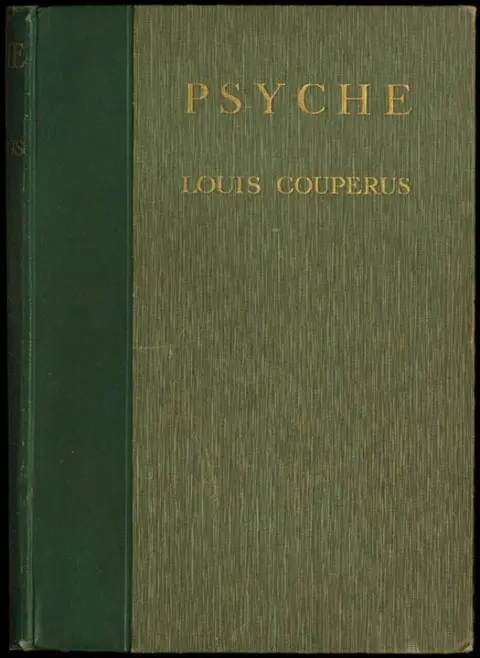
Louis Couperus
BEHIND THE BOOK
This eBook is for the use of anyone anywhere in the United States and most other parts of the world at no cost and with almost no restrictions whatsoever. You may copy it, give it away or re-use it under the terms of the Project Gutenberg License included with this eBook or online at www.gutenberg.org. If you are not located in the United States, you will have to check the laws of the country where you are located before using this eBook. Read the source licence.
The original source file, including credits and licence, is retained by this library. Request an original-format copy at no charge. Please include the book title and Project Gutenberg identifier #66911.
KEEP YOUR CURIOSITY GOING
Coulson Kernahan

Maurice Baring
Frances Wright
Cécile Tormay

Frederic Jesup Stimson

W. H. P. (William Henry Pope) Jarvis