
Old People and the Things That Pass
Louis Couperus
THE CLASSIC COLLECTION · 1892
"Eline Vere" by Louis Couperus is a novel written in the late 19th century. The book explores themes of beauty, youth, and societal roles through the life of the main character, Eline Vere, a sensitive and dreamy young woman navigating her relationships and ambitions in a social milieu that often feels stifling and unkind. The narrative offers a richly detailed look at the intricacies of her world, where social expectations clash with personal desires. The opening of "Eline Vere" introduces readers to a vibrant setting of a grand social event where various characters prepare for a tableau performance. Frédérique van Erlevoort, one of the performers, is assisted by Paul van Raat as she readies herself. The atmosphere is filled with excitement and a flurry of activity. Through insightful descriptions, we learn about Eline, who is later revealed as a more introspective character, feeling somewhat isolated due to her melancholic nature and her struggles with identity and purpose. Tender moments are interspersed with observations on the superficiality of social interactions, setting the stage for Eline's deeper emotional journey.
Introduction adapted from the source catalogue; source summaries may be automatically generated.
Free to read · English · 128,052 words · No account needed
MAKE TIME FOR A GOOD BOOK
On by default. Untick to stop anonymous reading totals. Each page counts after 10 seconds in view. How this works.
Anonymous counting is on unless you have switched it off.
“What! That house and a half?” asked Eline, her eyes big with surprise.
They all laughed, and Etienne asked her if she had expected to find a
sort of Nice or Biarritz.
“At least something like Scheveningen, with a Kurhaus—eh, Elly? I say, Elly, do you know the difference yet between rye and oats?”
“Not quite. Buckwheat I know when I see it—flax I know, very light yellow—and potato-fields I know. But rye and oats and barley, no; of them I know nothing whatever. Don’t worry me about them, Etienne! But, Théodore, is this indeed Horze? Are you really lord and master of these—one, two, three, four barns?”
And she roared with laughter under the broad brim of her big straw hat; and they all laughed at Eline’s innocent surprise, although Théodore felt a little hurt.
Eline, however, quickly regretted her jest, which she felt was not quite in harmony, and she declared that it was full of picturesque spots, a little house like that with a cluster of trees, very pretty, really.
“And the big tree, where is the big tree?” asked Eline.
They passed through the village, between the pecking fowls, which scampered away frightened, while the blacksmith and a couple of farmers, to each of whom Théodore addressed a few words, heartily greeted their landlord, remaining for a while staring after his guests. They crossed over a meadow, and Théodore shouted to a boy to hold a cow close by them, as Eline was afraid of the huge, fat beast, with its big, staring eyes and chewing mouth.
“Etienne, Cor—do leave off, Cor!” she cried, on Otto’s arm, to Etienne and Cor, who, to frighten the cow, set up a melancholy boo! boo!
“You see, Eline, that’s because you laughed at Horze,” cried Théodore in his big bass, but she looked at him laughingly and so softly between her half-closed lashes, that he was quite disarmed, and asked Etienne and Cor to stop their silly noise. At the end of the meadow stood the big tree, an oak with a colossal stem, tall and powerful as a giant. Frédérique, Marianne, Henriette, and the children had already ensconced themselves between its spreading roots. Howard and Eline were urged on all sides to give vent to their admiration for the tree. Eline mustered forth a few words, such as colossal, immense; but Théodore noticed from the mocking little smile that played on her features, that the oak had made no impression whatever upon her, and he held up his finger to her threateningly, until she burst out in a peal of laughter, which was renewed when Howard, in a very serious tone, declared—
Your reading position is saved on this browser. Take it to another device with a library code. Reading pages adapt to text, rather than matching a printed edition.
Louis Couperus
Louis Couperus

Louis Couperus
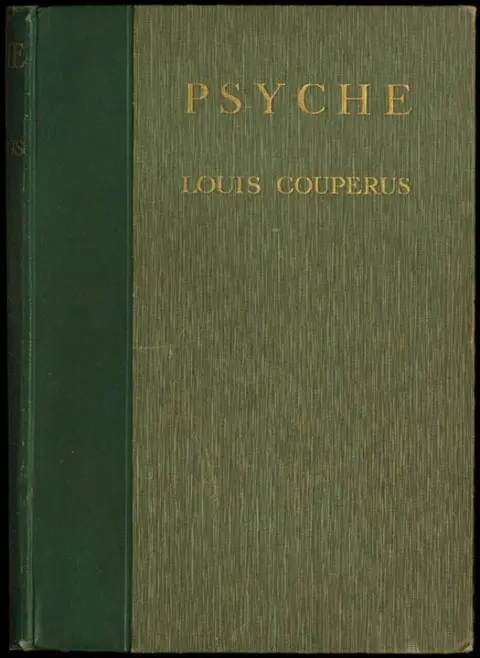
Louis Couperus
BEHIND THE BOOK
This eBook is for the use of anyone anywhere in the United States and most other parts of the world at no cost and with almost no restrictions whatsoever. You may copy it, give it away or re-use it under the terms of the Project Gutenberg License included with this eBook or online at www.gutenberg.org. If you are not located in the United States, you will have to check the laws of the country where you are located before using this eBook. Read the source licence.
The original source file, including credits and licence, is retained by this library. Request an original-format copy at no charge. Please include the book title and Project Gutenberg identifier #66911.
KEEP YOUR CURIOSITY GOING
Coulson Kernahan

Maurice Baring
Frances Wright
Cécile Tormay

Frederic Jesup Stimson

W. H. P. (William Henry Pope) Jarvis