
Old People and the Things That Pass
Louis Couperus
THE CLASSIC COLLECTION · 1892
"Eline Vere" by Louis Couperus is a novel written in the late 19th century. The book explores themes of beauty, youth, and societal roles through the life of the main character, Eline Vere, a sensitive and dreamy young woman navigating her relationships and ambitions in a social milieu that often feels stifling and unkind. The narrative offers a richly detailed look at the intricacies of her world, where social expectations clash with personal desires. The opening of "Eline Vere" introduces readers to a vibrant setting of a grand social event where various characters prepare for a tableau performance. Frédérique van Erlevoort, one of the performers, is assisted by Paul van Raat as she readies herself. The atmosphere is filled with excitement and a flurry of activity. Through insightful descriptions, we learn about Eline, who is later revealed as a more introspective character, feeling somewhat isolated due to her melancholic nature and her struggles with identity and purpose. Tender moments are interspersed with observations on the superficiality of social interactions, setting the stage for Eline's deeper emotional journey.
Introduction adapted from the source catalogue; source summaries may be automatically generated.
Free to read · English · 128,052 words · No account needed
MAKE TIME FOR A GOOD BOOK
On by default. Untick to stop anonymous reading totals. Each page counts after 10 seconds in view. How this works.
Anonymous counting is on unless you have switched it off.
“Hallo, girl, is that you?” he said, in a jovial tone, whilst in his sleepy blue-gray eyes and about his heavily fair-bearded mouth there played a good-humoured smile. “Did you not feel terribly bored, left to yourself all the evening?”
“Yes; just a little. Perhaps you did even more?” she asked with a
pleasant smile.
“I? Not at all. The tableaux were very pretty.”
Then with his back leaning against the mantelpiece he began sipping his
grog.
“Has the youngster been good?”
“Yes; he has been asleep. Are you not going to bed?”
“I just want to look at the papers. But why are you still up?”
“Oh—just because——” With a languid, graceful movement she stretched her arms, and then twisted her heavy locks into a glossy brown coil. She felt the need to speak to him without constraint, but the words would not come, and not the faintest thought could she conjure up to take shape within her dreamy mind. Gladly would she have burst into tears, not because of any poignant sorrow, but for the mere longing of hearing his deep solacing tones in comforting her. But she could find no words to give expression to her feelings, and again she stretched forth her arms in languid grace.
“Is anything wrong, eh, old girl? Come, tell me what it is.”
With a vacant stare she shook her head. No, there was nothing to tell.
“Come, you can tell me all about it, you know that.”
“Oh—I feel a little miserable.”
“What about?”
Then with a pretty little pout, “Oh—I don’t know. I have been a little
nervous all day.”
He laughed—his usual soft, sonorous laugh.
“You and your nerves! Come, sis, cheer up. You are such good company when you are not so melancholy; you must not give yourself over to these fits.” He felt conscious that his eloquence would not hold out to argue the matter further, so with a laugh he concluded, “Will you have a drop of grog, sis?”
“Thank you—yes, just a sip out of your glass.”
She turned to him, and laughing in his fair beard, he raised the steaming glass to her lips. Through the half-closed eyelids he saw a tear glistening, but she kept it back. All at once, with sudden determination, he set down his glass and grasped her hands.
“Come, girl, tell me; there is something—something has occurred with Betsy, or—come now, you generally trust me.” And he gave her a reproachful glance with his sleepy, kindly, stupid eyes, like those of a faithful sheep-dog.
Your reading position is saved on this browser. Take it to another device with a library code. Reading pages adapt to text, rather than matching a printed edition.
Louis Couperus
Louis Couperus

Louis Couperus
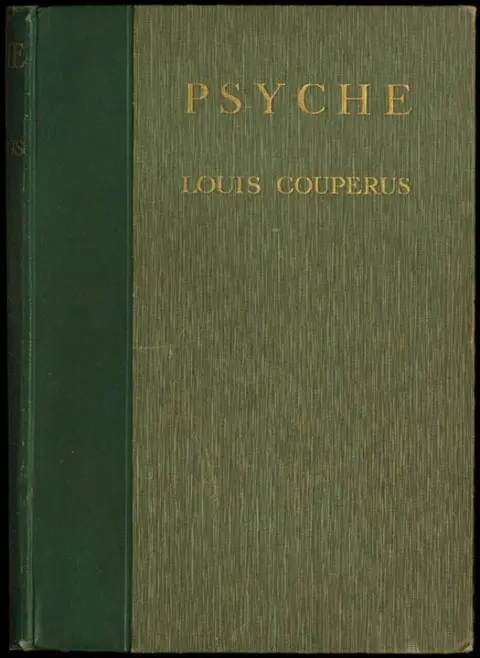
Louis Couperus
BEHIND THE BOOK
This eBook is for the use of anyone anywhere in the United States and most other parts of the world at no cost and with almost no restrictions whatsoever. You may copy it, give it away or re-use it under the terms of the Project Gutenberg License included with this eBook or online at www.gutenberg.org. If you are not located in the United States, you will have to check the laws of the country where you are located before using this eBook. Read the source licence.
The original source file, including credits and licence, is retained by this library. Request an original-format copy at no charge. Please include the book title and Project Gutenberg identifier #66911.
KEEP YOUR CURIOSITY GOING
Coulson Kernahan

Maurice Baring
Frances Wright
Cécile Tormay

Frederic Jesup Stimson

W. H. P. (William Henry Pope) Jarvis