THE CLASSIC COLLECTION✦Studies of American Fungi. Mushrooms, Edible, Poisonous, etc.CLASSIC FREE BOOKS
Studies of American Fungi. Mushrooms, Edible, Poisonous, etc.
George Francis Atkinson
THE CLASSIC COLLECTION · 1898
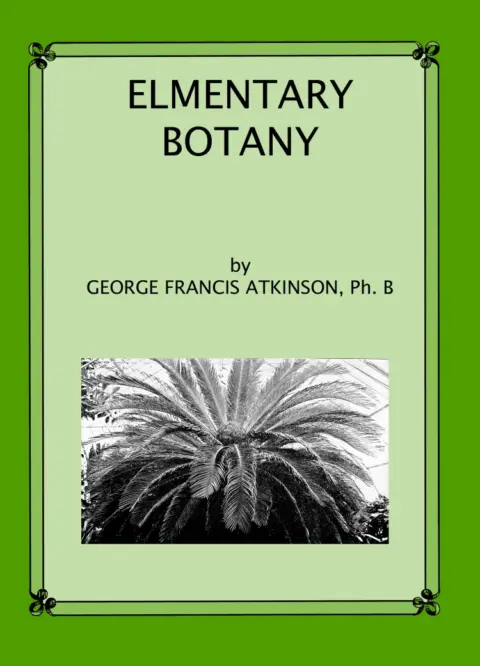
"Elementary Botany" by George Francis Atkinson is a scientific publication written in the early 20th century. The work provides a comprehensive introduction to botany, focusing on plant physiology, morphology, and ecology, exploring the fundamental life processes of plants, as well as their form and function in relation to their environment. It serves as a textbook for students, particularly those in botany courses, aiming to deepen their understanding of plant life. At the start of the book, the author outlines the structure and aims of the text, detailing its organization into three main parts: physiology, morphology and life history of representative plants, and the relationship between plant members and their environment. This introductory section sets the stage for an in-depth exploration of protoplasm—the living material of plants—beginning with its study in various simple plants like "Spirogyra" and "Mucor". The opening discussions illustrate important concepts such as the properties of protoplasm, methods of observation, and initial experiments to observe plant behavior under different conditions, laying a strong foundation for the chapters that follow.
Introduction adapted from the source catalogue; source summaries may be automatically generated.
Free to read · English · 146,679 words · No account needed
MAKE TIME FOR A GOOD BOOK
On by default. Untick to stop anonymous reading totals. Each page counts after 10 seconds in view. How this works.
Anonymous counting is on unless you have switched it off.
=470. Order Lycoperdales (Lycoperdineæ).=—These include the “puff-balls,” or “devil’s snuff-box” (Lycoperdon), and the earth stars (Geaster). The basidia form a distinct hymenium, but at maturity the entire inner portion of the plant (except certain peculiar threads, the capillitium) disintegrates and with the spores forms a powdery mass.
=471. Order Nidulariales (Nidulariineæ).=—These are known as bird-nest fungi. The fruit body when mature is cup-shaped, or goblet-shaped, and contains minute flattened circular bodies (peridiola) containing the spores. The intermediate portions of the fruit body disintegrate and set the peridiola free, which then lie in the cup-shaped base like eggs in a nest.
=472. Order Plectobasidiales (Plectobasidiineæ).=—The basidia do not form a definite hymenium, but are interwoven with the threads inside, or are collected into knot-like groups. (Examples: Calostoma, Tulostoma, Astræus, Sphærobolus, etc.)
=472a. Lichens.=—The plant body of the lichens (see paragraphs 200, 201) consists of two component parts, the one a fungus, the other an alga. The fructification is that of the fungus. The fruit body shows the lichens to be related some to the Ascomycetes, others to the Hymenomycetes, and Gasteromycetes. They are usually classified as a distinct class or order from the fungi, but a natural arrangement would distribute them in several of the orders above. Their special relationship with these orders has not been satisfactorily worked out. For the present they are arranged as follows:
=Ascolichenes.=
Pyrenocarpous lichens (those with a fruit body like the
Pyrenomycetes).
Gymnocarpous lichens (those with a fruit body like the Discomycetes).
=Hymenolichenes= (those with a fruit body like the Hymenomycetes).
=Gasterolichenes= (those with a fruit body like the
Gasteromycetes).
From a vegetative standpoint there are two types according to the
distribution of the elements.
1st. Where the fungal and algal elements are evenly distributed in the plant body the lichen is said to be homoiomerous. There are two types of these:
a. Filamentous lichens, example, Ephebe pubescens.
b. Gelatinous lichens, example, Collema (with the alga nostoc), Physma (with the Chroococcaceæ).
2d. Where the elements are stratified, as in Parmelia, etc., the lichen is said to be heteromerous. In these there are three types:
a. Crustaceous lichens, the plant body is in the form of a thin
incrustation on rocks, etc.
b. Foliaceous lichens, the plant body is leaf-like and lobed and more or less loosely attached by rhizoids: Parmelia, Peltigera, etc.
c. Fruticose lichens, the plant body is filamentous or band-like and branched, as in Usnea, Cladonia, etc.
[20] As suborder in Engler and Prantl.
[21] As suborder in Engler and Prantl.
[22] As suborder in Engler and Prantl.
[23] The Uredinales and Auriculariales in Engler and Prantl are placed in order, Auriculariineæ.
Your reading position is saved on this browser. Take it to another device with a library code. Reading pages adapt to text, rather than matching a printed edition.
BEHIND THE BOOK
This eBook is for the use of anyone anywhere in the United States and most other parts of the world at no cost and with almost no restrictions whatsoever. You may copy it, give it away or re-use it under the terms of the Project Gutenberg License included with this eBook or online at www.gutenberg.org. If you are not located in the United States, you will have to check the laws of the country where you are located before using this eBook. Read the source licence.
The original source file, including credits and licence, is retained by this library. Request an original-format copy at no charge. Please include the book title and Project Gutenberg identifier #64601.
KEEP YOUR CURIOSITY GOING
John Muir
Asa Gray
Asa Gray

Florence Nightingale
Elizabeth Robins Pennell
Denison Olmsted