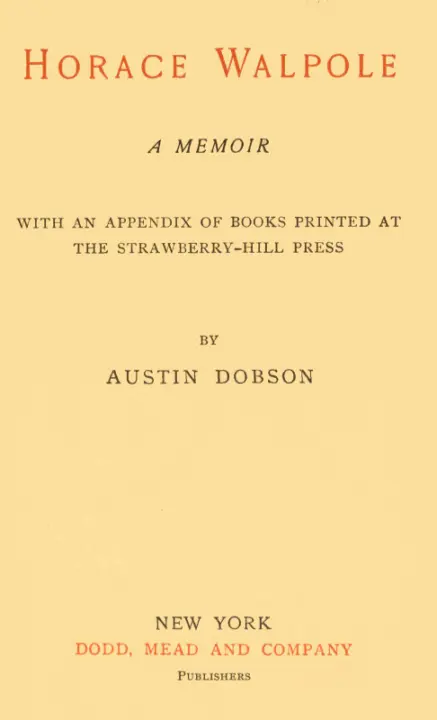
Horace Walpole: A memoir With an appendix of books printed at the Strawberry Hill Press
Austin Dobson
THE CLASSIC COLLECTION · 1892
"Eighteenth Century Vignettes" by Austin Dobson is a collection of historical essays written in the late 19th century. The work presents a series of episodic portraits and reflections on significant figures and events of the 18th century, blending fact with a light degree of narrative elaboration. This compilation aims to capture the essence of the era, focusing on both personal stories and broader cultural moments that shaped the time. The opening portion of the book introduces the reader to a scene from 1708 involving Captain Richard Steele and his wife, Mary Scurlock Steele. The narrative describes a moment of impatience experienced by Mrs. Steele as she awaits her husband in a coach outside Lord Sunderland's office in Whitehall. The text paints a vivid picture of their marriage, highlighting Steele's charming yet tumultuous nature, conflicts over his frequent absences from home, and Mrs. Steele's wrestling emotions. Through letters exchanged between the couple, we gain insights into their relationship dynamics, revealing both affection and underlying tensions that characterize their life together in a bustling 18th century London.
Introduction adapted from the source catalogue; source summaries may be automatically generated.
Free to read · English · 58,985 words · No account needed
MAKE TIME FOR A GOOD BOOK
On by default. Untick to stop anonymous reading totals. Each page counts after 10 seconds in view. How this works.
Anonymous counting is on unless you have switched it off.
* There is a print of Edwin in this character after a picture by Alefounder. He was also a favourite 'Croaker' in the 'Good Natur'd Man.'
But if he was pleased with the acting, he was not equally impressed by the audience. The ceaseless clamour of the upper gallery and the steady hail of missiles were anything but agreeable. 'Often and often whilst I sat here [i.e. in the pit], did a rotten orange, or pieces of the peel of an orange, fly past me, or past some of my neighbours, and once one of them actually hit my hat, without my daring to look round, for fear another might then hit me on my face.' Another passage connected with this part of the entertainment illustrates the old fashion of sending the lackeys to keep their masters' places: 'In the boxes, quite in a corner, sat several servants, who were said to be placed there, to keep the seats for the families they served, till they should arrive; they seemed to sit remarkably close and still, the reason of which, I was told, was their apprehension of being pelted, for, if one of them dares but to look out of the box, he is immediately saluted with a shower of orange peel from the gallery.'
Over the descriptions of St. Paul's and Westminster Abbey we must pass silently, in order to accompany the tourist on his road to Derbyshire, to the 'natural curiosities' of which, after some hesitation, he felt himself most at tracted. Equipped with a road-book, he set out by stage-coach from the White Hart (in the Strand) for Richmond, intending thence to pursue his journey on foot. According to his own account, he must have travelled in just such' another vehicle as that depicted in Hogarth's 'Country Inn-Yard,' and have shared the curiosity, so often felt by admirers of that veracious picture, and afterwards amply gratified in his own case, as to the method by which passengers managed to 'fasten themselves securely on the roof.' Luckily the coach met neither highwayman nor footpad. At Richmond he alighted, and is properly enthusiastic, almost dithyrambic, over 'one of the first situations in the world.' He even got up to see the sun rise from Richmond Hill, with the usual fate of such premature adventurers, a clouded sky. Then he set out on foot by Windsor to Oxford. But he speedily discovered that, in a horse-riding age, a pedestrian was a person of very inferior respectability; and though--modelling himself upon the Vicar of Wakefield--he was careful to invite the landlords to drink with him, he found himself generally treated with pity or contempt, which, when he sat down under a hedge to read Milton, almost changed into a doubt of his sanity. At most of the inns they declined to give him house-room, though, finally, he was allowed to enter 'one of those kitchens which I had so often read of in Fielding's fine novels,' where, just as in those novels, presently arrives a showy post-chaise to set the servile establishment in a bustle, although the occupants called for nothing but two pots of beer. After a vain attempt to obtain a night's lodging at Nuneham, he picks up a travelling companion in the shape of a young parson, who had been preaching at Dorchester and was returning to Oxford. His new ally takes him to the time-honoured Mitre, where he finds a great number of clergymen, all with their gowns and bands on, sitting round a large table, each with his pot of beer before him.' A not very edifying theological discussion ensues, which is too long to quote, and poor Parson Moritz is so well entertained that he has a splitting headache next morning. His further fortunes cannot be detailed here. From Oxford he goes to Stratford-on-Avon, then to Lichfield and Derby, and so to his destination, 'the great cavern near Castleton, in the high Peake of Derbyshire,' which he describes at length. He returns by Nottingham and Leicester, whence, still enthusiastic, but a little weary of his humiliations on foot, he takes coach to Northampton, mounting to the top, in company with a farmer, a young man and 'a black-a-moor.' This eminence proving as perilous as it looked, he creeps into the basket, in spite of the warnings of the black. 'As long as we went up hill, it was easy and pleasant. And, having had little or no sleep the night before, I was almost asleep among the trunks and the packages; but how was the case altered when we came to go down hill; then all the trunks and parcels began, as it were, to dance around me, and everything in the basket seemed to be alive; and I every moment received from them such violent blows, that I thought my last hour was come. I now found that what the black had told me was no exaggeration; but all my complaints were useless. I was obliged to suffer this torture nearly an hour, till we came to another hill again, when, quite shaken to pieces and sadly bruised, I again crept to the top of the coach, and took possession of my former seat.' No wonder he concludes his part of his experiences with a solemn warning to travellers to take inside places in English post coaches. With his return to London his narrative practically ends. But the rapid sketch here given of it affords no sufficient hint of the abundance of naïf detail, of simple enthusiasm and kindly wonderment, which characterize its pages. To complete the impression given, we should be able to suppose the writer resting contentedly from a solitary literary effort, and ending tranquil days as a kind of German Dr. Primrose, telling grandchildren, such as Chodowiecki drew, how he once saw Goldsmith's monument in the great Abbey by the Thames, and heard Pitt speak in the Parliament House at Westminster. But this is to reckon without the all-recording pages of the 'Allgemeine Deutsche Biographie,' and that harsh resolvent, Fact. For the future of Pastor Charles P. Moritz was not at all in this wise. Besides his letters to his 'dearest Gedike,' he wrote many other works, including a 'psychological romance' and 'Travels in Italy;' became a Fine-Art Professor; married late in life, but not happily; left no family; and, last of all, had been dead two years when the translation which has formed the subject of these pages was first introduced to English readers.
Your reading position is saved on this browser. Take it to another device with a library code. Reading pages adapt to text, rather than matching a printed edition.
Austin Dobson
Austin Dobson
Austin Dobson
Austin Dobson
BEHIND THE BOOK
This eBook is for the use of anyone anywhere in the United States and most other parts of the world at no cost and with almost no restrictions whatsoever. You may copy it, give it away or re-use it under the terms of the Project Gutenberg License included with this eBook or online at www.gutenberg.org. If you are not located in the United States, you will have to check the laws of the country where you are located before using this eBook. Read the source licence.
The original source file, including credits and licence, is retained by this library. Request an original-format copy at no charge. Please include the book title and Project Gutenberg identifier #47996.
KEEP YOUR CURIOSITY GOING

David Patterson (Spirit) Hatch

David Patterson (Spirit) Hatch

David Patterson (Spirit) Hatch
Cécile Tormay

Moritz Busch
John L. Ransom