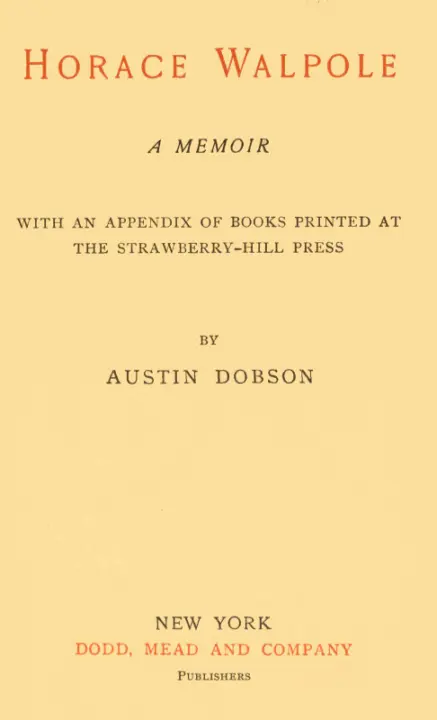
Horace Walpole: A memoir With an appendix of books printed at the Strawberry Hill Press
Austin Dobson
THE CLASSIC COLLECTION · 1892
"Eighteenth Century Vignettes" by Austin Dobson is a collection of historical essays written in the late 19th century. The work presents a series of episodic portraits and reflections on significant figures and events of the 18th century, blending fact with a light degree of narrative elaboration. This compilation aims to capture the essence of the era, focusing on both personal stories and broader cultural moments that shaped the time. The opening portion of the book introduces the reader to a scene from 1708 involving Captain Richard Steele and his wife, Mary Scurlock Steele. The narrative describes a moment of impatience experienced by Mrs. Steele as she awaits her husband in a coach outside Lord Sunderland's office in Whitehall. The text paints a vivid picture of their marriage, highlighting Steele's charming yet tumultuous nature, conflicts over his frequent absences from home, and Mrs. Steele's wrestling emotions. Through letters exchanged between the couple, we gain insights into their relationship dynamics, revealing both affection and underlying tensions that characterize their life together in a bustling 18th century London.
Introduction adapted from the source catalogue; source summaries may be automatically generated.
Free to read · English · 58,985 words · No account needed
MAKE TIME FOR A GOOD BOOK
On by default. Untick to stop anonymous reading totals. Each page counts after 10 seconds in view. How this works.
Anonymous counting is on unless you have switched it off.
`````'smoke-inhaling Bull,
````Always filling, never full,'=
was wont to deposit his pipes and his tobacco. 'Having furnished it with a table and two chairs,' says Cowper, * here I write all that I write in summer time, whether to my friends or the public. It is secure from all noise, and a refuge from all intrusion, for intruders sometimes trouble me in the winter evenings at Olney, but (thanks to my boudoir!) I can now hide myself from them.'
The summer-house, * it has been stated, is still standing.
* Since this paper was first written, the summer-house, the garden, and the 'Guinea Orchard'--a strip of field which came between Cowper's garden and that of the Parsonage--have been sold by auction, the purchaser being a local butcher. The sale took place in February, 1896.
But of another favourite haunt of Cowper, which preceded and co-existed with it, there are now no traces. This was the greenhouse.=
```''T is a bower of Arcadian sweets,
````Where Flora is still in her prime,
```A fortress to which she retreats
````From the cruel assaults of the clime'--=
he writes in his favourite rocking-horse metre, and most conventional language, bidding his Mary remark the beauty of the pinks which it has preserved through the frosts; and in mid-July, when the floor was carpeted, and the sun was excluded by an awning of mats, it became 'the pleasantest retreat in Olney.' 'We eat, drink, and sleep, where we always did,' he says to Newton; 'but here we spend all the rest of our time, and find that the sound of the wind in the trees, and the singing of birds, are much more agreeable to our ears than the incessant barking of dogs and screaming of children,' from both of which, it may be observed, they suffered considerably in the front of the house. Two years later he tells Mr. Unwin that 'our severest winter, commonly called the spring, is now over, and I find myself seated in my favourite recess, the greenhouse. In such a situation, so silent, so shady, where no human foot is heard, and where only my myrtles presume to peep in at the window, you may suppose I have no interruption to complain of, and that my thoughts are perfectly at my command. But the beauties of the spot are themselves an interruption, my attention being called upon by those very myrtles, by a double row of grass pinks, just beginning to blossom, and by a bed of beans already in bloom; and you are to consider it, if you please, as no small proof of my regard, that, though you have so many powerful rivals, I disengage myself from them all, and devote this hour entirely to you.'
Your reading position is saved on this browser. Take it to another device with a library code. Reading pages adapt to text, rather than matching a printed edition.
Austin Dobson
Austin Dobson
Austin Dobson
Austin Dobson
BEHIND THE BOOK
This eBook is for the use of anyone anywhere in the United States and most other parts of the world at no cost and with almost no restrictions whatsoever. You may copy it, give it away or re-use it under the terms of the Project Gutenberg License included with this eBook or online at www.gutenberg.org. If you are not located in the United States, you will have to check the laws of the country where you are located before using this eBook. Read the source licence.
The original source file, including credits and licence, is retained by this library. Request an original-format copy at no charge. Please include the book title and Project Gutenberg identifier #47996.
KEEP YOUR CURIOSITY GOING

David Patterson (Spirit) Hatch

David Patterson (Spirit) Hatch

David Patterson (Spirit) Hatch
Cécile Tormay

Moritz Busch
John L. Ransom