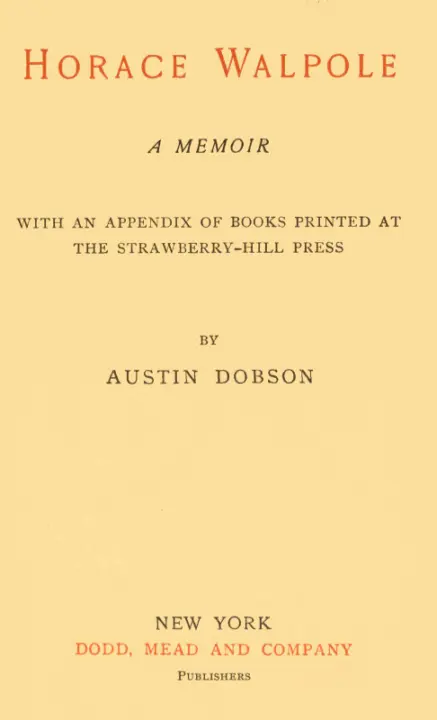
Horace Walpole: A memoir With an appendix of books printed at the Strawberry Hill Press
Austin Dobson
THE CLASSIC COLLECTION · 1892
"Eighteenth Century Vignettes" by Austin Dobson is a collection of historical essays written in the late 19th century. The work presents a series of episodic portraits and reflections on significant figures and events of the 18th century, blending fact with a light degree of narrative elaboration. This compilation aims to capture the essence of the era, focusing on both personal stories and broader cultural moments that shaped the time. The opening portion of the book introduces the reader to a scene from 1708 involving Captain Richard Steele and his wife, Mary Scurlock Steele. The narrative describes a moment of impatience experienced by Mrs. Steele as she awaits her husband in a coach outside Lord Sunderland's office in Whitehall. The text paints a vivid picture of their marriage, highlighting Steele's charming yet tumultuous nature, conflicts over his frequent absences from home, and Mrs. Steele's wrestling emotions. Through letters exchanged between the couple, we gain insights into their relationship dynamics, revealing both affection and underlying tensions that characterize their life together in a bustling 18th century London.
Introduction adapted from the source catalogue; source summaries may be automatically generated.
Free to read · English · 58,985 words · No account needed
MAKE TIME FOR A GOOD BOOK
On by default. Untick to stop anonymous reading totals. Each page counts after 10 seconds in view. How this works.
Anonymous counting is on unless you have switched it off.
Lord Chesterfield puts his points coldly and cynically; but by his excellent sermon on the suaviter in modo and the fortiter in re, he preaches in reality little beyond that necessary conciliation of the feelings of others which is inculcated by almost every manual of ethics. Again, if he harps somewhat wearisomely upon 'les manières, les bienséances, les agrémens, it is precisely because these were the weak points of his pupil, who, master at twenty of Latin, Greek, and political history, speaking readily German, French, and Italian, having a remarkable memory and a laudable curiosity, still retained an awkwardness of address which neither Marcel nor Desnoyers could wholly overcome, * and a defective enunciation which would have resisted all the pebbles of Demosthenes.
* Desnoyers was the fashionable English dancing-master;
Marcel, the French one.
For the rest, Lord Chesterfield's teaching is, in great measure, unexceptionable. Its worst fault, in addition to those already mentioned, is that it too frequently confuses being with seeming, and the assumption of a virtue with the actual possession of it. But many of its injunctions are most praiseworthy, and even admirable as aphorisms; and those to whom their note of worldly wisdom is distasteful must blame not so much the writer, as Horace and Cicero, Bolingbroke and La Bruyère, De Retz and La Rochefoucault, from whom he had compiled his rules for conduct, and shaped his scheme of life.
When Philip Stanhope died at six-and-thirty, neither 'paitri [sic] de graces' as Lord Chesterfield hoped, nor particularly distinguished in statecraft (he was simply Envoy at Dresden), it was discovered that he had so far adopted the policy of 'pensieri stretti as to have been married privately for some years. Probably the shock of this discovery was softened to his father (who nevertheless behaved liberally to the widow) by the fact that, in the failure of his plans for his son, he had already begun to interest himself in the training of another member of his family, a little boy who was destined to be his successor in the earldom. Seven years before Philip Stanhope's death he had opened a new series of letters with a godchild, also Philip Stanhope, and the son of Mr. Arthur Stanhope, of Mansfield, in Nottinghamshire. Beginning when the boy was five and a half, the correspondence was continued for nine years, following him from 'Mr. Robert's boarding School at Marybone by London' to the house in Southampton Row of his tutor, the notorious Dr. Dodd. When the first letter was written, Lord Chesterfield was sixty-seven, and the last was penned only three years before his death. This is the collection which, after being mislaid for a long period, was published in 1889 by the late Lord Carnarvon, to whom it had been presented by his father-in-law, the sixth Earl of Chesterfield. It contributes not a little to the revision of the popular idea formed of the writer,--an idea, it may be added, which, upon re-examination of the earlier correspondence, had already been considerably modified by such critics as Mr. Abraham Hayward and M. Sainte-Beuve. Superficially, the letters resemble their predecessors, and the outline of education is much the same. Little Philip was to be 'perfectly master' of that French which his godfather loved so dearly, and in which he wrote so often and so well; he was to be thoroughly grounded in History, Geography, Dancing, Italian, German; he was to be proficient in Greek and Latin, and he was to complete his studies in the 'well-regulated republic' of Geneva, the salutary austerity of which was then usefully tempered by the presence of Voltaire and the French refugees. Many of the new letters reproduce the old precepts; there are even similarities of thought and phraseology; and though the volto sciolto is not obtruded, the suaviter in modo is still persistently advocated. But age has brought its softening influences--the moral tone is ostensibly higher, and the old worldly savoir-faire has lost much of its ancient cynicism. Some of the axioms which Lord Carnarvon quotes are remarkable for their accent of earnestness; others, as he observes, are 'almost theological' in tone. Saint Augustine, for example, could hardly say more than this: 'Si je pouvois empêcher qu'il n'y eut un seul malheureux sur la Terre, j'y sacrifierois avec plaisir mon bien, mes soins, et même ma santé. C'est le grand devoir de l'homme, surtout de l'homme chrétien.' The next is nearer to the elder manner: 'Ayez une grande Charité pour l'amour de Dieu et une extrême politesse pour l'amour de vous même.' And here is a graver utterance than either: 'God has been so good as to write in all our hearts the duty that He expects from us, which is adoration and thanksgiving and doing all the good we can to our fellow creatures.'
Your reading position is saved on this browser. Take it to another device with a library code. Reading pages adapt to text, rather than matching a printed edition.
Austin Dobson
Austin Dobson
Austin Dobson
Austin Dobson
BEHIND THE BOOK
This eBook is for the use of anyone anywhere in the United States and most other parts of the world at no cost and with almost no restrictions whatsoever. You may copy it, give it away or re-use it under the terms of the Project Gutenberg License included with this eBook or online at www.gutenberg.org. If you are not located in the United States, you will have to check the laws of the country where you are located before using this eBook. Read the source licence.
The original source file, including credits and licence, is retained by this library. Request an original-format copy at no charge. Please include the book title and Project Gutenberg identifier #47996.
KEEP YOUR CURIOSITY GOING

David Patterson (Spirit) Hatch

David Patterson (Spirit) Hatch

David Patterson (Spirit) Hatch
Cécile Tormay

Moritz Busch
John L. Ransom