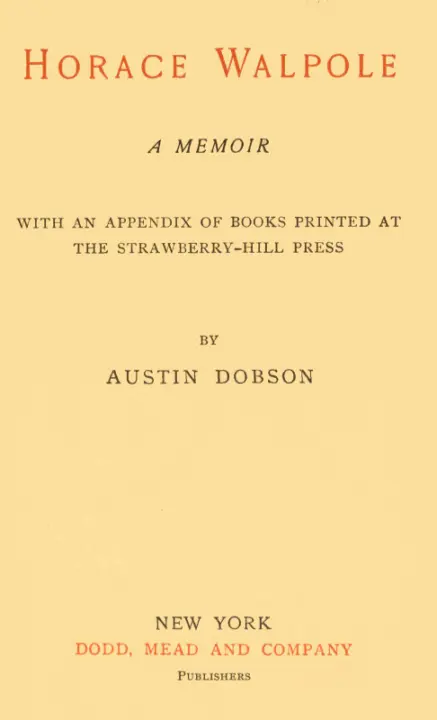
Horace Walpole: A memoir With an appendix of books printed at the Strawberry Hill Press
Austin Dobson
THE CLASSIC COLLECTION · 1892
"Eighteenth Century Vignettes" by Austin Dobson is a collection of historical essays written in the late 19th century. The work presents a series of episodic portraits and reflections on significant figures and events of the 18th century, blending fact with a light degree of narrative elaboration. This compilation aims to capture the essence of the era, focusing on both personal stories and broader cultural moments that shaped the time. The opening portion of the book introduces the reader to a scene from 1708 involving Captain Richard Steele and his wife, Mary Scurlock Steele. The narrative describes a moment of impatience experienced by Mrs. Steele as she awaits her husband in a coach outside Lord Sunderland's office in Whitehall. The text paints a vivid picture of their marriage, highlighting Steele's charming yet tumultuous nature, conflicts over his frequent absences from home, and Mrs. Steele's wrestling emotions. Through letters exchanged between the couple, we gain insights into their relationship dynamics, revealing both affection and underlying tensions that characterize their life together in a bustling 18th century London.
Introduction adapted from the source catalogue; source summaries may be automatically generated.
Free to read · English · 58,985 words · No account needed
MAKE TIME FOR A GOOD BOOK
On by default. Untick to stop anonymous reading totals. Each page counts after 10 seconds in view. How this works.
Anonymous counting is on unless you have switched it off.
It was at Waltham St. Lawrence, a quiet little Berkshire village, whose churchyard is dotted with the tombs of earlier Newberys, that he had been born. His father, a small farmer, destined him for his own calling. But, like Gay, it was not John Newbery's fate 'to brighten ploughshares in paternal land.' He passed early into the service of a 'merchant,' otherwise a printer and newspaper proprietor, at Reading, managing so well that, when his employer died, he was left a co-legatee in the business. Thereupon, being a resolute man, he did better still, and married his master's widow, who had three children. Even this succeeded; upon which, progressing always in prosperity, he began to think of starting in London. Before doing so, he made a tour in the provinces. Of this expedition there exists a curious record in the shape of an unprinted journal, throwing much light upon modes of travelling in those early coaching days, when the unfortunate outside passenger (like Pastor Moritz in a later paper *) had to choose between being jolted to death in the basket, or clinging like a fly to the slippery top of the vehicle.
* See-post, 'A German in England.'
The majority of the entries are merely matter of business,--titles for new books, recipes for diet-drinks, shrewd trade maxims, and the like. But here and there the writer intersperses notes of general interest,--on Dick Turpin the highwayman, on Lady Godiva and peeping Tom, and (more than once) upon that 'curious and very useful machine,' the Ducking-Stool for scolds, a 'plan of which instrument (he says) he shall procure and transplant to Berkshire for the good of his native county.' His business at Reading was as miscellaneous as his memorandum book, and he seems to have dealt in all kinds of goods. About 1744 he removed to London, opening a shop at the sign of the 'Bible and Crown,' near Devereux Court, without Temple Bar, together with a branch establishment at the Royal Exchange. To this Johnson probably refers when he says: 'He has one habitation near Bow Church, and another about a mile distant. By this ingenious distribution of himself between two houses, he has contrived to be found at neither.' From the 'Bible and Crown,' which had been his old Reading sign, he moved a year later to the 'Bible and Sun' in St. Paul's Churchyard. This continued to be his headquarters until his death. Gradually his indiscriminate activities narrowed themselves to two distinct branches of business, in these days incongruous enough,--the sale of books and the sale of patent medicines. While at Reading, he had become part owner, among other things, of Dr. Hooper's Female Pills; and soon after his settlement in London, he acquired the sole management of a more famous panacea, Dr. James's Fever Powders, which had in their time an extraordinary vogue. According to Mrs. Delany, the King dosed the Princess Elizabeth with them; Gray and Cowper both believed in their efficacy; and Horace Walpole, declared he should take them if the house were on fire. Fielding specially praises them in 'Amelia,' affirming that in almost any country but England they would have brought 'public Honours and Rewards' to his 'worthy and ingenious Friend Dr. James;' while Goldsmith may be said to have laid down his life for them. With the sale of these and kindred specifics, John Newbery alternated his unwearied speculations as a bookseller. He was at the back of Smollett's venture of the 'British Magazine;' it was for his 'Universal Chronicle' that Johnson wrote his 'Idler' and quizzed his proprietor as 'Jack Whirler;' he was the publisher of Goldsmith's 'Traveller' and 'Citizen of the World;' and lie probably found part of the historical sixty guineas which somebody paid for the 'Vicar of Wakefield.' He died at Canbury or Canonbury House, Islington, in the still-existent Tower of which he was an occasional resident. Indeed, it is more than probable that he was at one time the responsible landlord of that favourite retiring place for literary men,--a retiring place not without its exceptional advantages, if we* are to believe last-century advertisements, which, in addition to a natural cold bath, speak of 'a superlative Room, furnish'd for a single Person, or two Gentlemen, having a Prospect into five Counties ['longos prospicit agros!'], and the use of a good Garden and Summer-House.' Besides this there were traditions of Prior Bolton and Anne of Cleves, of Bacon and Elizabeth, of Sir John Spencer and William Fielding, Earl of Denbigh (the novelist's grand-uncle), which certainly have figured in any schedule of attractions, and must naturally have been interesting to the Smarts and Hills and Woodfalls and Goldsmiths who afterwards inhabited the old ivy-clad Tower.
Your reading position is saved on this browser. Take it to another device with a library code. Reading pages adapt to text, rather than matching a printed edition.
Austin Dobson
Austin Dobson
Austin Dobson
Austin Dobson
BEHIND THE BOOK
This eBook is for the use of anyone anywhere in the United States and most other parts of the world at no cost and with almost no restrictions whatsoever. You may copy it, give it away or re-use it under the terms of the Project Gutenberg License included with this eBook or online at www.gutenberg.org. If you are not located in the United States, you will have to check the laws of the country where you are located before using this eBook. Read the source licence.
The original source file, including credits and licence, is retained by this library. Request an original-format copy at no charge. Please include the book title and Project Gutenberg identifier #47996.
KEEP YOUR CURIOSITY GOING

David Patterson (Spirit) Hatch

David Patterson (Spirit) Hatch

David Patterson (Spirit) Hatch
Cécile Tormay

Moritz Busch
John L. Ransom