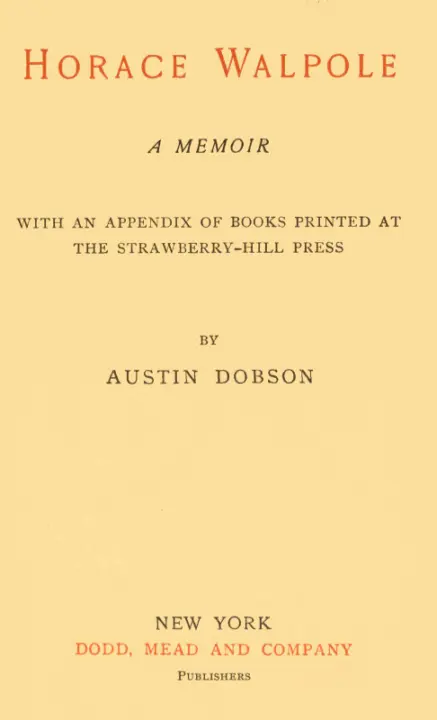
Horace Walpole: A memoir With an appendix of books printed at the Strawberry Hill Press
Austin Dobson
THE CLASSIC COLLECTION · 1892
"Eighteenth Century Vignettes" by Austin Dobson is a collection of historical essays written in the late 19th century. The work presents a series of episodic portraits and reflections on significant figures and events of the 18th century, blending fact with a light degree of narrative elaboration. This compilation aims to capture the essence of the era, focusing on both personal stories and broader cultural moments that shaped the time. The opening portion of the book introduces the reader to a scene from 1708 involving Captain Richard Steele and his wife, Mary Scurlock Steele. The narrative describes a moment of impatience experienced by Mrs. Steele as she awaits her husband in a coach outside Lord Sunderland's office in Whitehall. The text paints a vivid picture of their marriage, highlighting Steele's charming yet tumultuous nature, conflicts over his frequent absences from home, and Mrs. Steele's wrestling emotions. Through letters exchanged between the couple, we gain insights into their relationship dynamics, revealing both affection and underlying tensions that characterize their life together in a bustling 18th century London.
Introduction adapted from the source catalogue; source summaries may be automatically generated.
Free to read · English · 58,985 words · No account needed
MAKE TIME FOR A GOOD BOOK
On by default. Untick to stop anonymous reading totals. Each page counts after 10 seconds in view. How this works.
Anonymous counting is on unless you have switched it off.
In these days of steam power, and floating palaces, and luxurious sick-room appliances, it is not easy to realize the intolerable tedium and discomfort, especially to an invalid, of a passage in a second-rate sailing-ship in the middle of the last century. When, after a rapid but fatiguing two hours' drive, Fielding reached Redriff (Rotherhithe), he had to undergo a further penance. The 'Queen of Portugal' lay in midstream, a circumstance which necessitated his being carried perilously across slippery ground, transferred to a wherry, and finally hoisted over the ship's side in a chair. Nor were his troubles by any means at an end when he found himself securely deposited in the cabin. The voyage, already more than once deferred, was again postponed. First, the vessel could not be cleared at the Custom House until Thursday, because Wednesday was a holiday (Proclamation Day); then the skipper himself announced that he should not weigh anchor before Saturday. Meanwhile, from his unusual exertions and other causes, Fielding's main malady had gained so considerably that he was obliged to summon Dr. William Hunter from Covent Garden to tap him--an operation which he had already more than once undergone with considerable relief. On Sunday the vessel dropped down to Gravesend, reaching the Nore on July 1. Then, for a week, they were becalmed in the Downs, making Ryde just in time to lie safely on the Motherbank during a violent storm. Before the ship left Ryde, the 23rd of July had arrived; and it was not until the second week in August that she sailed up the Tagus, having taken seven weeks to perform a journey which then, at most, occupied three, and is now generally accomplished in about four days.
If the 'Journal of a Voyage to Lisbon' were no more than the chronicle of the facts thus summarized--nay, if it were no more than what Walpole flippantly calls the 'account how his [Fielding's] dropsy was treated and teased by an innkeeper's wife in the Isle of Wight,' it would require and deserve but little consideration. That it is a literary masterpiece is not pretended; nor, in the circumstances of its composition, could a masterpiece be looked for--even from a master. But it is interesting not so much by the events which it narrates as by the indirect light which it throws upon its writer's character, upon his manliness, his patience, and that inextinguishable cheerfulness which, he says in the 'Proposal for the Poor,' 'was always natural to me.' His sufferings must have been considerable (he had to be tapped again before the voyage ended); and yet, with the exception of some not resentful comment upon the inhumanity of certain watermen and sailors who had jeered at his ghastly appearance, no word of complaint as to his own condition is allowed to escape him. On the other hand, his solicitude for his fellow-travellers is unmistakable. One of the most touching pages in the little volume relates how, when his wife, worn out with toothache, lay sleeping lightly in the state room, he and the skipper, who was deaf, sat speechless over a 'small bowl of punch' in the adjoining cabin rather than run the risk of waking her by a sound. 'My dear wife and child,' he says, speaking of a storm in the Channel, 'must pardon me, if what I did not conceive to be any great evil to myself, I was not much terrified with the thoughts of happening to them: in truth, I have often thought they are both too good, and too gentle, to be trusted to the power of any man I know, to whom they could possibly be so trusted.' In another place he relates, quite in his best manner, how he rebuked a certain churlish Custom-house officer for his want of courtesy to Mrs. Fielding. At times one forgets that it is a dying man who is writing, so invincible is that appetite for enjoyment which made Lady Mary say he ought to have been immortal. Not long after they reached Ryde he wrote to his half-brother and successor John (afterwards Sir John) Fielding: 'I beg that on the Day you receive this Mrs. Daniel [his mother-in-law] may know that we are just risen from Breakfast in Health and Spirits [the italics are ours] this twelfth Instant at 9 in the morning.' At Ryde they were shamefully entreated by the most sharp-faced and tyrannical of landladies, in whose incommodious hostelry they sought temporary refuge; and yet it is at Ryde that he chronicles 'the best, the pleasantest, and the merriest meal [in a barn], with more appetite, more real, solid luxury, and more festivity, than was ever seen in an entertainment at White's.' And almost the last lines of the 'Journal' recall a good supper in a Lisbon coffee-house for which they 'were as well charged, as if the bill had been made on the Bath road, between Newbury and London.' But the pleasures of the table play a subordinate part in the sick man's diary, and often only prompt a larger subject, as when the John Dory which regales them at Torbay introduces a disquisition on the improvement of the London fish supply. As might be anticipated, some of his best passages deal with the humanity about him. With characteristic reticence, he says little of his own companions, but his pen strays easily into graphic sketches of the little' world of the 'Queen of Portugal.' The ill-conditioned Custom-house officer, already mentioned; the military fop who comes to visit the captain at Spithead; the sordid and shrewish Ryde landlady with her chuckleheaded nonentity of a husband--are all touched by a hand which, if tremulous, betrays no diminution of its cunning. Of all the potraits, however, that of the skipper is the best. *
Your reading position is saved on this browser. Take it to another device with a library code. Reading pages adapt to text, rather than matching a printed edition.
Austin Dobson

Austin Dobson
Austin Dobson
Austin Dobson
BEHIND THE BOOK
This eBook is for the use of anyone anywhere in the United States and most other parts of the world at no cost and with almost no restrictions whatsoever. You may copy it, give it away or re-use it under the terms of the Project Gutenberg License included with this eBook or online at www.gutenberg.org. If you are not located in the United States, you will have to check the laws of the country where you are located before using this eBook. Read the source licence.
The original source file, including credits and licence, is retained by this library. Request an original-format copy at no charge. Please include the book title and Project Gutenberg identifier #47996.
KEEP YOUR CURIOSITY GOING

David Patterson (Spirit) Hatch

David Patterson (Spirit) Hatch

David Patterson (Spirit) Hatch
Cécile Tormay

Moritz Busch
John L. Ransom