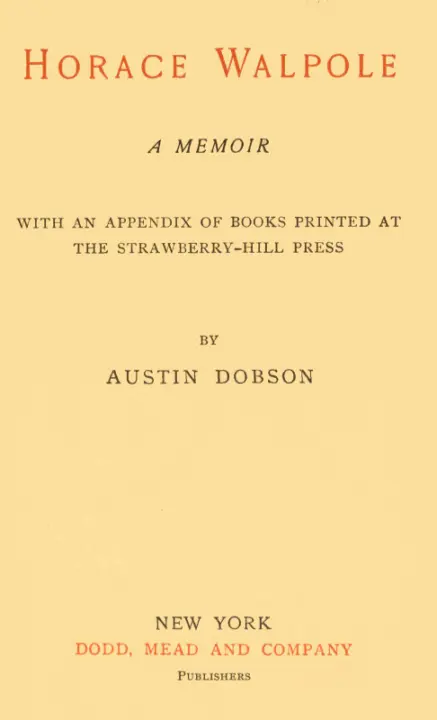
Horace Walpole: A memoir With an appendix of books printed at the Strawberry Hill Press
Austin Dobson
THE CLASSIC COLLECTION · 1892
"Eighteenth Century Vignettes" by Austin Dobson is a collection of historical essays written in the late 19th century. The work presents a series of episodic portraits and reflections on significant figures and events of the 18th century, blending fact with a light degree of narrative elaboration. This compilation aims to capture the essence of the era, focusing on both personal stories and broader cultural moments that shaped the time. The opening portion of the book introduces the reader to a scene from 1708 involving Captain Richard Steele and his wife, Mary Scurlock Steele. The narrative describes a moment of impatience experienced by Mrs. Steele as she awaits her husband in a coach outside Lord Sunderland's office in Whitehall. The text paints a vivid picture of their marriage, highlighting Steele's charming yet tumultuous nature, conflicts over his frequent absences from home, and Mrs. Steele's wrestling emotions. Through letters exchanged between the couple, we gain insights into their relationship dynamics, revealing both affection and underlying tensions that characterize their life together in a bustling 18th century London.
Introduction adapted from the source catalogue; source summaries may be automatically generated.
Free to read · English · 58,985 words · No account needed
MAKE TIME FOR A GOOD BOOK
On by default. Untick to stop anonymous reading totals. Each page counts after 10 seconds in view. How this works.
Anonymous counting is on unless you have switched it off.
Pro captu lectoris habent sua fata libelli. In spite of the verdict of Johnson and Fielding,--that is to say, in spite of the verdict of the Macaulay and Thackeray of the Eighteenth Century,--the Critic, it is to be feared, must be blamed to-day. Were Fielding alone, one might discount his opinion by assuming that he would naturally welcome a work of art which was on his side rather than on that of Richardson; but this would not account for the equally favourable opinion of Johnson. *
* Johnson had, if not a taste, at least an appetite, for the old-fashioned romances which Mrs. Lenox satirised. Once, at Bishop Percy's, he selected 'Fenxmarte of Hircania' (in folio) for his habitual reading, and he read it through religiously. Upon another occasion his choice fell upon Burke's favourite, 'Palmerin of England.' 'History as She is wrote' in 'Clelia' and 'Cleopatra;' the persistence of Arabella in finding princes in gardeners, and rescuers in highwaymen--are things not ill-invented. But repeated they pall; and not all the insistence upon her natural good sense and her personal charms, nor (as compared with such concurrent efforts as Mrs. Eliza Haywood's 'Betsy Thoughtless')
Nor could it be laid entirely to the novelty of the attempt, for 'Tom Jones' and 'Clarissa' and 'Peregrine Pickle,' masterpieces all, had by this time been written, and can still be read, which it is difficult to say of 'The Female Quixote; or, the Adventures of Arabella.' Mrs. Lenox's fundamental idea, no doubt, is a good one, although the character of the heroine has its feminine prototypes in the 'Précieuses Ridicules' of Molière and the Biddy Tipkin of Steele's 'Tender Husband.' It may be conceded, too, that some of the manifold complications which arise from her bringing every incident of her career to the touchstone of the high-falutin' romances of the Sieur de la Calprenède, and that 'grave and virtuous virgin,' Madeleine de Scudéry, are diverting enough. The lamentable predicament of the lover, Mr. Glanville, who is convicted of imperfect application to the pages of 'Cassandra,' by his hopeless ignorance of the elementary fact that the Orontes and Oroondates of that performance are one and the same person; the case of the luckless dipper into Thucydides and Herodotus at Bath who is confronted, to his utter discomfiture, with the inoffensive tone of the book itself, can reconcile us to a heroine who is unable to pass the sugar-tongs without a reference to Parisatis, Princess of Persia, or Cleobuline, Princess of Corinth;--who holds with the illustrious Mandana that, even after ten years of the most faithful services and concealed torments, it is still presumptuous for a monarch to aspire to her hand;--and who, upon the slightest provocation, plunges into tirades of this sort: 'Had you persevered in your Affection, and continued your Pursuit of that Fair-one, you would, perhaps, ere this, have found her sleeping under the Shade of a Tree in some lone Forest, as Philodaspes did his admirable Delia, or disguised in a Slave's Habit, as Ariobarsanes saw his Divine Olympia; or bound haply in a Chariot, and have had the Glory of freeing her, as Ambriomer did the beauteous Agione; or in a Ship in the Hands of Pirates, like the incomparable Eliza; or'--at which point she is fortunately interrupted. In another place she fancies her uncle is in love with her, and thereupon, 'wiping some Tears from her fine Eyes,' apostrophises that elderly and astounded relative in this wise--'Go then, unfortunate and lamented Uncle; go, and endeavour by Reason and Absence to recover thy Repose; and be assured, whenever you can convince me you have triumphed over these Sentiments which now cause both our Unhappiness, you shall have no Cause to complain of my Conduct towards you.' There is an air of unreality about all this, which, one would think, should have impeded its popularity in its own day. In the Spain of Don Quixote it is conceivable; it is intolerable in the England of Arabella. But there are other reasons which help to account for the oblivion into which the book has fallen. One is, that by neglecting to preserve the atmosphere of the age in which it was written, it has missed an element of vitality which is retained even by such fugitive efforts as Coventry's 'Pompey the Little.' *
Your reading position is saved on this browser. Take it to another device with a library code. Reading pages adapt to text, rather than matching a printed edition.
Austin Dobson
Austin Dobson
Austin Dobson
Austin Dobson
BEHIND THE BOOK
This eBook is for the use of anyone anywhere in the United States and most other parts of the world at no cost and with almost no restrictions whatsoever. You may copy it, give it away or re-use it under the terms of the Project Gutenberg License included with this eBook or online at www.gutenberg.org. If you are not located in the United States, you will have to check the laws of the country where you are located before using this eBook. Read the source licence.
The original source file, including credits and licence, is retained by this library. Request an original-format copy at no charge. Please include the book title and Project Gutenberg identifier #47996.
KEEP YOUR CURIOSITY GOING

David Patterson (Spirit) Hatch

David Patterson (Spirit) Hatch

David Patterson (Spirit) Hatch
Cécile Tormay

Moritz Busch
John L. Ransom