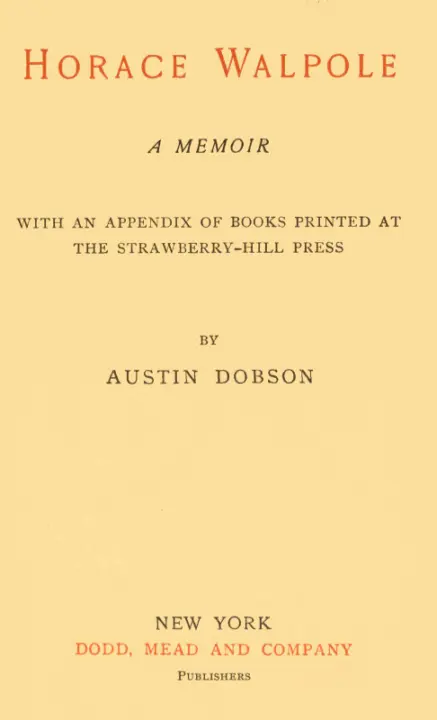
Horace Walpole: A memoir With an appendix of books printed at the Strawberry Hill Press
Austin Dobson
THE CLASSIC COLLECTION · 1892
"Eighteenth Century Vignettes" by Austin Dobson is a collection of historical essays written in the late 19th century. The work presents a series of episodic portraits and reflections on significant figures and events of the 18th century, blending fact with a light degree of narrative elaboration. This compilation aims to capture the essence of the era, focusing on both personal stories and broader cultural moments that shaped the time. The opening portion of the book introduces the reader to a scene from 1708 involving Captain Richard Steele and his wife, Mary Scurlock Steele. The narrative describes a moment of impatience experienced by Mrs. Steele as she awaits her husband in a coach outside Lord Sunderland's office in Whitehall. The text paints a vivid picture of their marriage, highlighting Steele's charming yet tumultuous nature, conflicts over his frequent absences from home, and Mrs. Steele's wrestling emotions. Through letters exchanged between the couple, we gain insights into their relationship dynamics, revealing both affection and underlying tensions that characterize their life together in a bustling 18th century London.
Introduction adapted from the source catalogue; source summaries may be automatically generated.
Free to read · English · 58,985 words · No account needed
MAKE TIME FOR A GOOD BOOK
On by default. Untick to stop anonymous reading totals. Each page counts after 10 seconds in view. How this works.
Anonymous counting is on unless you have switched it off.
There is but slender invention in this little picture. The gentleman was Captain Steele, late of the Life Guards, the Coldstreams, and Lucas's regiment of foot, now Gazetteer, and Gentleman Waiter to Queen Anne's consort, Prince George of Denmark, and not yet 'Mr. Isaac Bickerstaff' of the immortal 'Tatler.' The lady was Mrs. Steele, née Miss Mary Scurlock, his 'Ruler' and 'absolute Governesse' (as he called her), to whom he had been married some eight months before. If you ask at the British Museum for the Steele manuscripts (Add. MSS. 5,145, A, B, and C), the courteous attendant will bring you, with its faded ink, dusky paper, and hasty scrawl, the very letter making arrangements for this meeting ('best Periwigg' and 'new Shoes' included), at the end of which the writer assures his 'dear Prue' (another pet name) that she is 'Vitall Life to YT Oblig'd Affectionate Husband & Humble Sernt Richd Steele.' There are many such in the quarto volume of which this forms part, written from all places, at all times, in all kinds of hands. They take all tones; they are passionate, tender, expostulatory, playful, dignified, lyric, didactic. It must be confessed that from a perusal of them one's feeling for the lady of the chariot is not entirely unsympathetic. It can scarcely have been an ideal household, that 'third door right hand turning out of Jermyn Street,' to which so many of them are addressed; and Mrs. Steele must frequently have had to complain to her confidante, Mrs. (or Miss) Binns (a lady whom Steele is obviously anxious to propitiate), of the extraordinary irregularity of her restless lord and master. Now a friend from Barbados has stopped him on his way home, and he will come (he writes) 'within a Pint of Wine;' now it is Lord Sunderland who is keeping him indefinitely at the Council; now the siege of Lille and the proofs of the 'Gazette' will detain him until ten at night. Sometimes his vague 'West Indian business' (that is, his first wife's property) hurries him suddenly into the City; sometimes he is borne off to the Gentleman Ushers' table at St. James's. Sometimes, even, he stays out all night, as he had done not many days before the date of the above meeting, when he had written to beg that his dressing-gown, his slippers, and 'clean Linnen' might be sent to him at 'one Legg's,' a barber 'over against the Devill Tavern at Charing Crosse,' where he proposes to lie that night, chiefly, it has been conjectured from the context, in order to escape certain watchful 'shoulder-dabbers' who were hanging obstinately about his own mansion in St. James's. For--to tell the truth--he was generally hopelessly embarrassed, and scarcely ever without a lawsuit on his hands. He was not a bad man; he was not necessarily vicious or dissolute. But his habits were incurably generous, profuse, and improvident; and his sanguine Irish nature led him continually to mistake his expectations for his income. Naturally, perhaps, his 'absolute Governesse' complained of an absolutism so strangely limited. If her affection for him was scarcely as ardent as his passion for her, it was still a genuine emotion. But to a coquette of some years' standing, and 'a cried-up beauty' (as Mrs. Manley calls her), the realities of her married life must have been a cruel disappointment; and she was not the woman to conceal it. 'I wish,' says her husband in one of his letters, 'I knew how to Court you into Good Humour, for Two or Three Quarrells more will dispatch me quite.' Of her replies we have no knowledge; but from scattered specimens of her style when angry, they must often have been exceptionally scornful and unconciliatory. On one occasion, where he addresses her as 'Madam,' and returns her note to her in order that she may see, upon second thoughts, the disrespectful manner in which she treats him, he is evidently deeply wounded. She has said that their dispute is far from being a trouble to her, and he rejoins that to him any disturbance between them is the greatest affliction imaginable. And then he goes on to expostulate, with more dignity than usual, against her unreasonable use of her prerogative. 'I Love you,' he says, 'better than the light of my Eyes, or the life-blood in my Heart but when I have lett you know that, you are also to understand that neither my sight shall be so far inchanted, or my affection so much master of me as to make me forgett our common Interest. To attend my businesse as I ought and improve my fortune it is necessary that my time and my Will should be under no direction but my own.' Clearly his bosom's queen had been inquiring too closely into his goings and comings. It is a strange thing, he says, in another letter, that, because she is handsome, he must be always giving her an account of every trifle, and minute of his time. And again--'Dear Prue, do not send after me, for I shall be ridiculous:' It had happened to him, no doubt. 'He is governed by his wife most abominably, as bad as Marlborough,' says another contemporary letter-writer. And we may fancy the blue eyes of Dr. Swift flashing unutterable scorn as he scribbles off this piece of intelligence to Stella and Mrs. Dingley.
Your reading position is saved on this browser. Take it to another device with a library code. Reading pages adapt to text, rather than matching a printed edition.
Austin Dobson
Austin Dobson
Austin Dobson
Austin Dobson
BEHIND THE BOOK
This eBook is for the use of anyone anywhere in the United States and most other parts of the world at no cost and with almost no restrictions whatsoever. You may copy it, give it away or re-use it under the terms of the Project Gutenberg License included with this eBook or online at www.gutenberg.org. If you are not located in the United States, you will have to check the laws of the country where you are located before using this eBook. Read the source licence.
The original source file, including credits and licence, is retained by this library. Request an original-format copy at no charge. Please include the book title and Project Gutenberg identifier #47996.
KEEP YOUR CURIOSITY GOING

David Patterson (Spirit) Hatch

David Patterson (Spirit) Hatch

David Patterson (Spirit) Hatch
Cécile Tormay

Moritz Busch
John L. Ransom