THE CLASSIC COLLECTION✦My diaries, being a personal narrative of events 1888-1914, Part 2 (1900-1914)CLASSIC FREE BOOKS
My diaries, being a personal narrative of events 1888-1914, Part 2 (1900-1914)
Wilfrid Scawen Blunt
THE CLASSIC COLLECTION · 1909
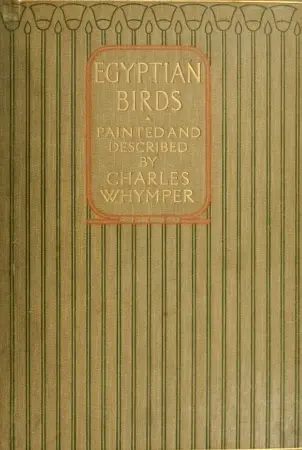
"Egyptian Birds" by Charles Whymper is a scientific publication written in the early 20th century. The book focuses on the diverse avian life found in Egypt, particularly in the Nile Valley, offering descriptions and illustrations of the various species encountered there. Whymper aims to make the information accessible to general readers, especially travelers interested in identifying the birds they observe. The opening of the text sets the stage for a detailed exploration of Egyptian birds, beginning with an anecdote about the significance of observing their flight patterns for identification. The author emphasizes the ease of spotting birds along the Nile due to their almost tame behavior, and provides a list of species commonly seen, such as Kites, Vultures, and various types of Owls. Whymper shares personal experiences and observations during his travels, including his time spent at significant locations such as the Sacred Lake at Karnak. This portion establishes the book's intent to be a practical guide for bird enthusiasts and travelers seeking to enrich their understanding of avian life in Egypt.
Introduction adapted from the source catalogue; source summaries may be automatically generated.
Free to read · English · 46,004 words · No account needed
MAKE TIME FOR A GOOD BOOK
On by default. Untick to stop anonymous reading totals. Each page counts after 10 seconds in view. How this works.
Anonymous counting is on unless you have switched it off.
H.H. the Khedive being informed of my desire to visit the Flamingo at its home in Lake Menzaleh, exceedingly kindly granted me special facilities, and I was able to go from end to end of this great lake and from side to side, visiting every place where they were to be found. I was allowed the use of one of the coastguard dahabeahs. These boats are built on the lines of the native fishing-boats; being practically flat-bottomed they draw but little water, which is necessary, as the lake for its size is very shallow. It is this shallowness which makes Menzaleh such a happy hunting-ground for all water-birds. It fairly teems with birds; in February there are literally millions of Duck there, with Cormorants, Pelicans, Herons, Flamingoes, and Waders of every sort. In March they lessen in numbers, many only using it as a place to spend a few weeks at before going north to their summer homes, and by the time April comes there are not an overwhelming number; but the Flamingoes keep there as a feeding-ground nearly all the year round, and it was to see if they had their nesting-quarters there that I went to Menzaleh early this year, 1909.
You cannot be long on the lake before you begin to understand why birds love it so, for as you sail along you frequently see, first here, then there, fish jumping out of the water, and when you look into the shallows in all directions you see shoals of little fishes. Then the number of fishing-boats, with their great nets picturesquely hung up to dry, is another visible evidence of the teeming myriads of fish that this saltish-water lake contains. The first Flamingoes I saw were in the centre of a large flock of tufted Ducks. Leaving the dahabeah I got into the small boat and quickly paddled towards them, but they would not allow of a very near approach before up got the Duck, and then in another moment the Flamingoes, who had up to then been feeding with heads down in the water, were all on the wing--to rise they faced for one minute in my direction, and the great mass of crimson feathers under the wings made a most gorgeous spectacle against the blue sky; then they swung round, and more white than red was visible, and quickly in a long irregular line they were away to some less disturbed place. Only once did I get really close up to one, and I found out afterwards by the hanging leg that it only allowed me to because it was some poor crippled bird. They are so shot at and persecuted generally that they are now exceedingly shy, and in spite of the good feeding they get here it is surprising they still keep to these waters in the numbers they do. At a town called Matariya I visited a great local bird-dealer, one Angelino Tedeschi. His place was on the outskirts of the town, and was a collection of tumble-down shanties made of straw, matting, and boards. Behind his own dwelling, which was literally worse than any Irish cabin, were three enclosures made of tall reeds and split palm branches about eight feet high, with more open lattice-work on the top; in these enclosures were fully fifty to sixty Flamingoes. I walked right in, and the birds did not stampede or dash themselves about, yet Angelino said they had not long been caught. They were all in surprisingly good condition, considering their numbers and cramped space. A door at one end was opened and they filed out into the adjoining enclosure to have their bath--a very dirty, muddy hole in the sodden ground, but they seemed to enjoy it; one after the other, and sometimes two or three at a time, all went in, and drank and splashed about, trumpeting a little, and then they were driven back. I bought a particularly brilliant-coloured one which had died that day, for the price the man asked, three shillings, which seemed to me very cheap, as it was in perfect order. I wanted one to make detailed studies of, and I took it back to the boat with me, and worked from this poor bird till all the crew covered their noses with their hands as they came near my model, and I myself could stand it no longer, and it was tossed over as food for the fishes, who later again would be food for others of its own kindred. Scattered about Angelino's quarters were curious high crates made of split palm branches and lined with canvas. Asking what they were for, I was told they were the cages for the poor birds to be sent away--"to America," he said--and I could get no more out of him. We learned this man comes every winter from Alexandria, settles down in these remarkable quarters, and buys his Flamingoes from the local fishermen, who vary their ordinary pursuit by catching duck and any wildfowl that they can net, and the result is that, though years ago Flamingoes did nest on the lake, now not one does.
Your reading position is saved on this browser. Take it to another device with a library code. Reading pages adapt to text, rather than matching a printed edition.
BEHIND THE BOOK
This eBook is for the use of anyone anywhere in the United States and most other parts of the world at no cost and with almost no restrictions whatsoever. You may copy it, give it away or re-use it under the terms of the Project Gutenberg License included with this eBook or online at www.gutenberg.org. If you are not located in the United States, you will have to check the laws of the country where you are located before using this eBook. Read the source licence.
The original source file, including credits and licence, is retained by this library. Request an original-format copy at no charge. Please include the book title and Project Gutenberg identifier #46825.
KEEP YOUR CURIOSITY GOING
Wilfrid Scawen Blunt
Wilfrid Scawen Blunt

E. W. (Edgar Watson) Howe
Francis Greenleaf Allinson & Anne C. E. (Anne Crosby Emery) Allinson
Cyrenus Cole

John Martineau