THE CLASSIC COLLECTION✦My diaries, being a personal narrative of events 1888-1914, Part 2 (1900-1914)CLASSIC FREE BOOKS
My diaries, being a personal narrative of events 1888-1914, Part 2 (1900-1914)
Wilfrid Scawen Blunt
THE CLASSIC COLLECTION · 1909
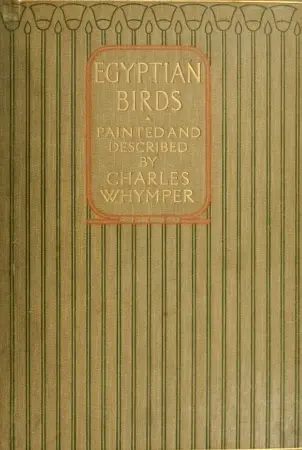
"Egyptian Birds" by Charles Whymper is a scientific publication written in the early 20th century. The book focuses on the diverse avian life found in Egypt, particularly in the Nile Valley, offering descriptions and illustrations of the various species encountered there. Whymper aims to make the information accessible to general readers, especially travelers interested in identifying the birds they observe. The opening of the text sets the stage for a detailed exploration of Egyptian birds, beginning with an anecdote about the significance of observing their flight patterns for identification. The author emphasizes the ease of spotting birds along the Nile due to their almost tame behavior, and provides a list of species commonly seen, such as Kites, Vultures, and various types of Owls. Whymper shares personal experiences and observations during his travels, including his time spent at significant locations such as the Sacred Lake at Karnak. This portion establishes the book's intent to be a practical guide for bird enthusiasts and travelers seeking to enrich their understanding of avian life in Egypt.
Introduction adapted from the source catalogue; source summaries may be automatically generated.
Free to read · English · 46,004 words · No account needed
MAKE TIME FOR A GOOD BOOK
On by default. Untick to stop anonymous reading totals. Each page counts after 10 seconds in view. How this works.
Anonymous counting is on unless you have switched it off.
Elsewhere the point of the scarcity of bird life in the hot summer months has been spoken of, but it is also curious to note that there are just about three to five weeks of mid-winter during which there is no migratory wave seemingly going on at all, up or down the Nile valley. No bands, great or small, of birds heading due north or due south are ever to be seen, and the remark is often made on the paucity of bird life, some persons even declaring that it is "a birdless land." That the native birds are very small in number is true, but the total number of birds, and varieties of birds, that come for a time and pass on is very great. Those that live in temperate climes do, however, have the best of the deal, as it must ever be a greater
possession to have the birds nesting around one than merely passing by in migrating flights, be those flights as amazing as they may. Birds, from whatever reason is not certainly known, do not love the excessively hot or cold areas as breeding-places, but do seem to love the more moderate temperate climes. In Great Britain the number of birds that will and do breed within a very small tract of ground is amazing, and Mr. Kearton tells of a small copse in Hertfordshire in which were the nests, with eggs or young, of nine different species of birds, all within fifty yards of one another; and in another case, within a space of ten yards, were a tit's, a flycatcher's, and a wood wren's nest. In Egypt, the number of birds breeding is not large, and excepting some of the great lakes with their margins of shallow water and swampy reeds, there are few places that offer any attractions for birds to nest in any numbers. In the groves of palms you do get many doves building in close proximity with kites and crows, and along certain stretches of the Nile banks large colonies of sand-martins build, but with these exceptions the fact remains that this country has not a large list of birds breeding in any numbers. In the great lakes of Lower Egypt and the Fayoum there are, however, enormous areas of some of the best feeding-grounds imaginable for water-fowl, and the fowl know it; nowhere can be seen more variety of duck, and herons, and waders, and shore birds, than at Lake Menzaleh. Elsewhere, I have already referred to my visit in March and April to this little known part of Egypt, and I wish that those who say this is "a birdless land," would only go and stay a few days at Kantara, Matariya, Damietta or Port Said, and then see if they could still call it "birdless." The extreme north and east side of the lake is separated only from the Mediterranean by a narrow bank of sand. Its waters are brackish, the Nile contributes but little to its bulk, and the opinion is largely held that if it could be made to contribute more, the food supply for the fish in it would be considerably increased, to the very great benefit of the fish supply of the country. Every village and town on the lake has many fishermen with boats out night and day. They catch a very large quantity, but it is said every year the size of the fish caught is steadily decreasing, and to increase the food-supply for the fish is now the aim of the authorities. This matter does not immediately affect the birds, as they love the small fry, but if Lake Menzaleh were to once lose its value as a supplier of profitable fish food, it might come to pass that some future engineer would turn his attention to this great area of waste water, and turn it into profitable cultivated ground, and then the birds would be driven away here as completely as they were in England when our fens and meres were drained to make good corn land. Therefore, this proposal to let in more Nile water is of much importance to Menzaleh remaining the great stronghold of bird life in Egypt. At present the spectacle it presents of its crowds of birds seen under the almost constant blue sky, is one that all would be very sorry to lose. The Flamingo come as its crowning glory, but the list of birds is long, and Mr. M. J. Nicoll tells how in only one week's stay, at Gheit-el-Nassara, on the north-west side of the lake, he met with no less than eighty-seven species. The ordinary visitor to Egypt hurries away from Alexandria or Port Said, but any who love Nature ought to leave a few days for places other than the Nile, if they are to obtain anything at all like a complete knowledge of Egyptian Birds.
Your reading position is saved on this browser. Take it to another device with a library code. Reading pages adapt to text, rather than matching a printed edition.
BEHIND THE BOOK
This eBook is for the use of anyone anywhere in the United States and most other parts of the world at no cost and with almost no restrictions whatsoever. You may copy it, give it away or re-use it under the terms of the Project Gutenberg License included with this eBook or online at www.gutenberg.org. If you are not located in the United States, you will have to check the laws of the country where you are located before using this eBook. Read the source licence.
The original source file, including credits and licence, is retained by this library. Request an original-format copy at no charge. Please include the book title and Project Gutenberg identifier #46825.
KEEP YOUR CURIOSITY GOING
Wilfrid Scawen Blunt
Wilfrid Scawen Blunt

E. W. (Edgar Watson) Howe
Francis Greenleaf Allinson & Anne C. E. (Anne Crosby Emery) Allinson
Cyrenus Cole

John Martineau