THE CLASSIC COLLECTION✦My diaries, being a personal narrative of events 1888-1914, Part 2 (1900-1914)CLASSIC FREE BOOKS
My diaries, being a personal narrative of events 1888-1914, Part 2 (1900-1914)
Wilfrid Scawen Blunt
THE CLASSIC COLLECTION · 1909
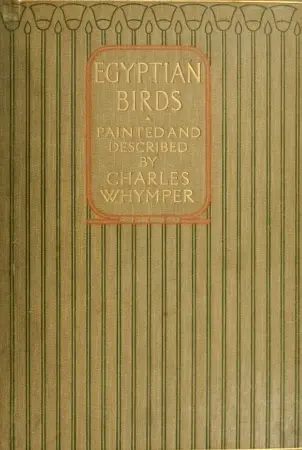
"Egyptian Birds" by Charles Whymper is a scientific publication written in the early 20th century. The book focuses on the diverse avian life found in Egypt, particularly in the Nile Valley, offering descriptions and illustrations of the various species encountered there. Whymper aims to make the information accessible to general readers, especially travelers interested in identifying the birds they observe. The opening of the text sets the stage for a detailed exploration of Egyptian birds, beginning with an anecdote about the significance of observing their flight patterns for identification. The author emphasizes the ease of spotting birds along the Nile due to their almost tame behavior, and provides a list of species commonly seen, such as Kites, Vultures, and various types of Owls. Whymper shares personal experiences and observations during his travels, including his time spent at significant locations such as the Sacred Lake at Karnak. This portion establishes the book's intent to be a practical guide for bird enthusiasts and travelers seeking to enrich their understanding of avian life in Egypt.
Introduction adapted from the source catalogue; source summaries may be automatically generated.
Free to read · English · 46,004 words · No account needed
MAKE TIME FOR A GOOD BOOK
On by default. Untick to stop anonymous reading totals. Each page counts after 10 seconds in view. How this works.
Anonymous counting is on unless you have switched it off.
to come to a great feast, all came except this Plover. Allah rebuked him. The Plover said he had fallen asleep and forgot all about the fixture. Allah, who knows all things, knew he lied, and answered, "Then from this time forth thou shalt know no sleep," and he made these two spurs to grow on the points of his shoulders so that he shall suffer great pain if he try to sleep by putting his head under his wing.
Pluvianus aegyptius
Arabic, Ter el timsah
Top of head black, as also is a band through eye which meets the black and across chest; wing and sides of back a very beautiful pale lilac blue-grey, under-parts white, lower throat and flanks a creamy rufous, legs bluish, eye brown. Total length, 8·5 inches.
This is regarded as quite certainly the bird known in ancient days as the Crocodile Bird. It was held to be the faithful attendant of this fearsome reptile, warning it of danger: and when the creature it fed was full, this little bird was supposed to attend to the proper cleaning of the ogre's teeth! For this purpose, we are told, the crocodile would lie quietly with its great mouth wide open whilst this brave little dentist ran about briskly right into the open jaws and deftly removed noisome leech or scrap of food left between those ugly fangs, and never showing the slightest fear. It is a pretty story, but as there are now no crocodiles in Egypt proper, the ordinary traveller has no chance of seeing if this be so or no. But though the crocodiles are gone the Black-headed Plover is
still to be seen by those going up or down by water. Mr. E. Cavendish Taylor, writing in 1867, says, "This bird is abundant all along the Nile above Cairo, wherever the banks of the river are muddy." Captain Shelley in 1870, referring to it, says, "It is plentifully distributed throughout Egypt and Nubia, but it is most abundant in Upper Egypt between Siool and Thebes." I myself saw it many times in 1875, whilst going up and returning, in good quiet-fashioned way, by dahabeah; but when I again went over the same ground in 1908, although going very slowly and stopping every day, I only find, from my notebook, that we saw it three or four times in our six weeks' journey from Thebes to Cairo. All that we saw were wild and anything but the confiding birds one has been taught to regard them. I think by far the most notable thing about this bird is its curious habit of laying its eggs on the sand, and then carefully burying them with the clear purpose of letting the genial sun do the bulk of the work of hatching out. Captain Verner gives a most interesting and detailed account of watching the movements of one of these birds on a sandbank. He went to the place, he writes, "And at the precise spot turned over the sand, and about half an inch below the surface discovered three fresh eggs, which the artful bird had completely buried.... Still I was unable to account in my own mind for the very energetic movements to and from the water which I had witnessed on this occasion, until I received an account from a cousin, Lieutenant George Verner, of the Borderers, who was stationed about forty miles farther down the river than I was, which solved the mystery, as follows:--'On 25th April I was waiting in a boat alongside of a sandbank, and my attention was attracted by a pair of Black-headed Plovers which kept flitting about quite close to me. I noticed that one of them was continually wetting its breast at the water's edge about ten yards below our boat, and then running up the bank to a spot about the same distance inshore of us, when it would squat down and remain about two minutes or so, after which it would get up, and, running down to the water's edge above us, fly round to the spot where it had dabbled previously.... At the spot where the bird had been crouching I found a clutch of eggs half buried in the sand, their tops only being visible; the sand immediately surrounding them was moist, although the bank I was on was an expanse of dry burning sand.'" From this it seems clear, as Captain Verner says, that this plover has learnt that with judicious damping, the sand and the sun will do the hatching, thereby removing the necessity of having to spend long days and nights brooding over the eggs. It is, however, very curious that no other of the large number of birds that lay their eggs on the desert sand or hard dry mud-banks should do this: and especially curious since these birds are first cousins, as one might say, to the Spur-winged Plover--which breeds often within a few hundred yards of where Black-headed ones are--and this bird sits continuously till the young are hatched. The egg resembles that of the Red Grouse and is not very plover-like in character--indeed, some ornithologists will have it this bird is not really a Plover, but is more allied to the Coursers.
Your reading position is saved on this browser. Take it to another device with a library code. Reading pages adapt to text, rather than matching a printed edition.
BEHIND THE BOOK
This eBook is for the use of anyone anywhere in the United States and most other parts of the world at no cost and with almost no restrictions whatsoever. You may copy it, give it away or re-use it under the terms of the Project Gutenberg License included with this eBook or online at www.gutenberg.org. If you are not located in the United States, you will have to check the laws of the country where you are located before using this eBook. Read the source licence.
The original source file, including credits and licence, is retained by this library. Request an original-format copy at no charge. Please include the book title and Project Gutenberg identifier #46825.
KEEP YOUR CURIOSITY GOING
Wilfrid Scawen Blunt
Wilfrid Scawen Blunt

E. W. (Edgar Watson) Howe
Francis Greenleaf Allinson & Anne C. E. (Anne Crosby Emery) Allinson
Cyrenus Cole

John Martineau