THE CLASSIC COLLECTION✦Scepticism and animal faithCLASSIC FREE BOOKS
Scepticism and animal faith
George Santayana
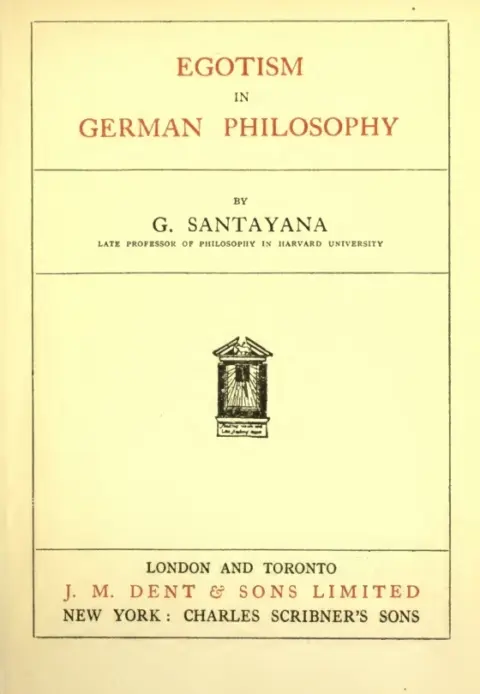
THE CLASSIC COLLECTION · 1916
"Egotism in German Philosophy" by George Santayana is a philosophical work written in the early 20th century. The book explores the nature of German philosophy, emphasizing its subjective and egotistical core, as well as its implications in the broader context of culture and morality. Santayana presents a critical analysis of German philosophical thought, particularly focusing on figures like Kant, Fichte, and Hegel, and argues that their ideas often reflect an overemphasis on the individual self at the expense of reality and communal values. The opening of the book lays the groundwork for Santayana's critique, revealing his perspective on German philosophy as fundamentally flawed yet influential. He expresses his skepticism about its validity and laments the pervasive egotism he perceives in its core tenets. Santayana introduces his views on the subjective nature of thought and the tendency of German philosophers to glorify this egotism, suggesting that it has contributed to a distorted understanding of existence, duty, and moral responsibility. By outlining the philosophical landscape, he sets the stage for a deeper examination of individualism versus collective experiences and the philosophical reflections that shape societal values.
Introduction adapted from the source catalogue; source summaries may be automatically generated.
Free to read · English · 36,439 words · No account needed
MAKE TIME FOR A GOOD BOOK
On by default. Untick to stop anonymous reading totals. Each page counts after 10 seconds in view. How this works.
Anonymous counting is on unless you have switched it off.
[Pg 169]
INDEX
Alexander the Great, a model for German idealists, 80, 81
Aristotle, 120, 124
Belief in God, disproved pragmatically, 134
Bull-psychology, 148, 153
Burckhardt, 47
Byron, 48, 49
Cæsar Borgia, a superman, 138
Calvinism, in Kant, 57; in Fichte, 25, 77; in Hegel, 111
Categorical imperative, its origin, 56; its prerogatives, 62;
its dangers, 63
Chancellor, the German, his chivalrous after-thought about Belgium, 50
Christianity, foreign to Germany, 11;
undermined by German philosophy, 104, 105;
patronised by Goethe, 46;
abandoned by romantic individualists, 107;
denounced by Nietzsche, 130-132;
has one element in common with egotism, 106
Classicism, romantic in Goethe, 46;
missed by Nietzsche, 139-142;
when truly vital, 48
Conquest, a sublime duty, 80, 81
Contraries, alleged to be inseparable, 89, 90
Criticism, historical, has a transcendental basis, 29
Critique of Pure Reason, its agnosticism, 14;
its sophistical foundation, 20
Durer, 27
Egotism, defined, 6;
distinguished from selfishness, 95-97, 100-102, 118;
based on error, 167;
implicit in the Kantian imperative and postulates, 62-64;
implies integrity, force, self-complacency, 163-166;
is odious in pedants, 142
Emerson, 24, 49; quoted, 119
England, judged by Fichte, 76
Evil, justified, 123, 132-134
Faith, German conception of it, 13, 27;
corroborated only by itself, 31, 68
Faust, typical egotist, 13, 14;
prefigures the evolution of Germany, 50, 51, 157;
improves on Saint John, 52
Fichte, 65-83
Gemüth, why self-conscious, 160
German ethics, its faults, 103
German language, its merits, 75
German nation, its purity, 75;
its mission, 78, 79;
in what sense the chosen people, 73, 74;
necessary to the continued existence of God, 68;
and of history, 79; its fortunes, 158-160
German philosophy, not all philosophy in Germany, 11;
primitive, 27; subjective, 12;
in what senses idealistic, 15;
in what sense not so, 16;
ambiguous, 17, 18;
a revelation, 22;
must continually be proved afresh, 26;
is a work of genius, 155
Gobineau, 77
Goethe, 43-53; quoted, 159, 165
Good and evil above right and wrong, 124
Gospel, amended by Faust, 52;
glossed by Hegelians, 105
Happiness, not for the egotist, 14, 15;
he despises it, 152;
not abstract nor absolute, 110, 111;
attainable, 118; its nature, 152, 153
Heathenism, use of the word, 144;
contrast with paganism, 145, 146;
its modern form, 147, 148
Hegel, 84-98
Human nature, 117, 118
Idealism, meanings of the word, 15, 16;
fosters practical materialism, 5, 69-72, 78, 81, 82;
should be imposed on the young, 80;
its mystical issue, 38-40
Ideals, when captious, when solid, 137
Infinity, evaded by Hegel, 88, 89;
recognised again by Schopenhauer, 108, 109
Kant, 54-64; 25, 34, 35, 42
Knowledge, assumed to be impossible, 15;
abuse of the term, 39, 60
Leibniz, anticipates transcendentalism, 33;
his insidious theology, 104
Lessing, on truth, 129
Locke, sets the ball rolling, 32
Luther, 135, 157
Max Stirner, 99-103; quoted, 73
Montaigne, quoted, 168 Music, 16, 161
Musset, 49
Mysticism, in knowledge, 38-40; in morals, 123
Nietzsche, 114-143
Optimism, egotistical, 25, 111, 114, 116, 118, 119
Passion, not naturally egotistical, 101;
may become so, 95, 98;
dull in egotists, 165, 166
Paulsen, 42
Perception, terminates in things not in ideas, 19
Pessimism, inherits disregard of intrinsic values, 109;
reacts against optimism, 25, 111;
is arbitrary, 116
Pier Gynt, typical egotist, 13, 14
Plato, his idealism contrasted with the German, 16;
his oppressive politics, 81;
on inspiration, 141
Postulates of practical reason, equivocal, 58-64
Power, divers meanings of the word, 125-127
Preservation, no law of nature, 115
Progress, when illusory, 17; when real, 112
Protestantism, 21-31, 151
Religion in German philosophy, 7, 13, 75, 76, 82, 83
Rome and German genius, 150
Your reading position is saved on this browser. Take it to another device with a library code. Reading pages adapt to text, rather than matching a printed edition.
George Santayana

George Santayana

George Santayana
George Santayana
BEHIND THE BOOK
This eBook is for the use of anyone anywhere in the United States and most other parts of the world at no cost and with almost no restrictions whatsoever. You may copy it, give it away or re-use it under the terms of the Project Gutenberg License included with this eBook or online at www.gutenberg.org. If you are not located in the United States, you will have to check the laws of the country where you are located before using this eBook. Read the source licence.
The original source file, including credits and licence, is retained by this library. Request an original-format copy at no charge. Please include the book title and Project Gutenberg identifier #48431.
KEEP YOUR CURIOSITY GOING

David Patterson (Spirit) Hatch
Coulson Kernahan

Ralph Waldo Emerson
Frances Wright

Edwin Abbott Abbott

Joseph Droz