THE CLASSIC COLLECTION✦VariationsCLASSIC FREE BOOKS
Variations
James Huneker
THE CLASSIC COLLECTION · 1925
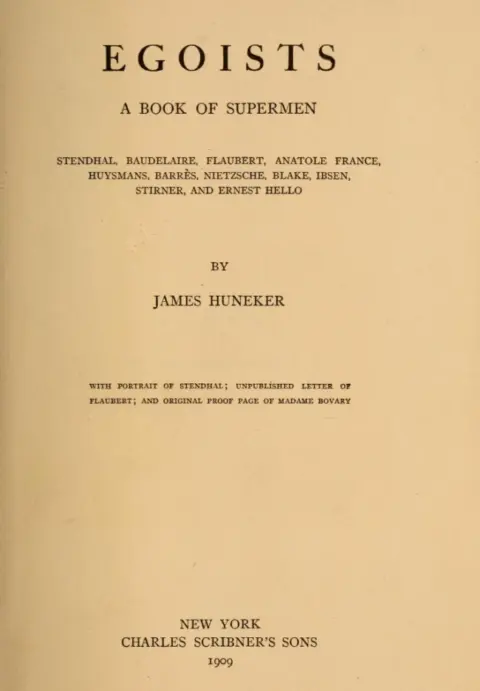
"Egoists, A Book of Supermen" by James Huneker is a collection of literary essays written in the early 20th century. The book explores prominent figures in literature and philosophy, including Stendhal, Flaubert, and Nietzsche, highlighting their contributions and idiosyncrasies. Through a critical lens, Huneker delves into the intricacies of their lives and works, examining the traits that set them apart as "supermen" in the literary canon. The opening of the collection introduces the first essay, focusing on Henry Beyle, better known as Stendhal. Huneker paints a vivid portrait of Stendhal, contrasting his delicate psychological insights with his unremarkable physical appearance. The text discusses Stendhal's duality as a passionate lover and cynical observer, emphasizing how his seemingly contradictory nature informed his writing. The essay sets the tone for the subsequent pieces, suggesting a rich exploration of the complex interplay between personality, creativity, and the societal contexts in which these literary figures existed.
Introduction adapted from the source catalogue; source summaries may be automatically generated.
Free to read · English · 89,359 words · No account needed
MAKE TIME FOR A GOOD BOOK
On by default. Untick to stop anonymous reading totals. Each page counts after 10 seconds in view. How this works.
Anonymous counting is on unless you have switched it off.
Where was he going, Gustave Flaubert, on that sunny afternoon? It was at the time when Jules Ferry appointed him an assistant-librarian at the Mazarine; hors cadre, a sinecure, a veiled pension with 3,000 francs a year; a charity, as the great writer bitterly complained. He was poor. He had given up, without a murmur, his entire fortune to his niece, then Madame Caroline Commainville, and through the influence of Turgenev and a few others this position had been created for him. He had no duties, yet he insisted on arriving at his post as early as half-past seven in the morning. He planned later that the government should be reimbursed for its outlay. His brother, Dr. Achille Flaubert, of Rouen, gave him a similar allowance, so the unhappy man had enough to live upon. Perhaps he was going to the Gare Saint-Lazare to take a train for Croisset; perhaps he was starting for Ancient Corinth--I thought--to see once more his Salammbô veiled by the sacred Zaïmph; or he might have been on the point of departing for Taprobana, the Ceylon of the antique world; that island whose very name he repeated with the same pleasure as did the old woman the blessed name of "Mesopotamia."
Taprobana! Taprobana! would cry Gustave Flaubert, to the despair of his friends. He was a man in love with beautiful sounds. He filled his books with them and with beautiful pictures. You must go to Beethoven or Liszt for a like variety in rhythms; the Flaubertian prose rhythms change in every sentence, like a landscape alternately swept by sunlight or shadowed by clouds. They vary with the moods and movements of the characters. They are music for ear and eye. And they can never be translated. He is poet, painter, and composer, and he is the most artistic of novelists. If his work is deficient in sentiment; if he fails to strike the chords of pity of Dostoïevsky, Turgenev, and Tolstoy; if he lacks the teeming variety of Balzac, he is superior to them all as an artist. Because of his stern theories of art, he renounced the facile victories of sentimentalism. He does not invite his readers to smile or weep with him. He is not a manipulator of marionettes. And he can compress in a page more than Balzac in a volume. In part he derives from Chateaubriand, Gautier, and Hugo, and he was a lover of Rabelais, Shakespeare, and Montaigne. His psychology is simple; he believed that character should express itself by action. His landscapes in the Dutch, "tight," miniature style, or the large, luminous, "loose" manner of Hobbema; or again full of the silver repose of Claude and the dark romantic beauty of Rousseau--witness the forest of Fontainebleau in Sentimental Education--are ravishing. He has painted interiors incomparably--this novel is filled with them: balls, café-life, political meetings, receptions, ladies in their drawing-rooms, Meissonier-like virtuosity in details or the bourgeois elegance of Alfred Stevens. As a portraitist Flaubert recalls Velasquez, Rembrandt, or Hals, and not a little of the diablerie to be found in the Flemish masters of grotesque. Emma Bovary is the most perfectly finished portrait in fiction and Frédéric Moreau is nearly as lifelike--the eternal middle-class Young Man. Madame Arnoux, chiefly rendered by marvellous evasions, is in the clear-obscure of Rembrandt. Homais stands alone, a subject the delineation of which Swift would have envied. And Rosannette Bron--the truest record of her class ever depicted, and during the same decade that saw the odious sentimental and false Camille. Or Salome in Hérodias, that vision, cruel, feline, exquisite, which lesser writers have sought vainly to imitate. (Gustave Moreau alone transposed her to paint--Moreau, too, was a cenobite of art.) Or Félicité in Trois Contes. Or the perpetual journalist, Hussonet, the swaggering politician, Regimbart, Pellerin, the dilettante painter, the socialist, Sénecal, and Arnoux, the immortal charlatan. Whatever subject Flaubert attacked, a masterpiece emerged. He left few books; each represents the pinnacle of its genre: Bovary, Salammbô, Sentimental Education, Hérodias, Bouvard and Pécuchet--this last-named an epitome of human stupidity. Not an original philosophic intellect, nevertheless a philosophy has been drawn from Flaubert's work by the brilliant French philosopher Jules Gaultier, who defines Bovaryisme as that tendency in mankind to appear other than it is; a tendency which is an important factor in our mental and social evolution. Without illusions mankind would take to the trees, the abode, we are told, of our prehistoric arboreal ancestors. Nevertheless, Emma Bovary as a philosophic symbol would have greatly astonished Gustave Flaubert.
Your reading position is saved on this browser. Take it to another device with a library code. Reading pages adapt to text, rather than matching a printed edition.
James Huneker
James Huneker
James Huneker
James Huneker
BEHIND THE BOOK
This eBook is for the use of anyone anywhere in the United States and most other parts of the world at no cost and with almost no restrictions whatsoever. You may copy it, give it away or re-use it under the terms of the Project Gutenberg License included with this eBook or online at www.gutenberg.org. If you are not located in the United States, you will have to check the laws of the country where you are located before using this eBook. Read the source licence.
The original source file, including credits and licence, is retained by this library. Request an original-format copy at no charge. Please include the book title and Project Gutenberg identifier #47454.
KEEP YOUR CURIOSITY GOING

David Patterson (Spirit) Hatch

David Patterson (Spirit) Hatch

David Patterson (Spirit) Hatch
Cécile Tormay

Moritz Busch
John L. Ransom