THE CLASSIC COLLECTION✦VariationsCLASSIC FREE BOOKS
Variations
James Huneker
THE CLASSIC COLLECTION · 1925
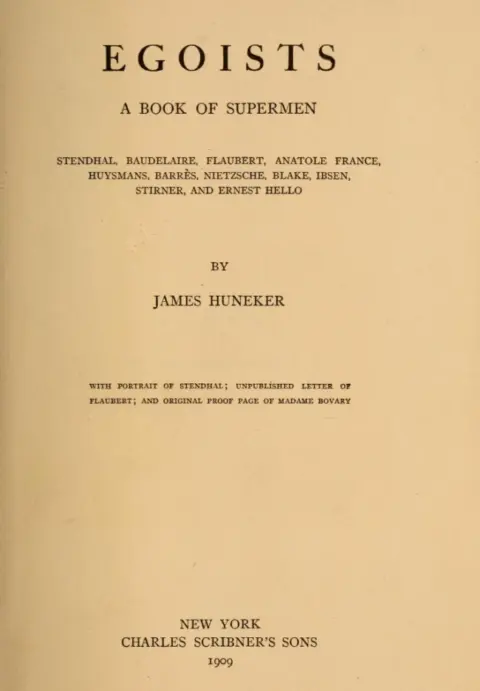
"Egoists, A Book of Supermen" by James Huneker is a collection of literary essays written in the early 20th century. The book explores prominent figures in literature and philosophy, including Stendhal, Flaubert, and Nietzsche, highlighting their contributions and idiosyncrasies. Through a critical lens, Huneker delves into the intricacies of their lives and works, examining the traits that set them apart as "supermen" in the literary canon. The opening of the collection introduces the first essay, focusing on Henry Beyle, better known as Stendhal. Huneker paints a vivid portrait of Stendhal, contrasting his delicate psychological insights with his unremarkable physical appearance. The text discusses Stendhal's duality as a passionate lover and cynical observer, emphasizing how his seemingly contradictory nature informed his writing. The essay sets the tone for the subsequent pieces, suggesting a rich exploration of the complex interplay between personality, creativity, and the societal contexts in which these literary figures existed.
Introduction adapted from the source catalogue; source summaries may be automatically generated.
Free to read · English · 89,359 words · No account needed
MAKE TIME FOR A GOOD BOOK
On by default. Untick to stop anonymous reading totals. Each page counts after 10 seconds in view. How this works.
Anonymous counting is on unless you have switched it off.
Science tells us that our I is really a We; a colony of cells, an orchestra of inherited instincts. We have not even free will, or at least only in a limited sense. We are an instrument played upon by our heredity and our environment. The cell, then, is the unit, not the Ego. Very well, Stirner would exclaim (if he had lived after Darwin and 1859), the cell is my cell, not yours! Away with other cells! But such an autonomous gospel is surely a phantasm. Stirner saw a ghost. He, too, in his proud Individualism was an aristocrat. No man may separate himself from the tradition of his race unless to incur the penalty of a sterile isolation. The solitary is the abnormal man. Man is gregarious. Man is a political animal. Even Stirner recognises that man is not man without society.
In practice he would not have agreed with Havelock Ellis that "all the art of living lies in the fine mingling of letting go and holding on." Stirner, sentimental, henpecked, myopic Berlin professor, was too actively engaged in wholesale criticism--that is, destruction of society, with all its props and standards, its hidden selfishness and heartlessness--to bother with theories of reconstruction. His disciples have remedied the omission. In the United States, for example, Benjamin R. Tucker, a follower of Josiah Warren, teaches a practical and philosophical form of Individualism. He is an Anarch who believes in passive resistance. Stirner speaks, though vaguely, of a Union of Egoists, a Verein, where all would rule all, where man, through self-mastery, would be his own master. ("In those days there was no king in Israel; every man did that which was right in his own eyes.") Indeed, his notions as to Property and Money--"it will always be money"--sound suspiciously like those of our "captains of industry." Might conquers Right. He has brought to bear the most blazing light-rays upon the shifts and evasions of those who decry Egoism, who are what he calls "involuntary," not voluntary, egotists. Their motives are shown to the bone. Your Sir Willoughby Patternes are not real Egoists, but only half-hearted, selfish weaklings. The true egotist is the altruist, says Stirner; yet Leibnitz was right; so was Dr. Pangloss. This is the best of possible worlds. Any other is not conceivable for man, who is at the top of his zoological series. (Though Quinton has made the statement that birds followed the mammal.) We are all "spectres of the dust," and to live on an overcrowded planet we must follow the advice of the Boyg: "Go roundabout!" Compromise is the only sane attitude. The world is not, will never be, to the strong of arm or spirit, as Nietzsche believes. The race is to the mediocre. The survival of the fittest means survival of the weakest. Society shields and upholds the feeble. Mediocrity rules, let Carlyle or Nietzsche thunder to the contrary. It was the perception of these facts that drove Stirner to formulate his theories in The Ego and His Own. He was poor, a failure, and despised by his wife. He lived under a dull, brutal régime. The Individual was naught, the State all. His book was his great revenge. It was the efflorescence of his Ego. It was his romance, his dream of an ideal world, his Platonic republic. Philosophy is more a matter of man's temperament than some suppose. And philosophers often live by opposites. Schopenhauer preached asceticism, but hardly led an ascetic life; Nietzsche's injunctions to become Immoralists and Supermen were but the buttressing up of a will diseased, by the needs of a man who suffered his life long from morbid sensibility. James Walker's suggestion that "We will not allow the world to wait for the Superman. We are the Supermen," is a convincing criticism of Nietzscheism. I am Unique. Never again will this aggregation of atoms stand on earth. Therefore I must be free. I will myself free. (It is spiritual liberty that only counts.) But my I must not be of the kind described by the madhouse doctor in Peer Gynt: "Each one shuts himself up in the barrel of self. In the self-fermentation he dives to the bottom; with the self-bung he seals it hermetically." The increased self-responsibility of life in an Egoist Union would prevent the world from ever entering into such ideal anarchy (an-arch, i.e., without government). There is too much of renunciation in the absolute freedom of the will--that is its final, if paradoxical, implication--for mankind. Our Utopias are secretly based on Chance. Deny Chance in our existence and life would be without salt. Man is not a perfectible animal; not on this side of eternity. He fears the new and therefore clings to his old beliefs. To each his own chimera. He has not grown mentally or physically since the Sumerians--or a million years before the Sumerians. The squirrel in the revolving cage thinks it is progressing; Man is in a revolving cage. He goes round but he does not progress. Man is not a logical animal. He is governed by his emotions, his affective life. He lives by his illusions. His brains are an accident, possibly from overnutrition as De Gourmont has declared. To fancy him capable of existing in a community where all will be selfgoverned is a poet's vision. That way the millennium lies, or the High Noon of Nietzsche. And would the world be happier if it ever did attain this condition?
Your reading position is saved on this browser. Take it to another device with a library code. Reading pages adapt to text, rather than matching a printed edition.
James Huneker
James Huneker
James Huneker
James Huneker
BEHIND THE BOOK
This eBook is for the use of anyone anywhere in the United States and most other parts of the world at no cost and with almost no restrictions whatsoever. You may copy it, give it away or re-use it under the terms of the Project Gutenberg License included with this eBook or online at www.gutenberg.org. If you are not located in the United States, you will have to check the laws of the country where you are located before using this eBook. Read the source licence.
The original source file, including credits and licence, is retained by this library. Request an original-format copy at no charge. Please include the book title and Project Gutenberg identifier #47454.
KEEP YOUR CURIOSITY GOING

David Patterson (Spirit) Hatch

David Patterson (Spirit) Hatch

David Patterson (Spirit) Hatch
Cécile Tormay

Moritz Busch
John L. Ransom