THE CLASSIC COLLECTION✦VariationsCLASSIC FREE BOOKS
Variations
James Huneker
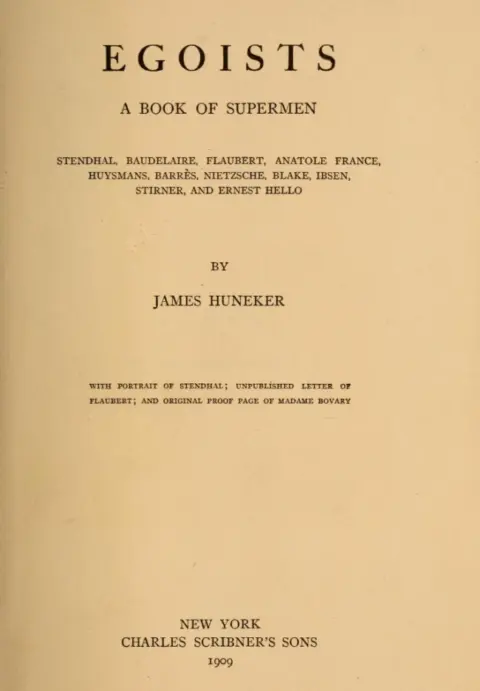
THE CLASSIC COLLECTION · 1925
"Egoists, A Book of Supermen" by James Huneker is a collection of literary essays written in the early 20th century. The book explores prominent figures in literature and philosophy, including Stendhal, Flaubert, and Nietzsche, highlighting their contributions and idiosyncrasies. Through a critical lens, Huneker delves into the intricacies of their lives and works, examining the traits that set them apart as "supermen" in the literary canon. The opening of the collection introduces the first essay, focusing on Henry Beyle, better known as Stendhal. Huneker paints a vivid portrait of Stendhal, contrasting his delicate psychological insights with his unremarkable physical appearance. The text discusses Stendhal's duality as a passionate lover and cynical observer, emphasizing how his seemingly contradictory nature informed his writing. The essay sets the tone for the subsequent pieces, suggesting a rich exploration of the complex interplay between personality, creativity, and the societal contexts in which these literary figures existed.
Introduction adapted from the source catalogue; source summaries may be automatically generated.
Free to read · English · 89,359 words · No account needed
MAKE TIME FOR A GOOD BOOK
On by default. Untick to stop anonymous reading totals. Each page counts after 10 seconds in view. How this works.
Anonymous counting is on unless you have switched it off.
In 1892 was published The Enemy of Law, a book of violent anarchical impulse and lyric disorder. It is still Philippe, though under another name, André, who approves of a bomb launched by the hand of an anarchist, and because of the printed expression of his sympathy he is sent to prison for a few months. A Free Man, he endures his punishment philosophically, winning the friendship of a young Frenchwoman, an exaltee, and also of a little Russian princess, a silhouette of Marie Bashkirtseff, and an unmistakable blood-relative of Stendhal's Lamiel. After his liberation André makes sentimental pilgrimages with one or the other, finally with both of his friends, to Germany and elsewhere. A shaggy dog, Velu, figures largely in these pages, and we are treated to some disquisitions on canine psychology. Nor are the sketches of Saint-Simon, Fourier, Karl Marx, Ferdinand Lassalle, and Ludwig of Bavaria, the Wagnerian idealist, particularly novel. They but reveal the nascent social sympathies of Barrès, who was at the law-despising period of his development. His little princess has a touch of Bérénice, coupled with a Calmuck disregard of the convenances; she loves the "warm smell of stables" and does not fear worldly criticism of her conduct; the trio vanish in a too Gallic, too rose-coloured perspective. A volume of protest, The Enemy of Law served its turn, though here the phrase--clear, alert, suave--of his earlier books is transformed to a style charged with flame and acid. The moral appears to be dangerous, as well as diverting--develop your instincts to the uttermost, give satisfaction to your sensibility; then must you attain the perfection of your Ego, and therefore will not attenuate the purity of your race. The Russian princess, we are assured, carried with her the ideas of antique morality.
In the second trilogy--Du Sang, de la Volupté, et de la Mort; Amori et Dolori Sacrum; and Les Amitiés Françaises--we begin an itinerary which embraces parts of Italy, Spain, Germany, France, particularly Lorraine. Barrès must be ranked among those travellers of acute vision and æsthetic culture who in their wanderings disengage the soul of a city, of a country. France, from Count de Caylus and the Abbé Barthélémy (Voyage du Jeune Anacharsis) to Stendhal, Taine, and Bourget, has given birth to many distinguished examples. The first of the new group, Blood, Pleasure, and Death--a sensational title for a work so rich and consoling in substance--is a collection of essays and tales. The same young man describes his æsthetic and moral impressions before the masterpieces of Angelo and Vinci, or the tombs, cathedrals, and palaces of Italy and Spain. Cordova is visited, the gardens of Lombardy, Ravenna, Parma--Stendhal's beloved city--Siena, Pisa; there are love episodes in diaphanous keys. Barrès, ever magnanimous in his critical judgments, pays tribute to the memory of his dead friends, Jules Tellier and Marie Bashkirtseff. He understood her soul, though afterward cooled when he discovered the reality of the Bashkirtseff legend. (He speaks of the house in which she died as 6 Rue de Prony; Marie died at 30 Rue Ampère.) In the succeeding volume, consecrated to love and sorrow, the soul of Venice, the soul of a dead city, is woven with souvenirs of Goethe, Byron, Chateaubriand, Musset, George Sand, Taine, Léopold Robert the painter-suicide, Théophile Gautier, and Richard Wagner. The magic of these prose-dreams is not that of an artist merely revelling in description; Pierre Loti, for instance, writes with no philosophy but that of the disenchanted; he is a more luscious Sénancour; D'Annunzio has made of Venice a golden monument to his gigantic pride as poet. Not so Barrès. The image of death and decay, the recollections of the imperial and mighty past aroused by his pen are as so many chords in his egoistic philosophy: Venice guarded its Ego from the barbarians; from the dead we learn the secret of life. The note of revolt which sounded so drastically in The Enemy of Law is absent here; in that story Barrès, mindful of Auguste Comte and Ibsen, asserted that the dead poisoned the living. The motive of reverence for the soil, for the past, the motive of traditionalism, is beginning to be overheard. In French Friendships, he takes his little son Philippe to Joan of Arc's country and enforces the lesson of patriotism. In his Le Voyage de Sparte, the same spirit is present. He is the man from Lorraine at Corinth, Eleusis, or Athens, humble and solicitous for the soul of his race, eager to extract a moral benefit from the past. He studies the Antigone of Sophocles, the Helen of Goethe. He also praises his master, the classical scholar, Louis Ménard. Barrès has, in a period when France seems bent on burning its historical ships, destroying precious relics of its past, blown the trumpet of alarm; not the destructive blast of Nietzsche, but one that calls "Spare our dead!" Little wonder Bourget pronounced him the most efficacious servitor, at the present hour, of France the eternal. Force and spiritual fecundity Barrès demands of himself; force and spiritual fecundity he demands from France. And, like the vague insistent thrumming of the tympani, a ground bass in some symphonic poem, the idea of nationalism is gradually disclosed as we decipher these palimpsests of egoism.
Your reading position is saved on this browser. Take it to another device with a library code. Reading pages adapt to text, rather than matching a printed edition.
James Huneker
James Huneker
James Huneker
James Huneker
BEHIND THE BOOK
This eBook is for the use of anyone anywhere in the United States and most other parts of the world at no cost and with almost no restrictions whatsoever. You may copy it, give it away or re-use it under the terms of the Project Gutenberg License included with this eBook or online at www.gutenberg.org. If you are not located in the United States, you will have to check the laws of the country where you are located before using this eBook. Read the source licence.
The original source file, including credits and licence, is retained by this library. Request an original-format copy at no charge. Please include the book title and Project Gutenberg identifier #47454.
KEEP YOUR CURIOSITY GOING

David Patterson (Spirit) Hatch

David Patterson (Spirit) Hatch

David Patterson (Spirit) Hatch
Cécile Tormay

Moritz Busch
John L. Ransom