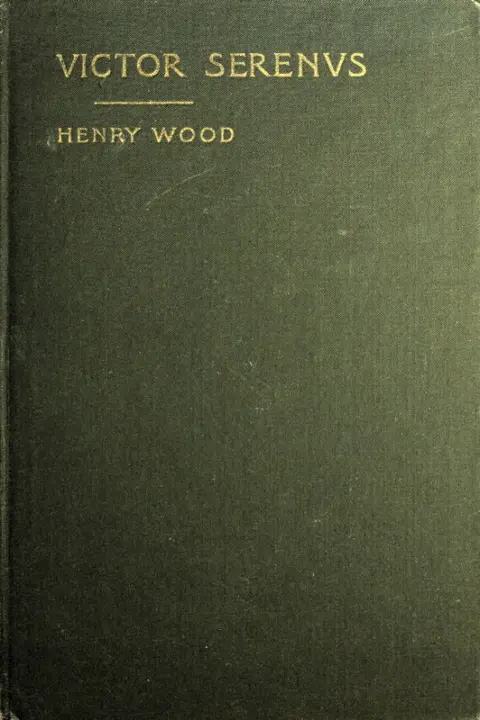
Victor Serenus: A Story of the Pauline Era
Henry Wood
THE CLASSIC COLLECTION · 1890
Edward Burton by Henry Wood is a novel written in the late 19th century. It follows a gifted, devout New Englander whose path toward the ministry is upended by illness and redirected by a turn to spiritual idealism, set against seaside society scenes where skeptics and believers debate evolution, marriage, and reform. Expect a blend of Bar Harbor social life, theological questioning, and a challenge to strict materialism.
The opening of the novel moves from a languid canoe ride on Frenchman’s Bay into a lively dinner party where Miss Jenness spars with medical student Junius Van Roden over evolution and materialism, and the guests argue about woman suffrage, state power, and social “reforms.” The narrative then shifts back in time to New Hampshire, tracing Edward’s pious upbringing, his mother’s plan for the pulpit, and his diligent progress through academy and college. Guided away from Andover to Princeton by a conservative pastor, Edward excels in theology but collapses at graduation and endures a severe illness in Boston. There, aided by his friend William Tapley’s quiet, metaphysical counsel, he journals a hard passage from narcotics and despair toward calm, prayerful receptivity to divine love, regaining strength and preparing to return home with a newly awakened inner spirituality.
Introduction adapted from the source catalogue; source summaries may be automatically generated.
Free to read · English · 87,768 words · No account needed
MAKE TIME FOR A GOOD BOOK
On by default. Untick to stop anonymous reading totals. Each page counts after 10 seconds in view. How this works.
Anonymous counting is on unless you have switched it off.
“Cool as a cucumber!” suggested Van Roden.
“By Jove, this is refreshing!” responded the Englishman.
While the rocks about the entrance were slimy with seaweed, when they had penetrated farther up into the cavern, there was but a slight cool dampness, which was agreeable by contrast with the temperature outside. The day being bright, and the mouth of the cave quite broad, there was abundant light, but its quality was weird and peculiar. The provisions and rugs were deposited in a suitable place, and all proceeded to explore the rocky apartment. The walls were cleft and crannied, far beyond where the height permitted the visitors to walk upright, giving evidence of the tremendous power of the waves when they surge in, during easterly gales and winter storms. In places, the rocks were literally frosted with barnacles and other crustacea, which abound in remarkable profusion along this shore. Upon the irregular floor of the cavern were several shining pools, which were replenished by each returning tide. The opalescent light which was shed upon the brilliant-tinted forms of marine, animal, and vegetable life, which thrive in these miniature ponds, made them like mirrors, whose depths were formed of rainbows in liquid form. To an enthusiastic naturalist, a place with such features would be like a diminutive garden of Eden.
“Please show me some specimens of the Anemone,” said Lord Percival, with notebook in hand, addressing Rosamond.
“My sister is more familiar with them than I am,” replied Rosamond. “Helen, will you be so kind as to ‘show up’ an Anemone to Lord Percival?”
“In this pool are some very good specimens,” said Helen, upon which all
gathered around.
“Please tell us whether they are ‘fish, flesh, or fowl,’” exclaimed Bert. “Let’s take one out.”
“I would like a good, well-developed specimen to dissect,” said Van Roden; “but perhaps it is best to wait till after luncheon is served, and then one can be secured in a dish.”
“There is a notice outside the cave, to the effect that the anemones must not be disturbed,” suggested Miss Jenness.
“Oh, pshaw!” said Bert, “I am going to stir up the animals.” He, however, desisted, upon a protest being made by the young ladies.
“But, Miss Bonbright, I thought that you were going to define the animal, and I am waiting to take notes,” said his lordship.
“Oh, I have never given them much attention,” replied Helen. “I am aware that they belong to a very low order of animal life, being almost a vegetable. Perhaps they may be regarded as a blossoming animal. Miss Jenness, probably, can give you more information, and--by the way--I have heard that Miss Tapley is a devoted naturalist.”
Your reading position is saved on this browser. Take it to another device with a library code. Reading pages adapt to text, rather than matching a printed edition.
BEHIND THE BOOK
This eBook is for the use of anyone anywhere in the United States and most other parts of the world at no cost and with almost no restrictions whatsoever. You may copy it, give it away or re-use it under the terms of the Project Gutenberg License included with this eBook or online at www.gutenberg.org. If you are not located in the United States, you will have to check the laws of the country where you are located before using this eBook. Read the source licence.
The original source file, including credits and licence, is retained by this library. Request an original-format copy at no charge. Please include the book title and Project Gutenberg identifier #77430.
KEEP YOUR CURIOSITY GOING
Coulson Kernahan

Maurice Baring
Frances Wright
Cécile Tormay

Frederic Jesup Stimson

W. H. P. (William Henry Pope) Jarvis