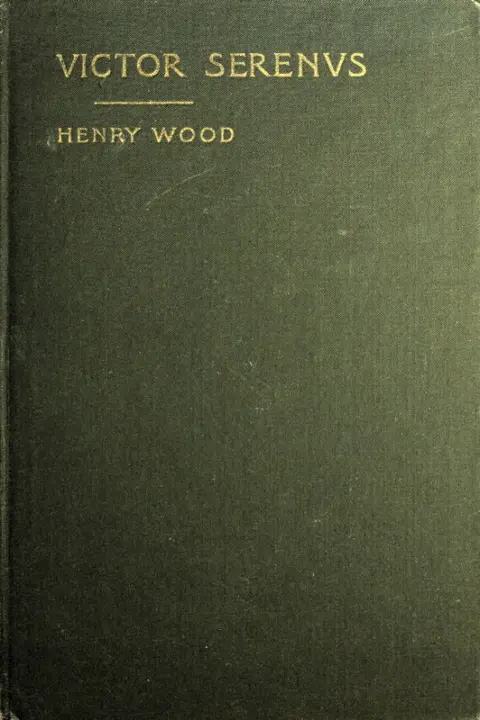
Victor Serenus: A Story of the Pauline Era
Henry Wood
THE CLASSIC COLLECTION · 1890
Edward Burton by Henry Wood is a novel written in the late 19th century. It follows a gifted, devout New Englander whose path toward the ministry is upended by illness and redirected by a turn to spiritual idealism, set against seaside society scenes where skeptics and believers debate evolution, marriage, and reform. Expect a blend of Bar Harbor social life, theological questioning, and a challenge to strict materialism.
The opening of the novel moves from a languid canoe ride on Frenchman’s Bay into a lively dinner party where Miss Jenness spars with medical student Junius Van Roden over evolution and materialism, and the guests argue about woman suffrage, state power, and social “reforms.” The narrative then shifts back in time to New Hampshire, tracing Edward’s pious upbringing, his mother’s plan for the pulpit, and his diligent progress through academy and college. Guided away from Andover to Princeton by a conservative pastor, Edward excels in theology but collapses at graduation and endures a severe illness in Boston. There, aided by his friend William Tapley’s quiet, metaphysical counsel, he journals a hard passage from narcotics and despair toward calm, prayerful receptivity to divine love, regaining strength and preparing to return home with a newly awakened inner spirituality.
Introduction adapted from the source catalogue; source summaries may be automatically generated.
Free to read · English · 87,768 words · No account needed
MAKE TIME FOR A GOOD BOOK
On by default. Untick to stop anonymous reading totals. Each page counts after 10 seconds in view. How this works.
Anonymous counting is on unless you have switched it off.
“Will you kindly state a few of the cardinal principles of the theory of development, as you accept them?” asked Miss Jenness.
“It would be very difficult to do so in a few words,” he replied; “but perhaps a mere outline might be given, as follows. We believe that all organisms, whether plants or animals, including man, have come into existence by the gradual growth and unfoldment of primordial germs; and that the whole physical universe, including everything organic and inorganic, is a mechanism, and as such, is to be accounted for on physical principles.”
Van Roden warmed up as he proceeded in the exposition of his favorite topic, for Miss Jenness appeared interested, and this was unlike his usual experience. As a rule, his listeners had been bored whenever he had trotted out his favorite hobby.
“All structures,” he continued, “have proceeded by regular gradations from extreme simplicity to greater complexity, and each has relations with the other. There is also a close analogy between the different series of gradations presented by the various species which comprise any great group of animals or plants, and, still farther, large groups of species of widely different habits present the same fundamental plan of structure.”
Adelbert, who had drawn near, and partially grasped the line of
argument, interposing, said,--
“We are ready to accept the doctrine of evolution, Van, without further proof, for we have evidence in you, that the process is going on, and that you are rapidly being unfolded into a crank.”
Van Roden, however, seeing that Miss Jenness continued interested, disregarded the interruption, and continued: “There are various structures and organs in a rudimentary and useless condition, which in the more advanced species of the same group have definite utility and perfection. It is observable, also, that the effects of varying conditions, or environment, exercise a modifying influence upon living organisms.”
“What is it that evolves itself, and how was the process brought about?” inquired Miss Jenness.
“As I before suggested,” said he, “the operation must have begun with primordial germs; and a mechanical, physical force, which is inherent in matter, caused their gradual unfoldment.”
“You can do me a great favor,” suggested Miss Jenness, with a mischievous twinkle in her eye.
“I shall be most happy,” replied the unsuspecting medical student.
“If you will be so kind as to procure for me a small basket of those primordial germs; I would like to take them home, when I return to Philadelphia.”
Your reading position is saved on this browser. Take it to another device with a library code. Reading pages adapt to text, rather than matching a printed edition.
BEHIND THE BOOK
This eBook is for the use of anyone anywhere in the United States and most other parts of the world at no cost and with almost no restrictions whatsoever. You may copy it, give it away or re-use it under the terms of the Project Gutenberg License included with this eBook or online at www.gutenberg.org. If you are not located in the United States, you will have to check the laws of the country where you are located before using this eBook. Read the source licence.
The original source file, including credits and licence, is retained by this library. Request an original-format copy at no charge. Please include the book title and Project Gutenberg identifier #77430.
KEEP YOUR CURIOSITY GOING
Coulson Kernahan

Maurice Baring
Frances Wright
Cécile Tormay

Frederic Jesup Stimson

W. H. P. (William Henry Pope) Jarvis