
The William Henry Letters
Abby Morton Diaz
THE CLASSIC COLLECTION · 1918
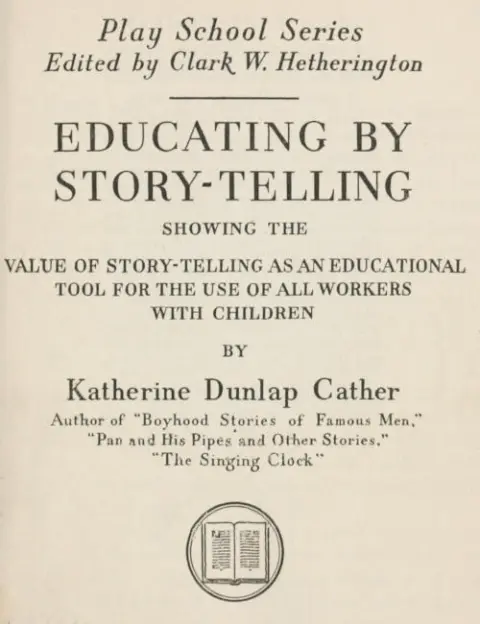
"Educating by Story-Telling" by Katherine Dunlap Cather is an educational guide written in the early 20th century. This book advocates for the use of storytelling as a powerful educational tool for those working with children, emphasizing its role in enhancing learning experiences and moral development. The author presents the value of storytelling not just as entertainment, but as a means to enrich children’s lives and education across various subjects, promoting a deeper understanding of literature and life principles. The opening of the work establishes the author's extensive experience with children and outlines the intention behind the book, which seeks to provide a structured approach to effective storytelling in educational settings. The author discusses how storytelling can be a vessel for cultural heritage and moral values, illuminating children's imaginations and interests. Cather proposes that an understanding of children's developmental stages and interests is crucial for selecting stories that will resonate with them, encouraging educators to adeptly match narratives to the psychological needs of their students. Overall, the beginning sets a foundation for the exploration of storytelling’s transformative potential in both the classroom and home environments.
Introduction adapted from the source catalogue; source summaries may be automatically generated.
Free to read · English · 121,766 words · No account needed
MAKE TIME FOR A GOOD BOOK
On by default. Untick to stop anonymous reading totals. Each page counts after 10 seconds in view. How this works.
Anonymous counting is on unless you have switched it off.
An adage of the old Italian school of vocalists, whose methods have given so many glorious songsters to the world, was, “To sing, you must be happy,” and one of the most celebrated prima donnas of today attributes a large measure of her success to the fact that during childhood her mother had the wisdom never to make music burdensome by forcing her to it, but played for her and sang to her without stint, giving her countless opportunities of hearing music and leading her to love it. Then when she began formal study at twelve, her teacher did not harass her with exercises, but gave simple songs that she liked to sing, songs chosen to give her voice the exercise it needed and to appeal to the natural love of melody.
We might well apply this plan to our public-school music, and arrange courses so that children will hear much good music, even if the amount of technical work has to be greatly lessened. It is here that the story may do its far-reaching work in helping to make the music period pleasurable to the children and causing them to respond with keener pleasure to a higher standard of music.
Many narrators exclaim, “It is not possible for me to lead children to appreciate the great music when I do not know the great music myself.”
But it is possible. Of course it is easier for one who is familiar with the masterpieces of melody to lead children to them than for one who is not; but even though the mother or teacher was not in her own childhood familiar with Mozart or Mendelssohn, she can bring children to appreciate these artists because the talking machine has made it possible. She need not try to acquaint them with the technical terms, and mechanics of music, but she can arouse an interest that is the twin sister of inspiration, and she can do it in such a way that every minute devoted to the work is filled with delight. She can tell the life story of some great composer and familiarize the child with selections from his work that will guide him away from the cheap and tawdry. She can give him incidents connected with the composition of musical gems, and a glimpse into the great treasure house of musical literature that will cause him to want to know more of the achievements of the immortal melody makers. It is not necessary that one be a musician in order to do this. Most schools and many homes are now supplied with talking machines, and the records manufactured by the different companies bring masterpieces within the reach of all. Even the catalogs are rich in suggestion, and following the cues supplied by them, a little thought and labor will bring most gratifying results. Almost all the great composers had eventful childhoods, and the early days of Mendelssohn, Mozart, Bach, Haydn, Handel, Beethoven, Chopin, Verdi, Wagner, and many others are rich in incidents that children enjoy hearing. These biographies, sources for which are listed in the appended bibliography (page 94), if told in story form and followed by selections from the artist’s works, will make an impression and arouse an interest as nothing else can do. Do not, however, make the mistake of beginning with the man and leading down to his childhood. Begin with his early years and lead up to his achievements. The child will become interested in the man only through his childhood, because children are near his own interests, while adults are not. Many inexperienced story-tellers do not understand this, and are disappointed in their failure to hold their little hearers. This was demonstrated not long ago in a university course in story-telling. An incident in the childhood of Mozart was to be given in story form to introduce some of that composer’s works to a group of children. Eighty per cent of the five hundred preparing the paper began thus: “When the great Mozart was a little boy.” That introduction meant nothing to the children, because they did not know “the great Mozart,” and were not interested in strange men. But they were intensely interested in hearing about a child who long, long ago was sailing down the Danube with his father and sister Marianne and was very much distressed because the father would have to pay duty on the harp they carried and therefore, when they reached Vienna, Marianne could not have a new dress that she sadly needed. Little eyes sparkled and little hands clapped when the children heard how, as they reached the customhouse of the Austrian capital, young Wolfgang asked his father if he might play something on the harp, and his rendition so delighted and amazed the officials that the duty was waived and Marianne was shabbily clad no longer.
Your reading position is saved on this browser. Take it to another device with a library code. Reading pages adapt to text, rather than matching a printed edition.
BEHIND THE BOOK
This eBook is for the use of anyone anywhere in the United States and most other parts of the world at no cost and with almost no restrictions whatsoever. You may copy it, give it away or re-use it under the terms of the Project Gutenberg License included with this eBook or online at www.gutenberg.org. If you are not located in the United States, you will have to check the laws of the country where you are located before using this eBook. Read the source licence.
The original source file, including credits and licence, is retained by this library. Request an original-format copy at no charge. Please include the book title and Project Gutenberg identifier #58255.
KEEP YOUR CURIOSITY GOING
Abby Morton Diaz
Helen Hunt Jackson
Mary Frances Blaisdell
Stuart Dodgson Collingwood

Kate Douglas Smith Wiggin
Hesba Stretton