
The William Henry Letters
Abby Morton Diaz
THE CLASSIC COLLECTION · 1918
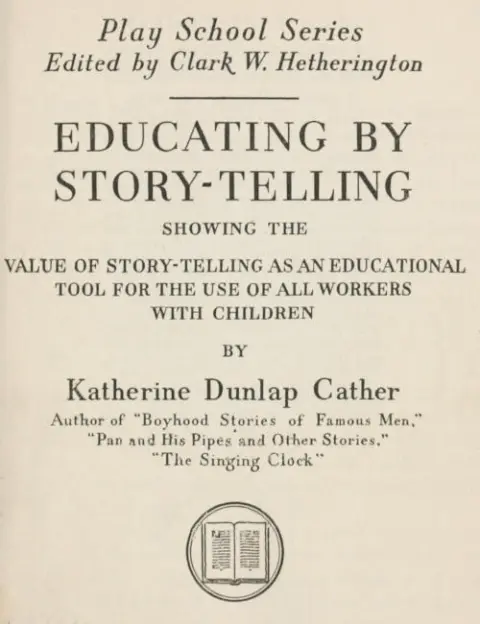
"Educating by Story-Telling" by Katherine Dunlap Cather is an educational guide written in the early 20th century. This book advocates for the use of storytelling as a powerful educational tool for those working with children, emphasizing its role in enhancing learning experiences and moral development. The author presents the value of storytelling not just as entertainment, but as a means to enrich children’s lives and education across various subjects, promoting a deeper understanding of literature and life principles. The opening of the work establishes the author's extensive experience with children and outlines the intention behind the book, which seeks to provide a structured approach to effective storytelling in educational settings. The author discusses how storytelling can be a vessel for cultural heritage and moral values, illuminating children's imaginations and interests. Cather proposes that an understanding of children's developmental stages and interests is crucial for selecting stories that will resonate with them, encouraging educators to adeptly match narratives to the psychological needs of their students. Overall, the beginning sets a foundation for the exploration of storytelling’s transformative potential in both the classroom and home environments.
Introduction adapted from the source catalogue; source summaries may be automatically generated.
Free to read · English · 121,766 words · No account needed
MAKE TIME FOR A GOOD BOOK
On by default. Untick to stop anonymous reading totals. Each page counts after 10 seconds in view. How this works.
Anonymous counting is on unless you have switched it off.
“If only they will let us stay together,” she murmured to Hulda as they drew rein at the gate.
They rode in through the courtyard, and then, dismounting, the baron led the two women up a winding stairway to the tower.
“Here you may stay,” he said savagely, “and decide what to do.”
Then, striding out, he bolted the heavy door.
They looked around. The windows were covered with an iron grating, and there was no possible way of escape.
“We cannot get away,” said Hulda, “so let us make the best of it and find something to eat, for I am hungry.”
But there was no food about the place, and they realized then that he meant to starve Willeswind into obeying him.
But suddenly a bright thought came to her, and she smiled.
“He cannot do it, though, for I have my raven.” And stroking its glossy wings she said, “Berries, pet, berries.”
Her hours of training had been well spent. For as if it understood, the bird spread its shining wings and flew out between the grating. After a while it returned with a sprig of crimson berries, the fragrant, juicy Rhine buds, and laid them in its mistress’ lap.
Many trips it made during the days that followed, and the woodland fruit kept the women from starvation, for it contained both nourishment and water.
So, instead of growing weak and wan, they kept their strength, and the baron could not understand how, with neither food nor water, Willeswind remained strong and well, and as defiant as ever. But to Willeswind and Hulda it was no mystery, and they were full of gratitude to the raven.
One morning Hulda stood by the window, looking out over the woods at the sunlight on the river. Suddenly she gave an excited cry. “Some horsemen are riding up the Rhine road!” she exclaimed. “They are coming this way.”
Willeswind flew to the casement and watched as they drew near. Straight along the forest path they advanced, so close that the watchers could see their faces.
“Oh!” cried the lady of Stolzenfels. “It is Othmar and his men. The war is over and they are coming home.”
She called loudly, waving her handkerchief between the grating, and Othmar saw and heard. “We are up here, prisoners in the tower!” she shouted, as he galloped nearer. And a minute later the Stolzenfels men were battering at the castle gate.
“For your mistress, comrades!” called Rupert the forester’s son, as he
led the charge.
Your reading position is saved on this browser. Take it to another device with a library code. Reading pages adapt to text, rather than matching a printed edition.
BEHIND THE BOOK
This eBook is for the use of anyone anywhere in the United States and most other parts of the world at no cost and with almost no restrictions whatsoever. You may copy it, give it away or re-use it under the terms of the Project Gutenberg License included with this eBook or online at www.gutenberg.org. If you are not located in the United States, you will have to check the laws of the country where you are located before using this eBook. Read the source licence.
The original source file, including credits and licence, is retained by this library. Request an original-format copy at no charge. Please include the book title and Project Gutenberg identifier #58255.
KEEP YOUR CURIOSITY GOING
Abby Morton Diaz
Helen Hunt Jackson
Mary Frances Blaisdell
Stuart Dodgson Collingwood

Kate Douglas Smith Wiggin
Hesba Stretton